
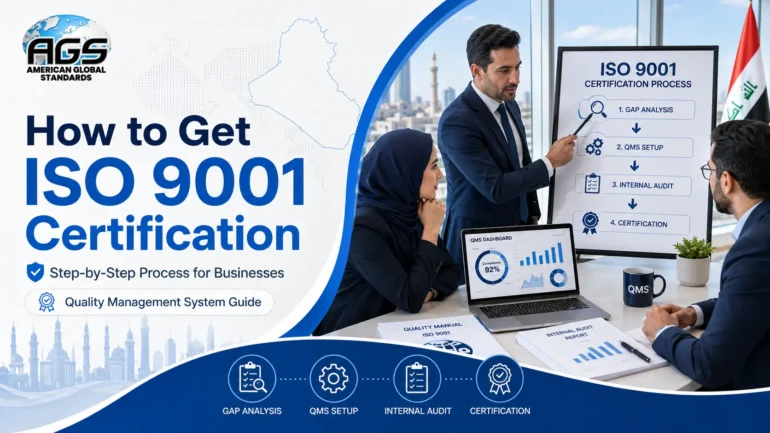
How to Get ISO 9001 Certification: Step-by-Step Process for Businesses To get ISO 9001 certification, a business must prepare and run a Quality Management System, define its certification scope, complete a gap analysis, organize documents and records, train employees, perform internal audit and management review, choose an external certification body, complete Stage 1 audit and Stage 2 audit, close nonconformities, and maintain certification through surveillance and recertification. ISO 9001 certification applies to an organization’s Quality Management System, also called a QMS. It does not certify an individual person. A company is also certified to ISO 9001, not “by ISO,” because ISO develops standards but does not issue certificates. To get ISO 9001 certification, build a working QMS, complete internal audit and management review, choose a certification body, pass Stage 1 and Stage 2 audits, close nonconformities, and maintain the certificate through ongoing audits. Detailed explanation below: What ISO 9001 Certification Means for a Business ISO 9001 certification means an external certification body has audited an organization’s QMS and confirmed that the system meets ISO 9001 requirements within a defined scope. The certificate is not just proof that documents exist. The certificate shows that the organization has processes, roles, controls, records, review methods, and improvement actions in place. ISO 9001 Is a Quality Management System Standard ISO 9001 is a quality management system standard for organizations that want to control work, meet customer expectations, satisfy applicable requirements, and improve performance over time. ISO describes ISO 9001 as a standard that helps organizations establish, implement, maintain, and continually improve a QMS. A QMS is the way a business manages quality. It includes process controls, responsibilities, policies, objectives, training, supplier controls, customer feedback, internal audits, corrective actions, and performance review. In simple terms, ISO 9001 asks one main question: Can the organization consistently deliver what the customer and applicable requirements expect? Companies Are Certified to ISO 9001, Not by ISO Companies are certified to ISO 9001 by an external certification body. ISO does not perform certification, does not issue ISO certificates, and does not allow the ISO logo to be used in connection with certification. That wording matters. “Certified by ISO” is not correct. The cleaner wording is: Certified to ISO 9001 ISO 9001 certified organization ISO 9001 certified quality management system ISO 9001 certificate issued by a certification body This distinction protects the organization from weak certificate claims, wrong marketing language, and buyer confusion. ISO 9001 Certification Applies to Organizations, Not Individuals ISO 9001 certification applies to an organization’s QMS. An individual can complete ISO 9001 awareness training, internal auditor training, or lead auditor training, but that is not the same as organization-level ISO 9001 certification. A person may hold a training certificate or an auditor qualification. A business holds ISO 9001 certification when its QMS has been audited and certified within a defined scope. What Is the Process for ISO 9001 Certification? The ISO 9001 certification process moves from preparation to audit to certificate maintenance. Each step builds evidence that the QMS is not only written, but also used. Step 1: Understand ISO 9001 Requirements The first step is to understand what ISO 9001 expects from the organization. ISO 9001 covers major QMS areas such as: Context of the organization Leadership Planning Support Operation Performance evaluation Improvement These areas help the organization define business context, assign responsibilities, set quality objectives, control work, monitor performance, check results, and improve the system. ISO’s own ISO 9001 overview lists these core topic areas. Step 2: Define the Certification Scope The certification scope defines what the ISO 9001 certificate covers. The scope should state the activities, locations, products, services, departments, or process boundaries included in certification. A vague scope creates problems later because buyers, auditors, and internal teams need to know exactly what the certificate applies to. A single-site service company may have a simple scope. A multi-site manufacturer, contractor, or logistics company usually needs a more detailed scope because audit planning changes when locations and processes change. Step 3: Conduct a Gap Analysis A gap analysis compares the current QMS against ISO 9001 requirements. The gap analysis should identify: Missing documents Weak records Unclear responsibilities Uncontrolled processes Training gaps Supplier control gaps Missing internal audit evidence Missing management review evidence Corrective-action weaknesses A gap analysis is useful because it turns a broad certification goal into a clear action plan. Without a gap analysis, teams often prepare documents randomly and miss the evidence auditors actually need. Step 4: Build or Update the Quality Management System The organization must build or update the QMS before the certification audit. A working QMS includes: Quality policy Quality objectives Process controls Roles and responsibilities Risk-based thinking Supplier control Customer feedback handling Document control Record control Corrective action Performance monitoring The QMS should fit the business. A small service company does not need the same system as a multi-site manufacturer. The system needs to be controlled, documented, used, and measurable. Step 5: Prepare Documents and Records ISO 9001 uses the term documented information for the documents and records needed to run and prove the QMS. Documents describe what should happen. Records prove what happened. The organization should prepare controlled documents and real records before the external audit. Written procedures with no records usually show that the system is not fully implemented. Step 6: Train Employees and Implement the System Employees need to understand the parts of the QMS that affect their work. Training should cover: Process responsibilities Quality objectives Documented procedures Customer requirements Risk controls Recordkeeping Nonconformity reporting Corrective-action steps ISO 9001 certification requires implementation. A company cannot rely on a manual sitting in a folder. Auditors look for evidence that people know the process and use the process. Step 7: Conduct an Internal Audit An internal audit is the organization’s own check before the external certification audit. The internal audit checks whether the QMS meets ISO 9001 requirements and whether the organization is following its own processes. Internal audit evidence can include audit plans, checklists, audit notes, findings,