HACCP Certification In Iraq


    ISO Certification

    ISO 14001 CERTIFICATION
    ISO 18001 CERTIFICATION
    ISO 45001 CERTIFICATION
    ISO 27001 CERTIFICATION
    ISO 22000 CERTIFICATION
    ISO 50001 CERTIFICATION
    ISO 29001 CERTIFICATION
    ISO 18788 CERTIFICATION
    ISO 37001 CERTIFICATION
    ISO 22301 CERTIFICATION
    ISO 13485 CERTIFICATION
    ISO 10002 CERTIFICATION
    ISO 21500 CERTIFICATION
    ISO 17025 CERTIFICATION
    ISO 15189 CERTIFICATION

    HACCP certification guide for food safety compliance in Iraq

    For food manufacturers, processors, restaurants, catering businesses, storage and transport providers, retailers, distributors, and exporters in Iraq seeking structured HACCP implementation and certification support.

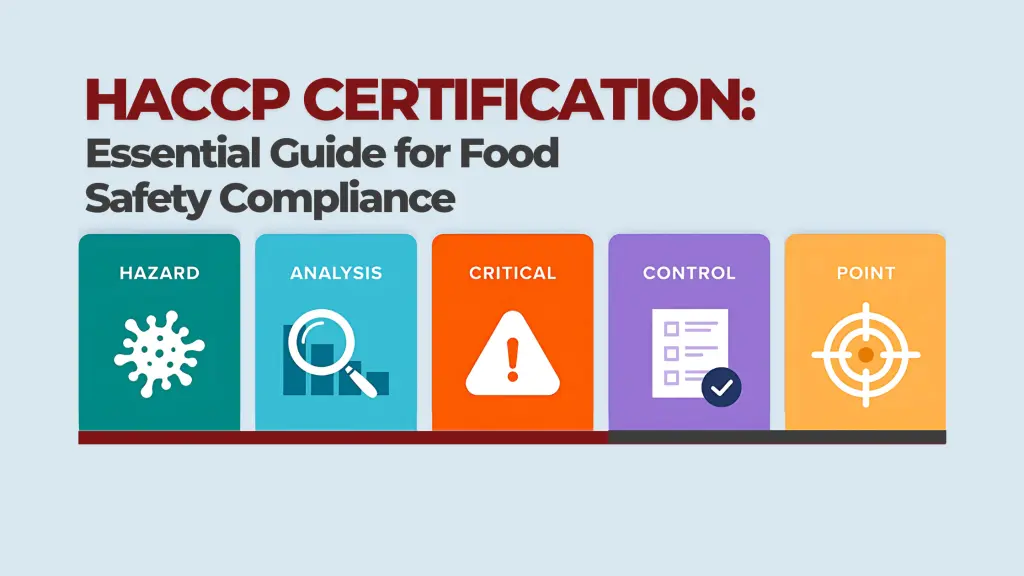
    HACCP certification in Iraq helps a food business build, implement, and present a preventive food safety system that controls biological, chemical, and physical hazards before they become product, compliance, or customer problems. FDA describes HACCP as a preventive hazard-control system built on seven core principles, and Codex places HACCP within the wider food-hygiene framework used across the food chain.

    For Iraqi food businesses, that matters for more than basic compliance. Food safety remains an active national issue, with WHO noting Iraq’s ongoing work on food safety monitoring, inspection, and outbreak response, and Codex highlighting Iraq’s recent push to align national standards with Codex principles to protect consumers and support trade.

    AGS supports Iraqi food businesses through the practical side of the process: gap reviews, HACCP plan development, documentation support, implementation guidance, audit readiness, and coordination toward third-party certification. AGS has a regional office in Basra and provides on-site support across Baghdad, Erbil, and other Iraqi cities.

    What Is HACCP Certification?

    HACCP certification is third-party confirmation that a food operation has a functioning HACCP system and the controls needed to manage food safety hazards. In business terms, the site is assessed against its hazard analysis, critical control points, monitoring, corrective actions, verification, and records rather than relying on end-product inspection alone. FDA describes HACCP as a preventive system focused on controlling hazards before they occur through structured food safety processes and documentation.

    In Iraq, the value of HACCP certification is practical. It gives food businesses a more defensible system for handling food safety risks, a clearer audit trail, and stronger proof when buyers, importers, or supply-chain partners ask how hazards are being controlled. Iraq’s food safety work has also included official efforts to strengthen food control, foodborne disease response, hygiene practices, and HACCP-based approaches in the food industry.

    Why Is HACCP Important For Food Businesses In Iraq?

    HACCP matters because it gives food businesses in Iraq a preventive system for controlling food safety risk before it becomes a failed batch, a customer complaint, or a market-access problem. FDA states that the whole point of HACCP is to prevent problems from occurring, and Codex ties HACCP-based hygiene practices to confidence in traded food.

    For businesses in Iraq, the benefits usually show up in a few clear ways:

    • stronger food safety control over day-to-day operations
    • better buyer and customer confidence
    • cleaner audit readiness and easier evidence review
    • more disciplined documentation and monitoring
    • stronger preparation for export and conformity-related demands
    • better operational control across production, storage, handling, and distribution


    That is why HACCP matters well beyond factories. Restaurants, caterers, processors, distributors, and exporters all benefit when the system is structured enough to show what hazards exist, where they are controlled, and what happens when control slips.

    Doing the right thing, at the right time.

    300+

    Satisfied Clients

    10+

    Years of Experience

    1700+

    ISO certifications

    Who Needs HACCP Certification In Iraq?

    HACCP certification in Iraq is relevant for food businesses that need structured hazard control and auditable food safety practices. That includes manufacturers, processors, restaurants, catering businesses, storage and transport providers, retailers, distributors, and exporters. Codex applies the hygiene and HACCP frameworks across the food chain from primary production to the final consumer, and AGS provides HACCP support for food operations that need structured, reviewable controls.

    In practical terms, the strongest fit is usually one of these:

    • food manufacturers and processors handling raw materials, cooking, packaging, or finished goods
    • restaurants and catering businesses managing preparation, storage, and service risks
    • storage and transport operations controlling temperature, handling, and contamination risk
    • distributors and exporters that need stronger buyer confidence and clearer food safety evidence
    • mixed food operations that need a disciplined system before a customer or certification audit begins

    How To Get HACCP Certification In Iraq


    The path works best when it is treated as a staged implementation project, not as a rush to an audit.

    1. Start with a gap review.
      Define the site, products, processes, current GMP status, HACCP documentation, and the commercial reason for certification. Scope review and gap assessment are the first serious steps because the site, product flow, and existing controls all affect the route.
    2. Build or refine the HACCP plan.
      The business maps hazards, identifies CCPs where needed, defines limits, monitoring, corrective action, verification, and recordkeeping. FDA’s HACCP guidance anchors this structure through the seven basic principles.
    3. Implement the controls in real operations.
      A plan is not enough. The system has to be running on the floor, supported by prerequisite programs, staff responsibilities, and records that show the controls are live. Readiness depends on a working HACCP system and evidence that it is operating.
    4. Train the staff who run the system.
      Monitoring, verification, corrective action, and recordkeeping only work if the people responsible understand what they are doing and why it matters. Iraq’s food safety improvement work has also emphasized training, hygiene, and HACCP principles in food-chain operations.
    5. Review documents and records before the audit.
      The business should have its HACCP plan, supporting records, and internal checks ready before the third-party review starts. Weak evidence is one of the fastest ways to create avoidable findings.
    6. Complete the external audit.
      The certification route typically includes document review, implementation review, site audit activity, and findings if the system is weak or incomplete.
    7. Close nonconformities and move to certification decision.
      If gaps are raised, they have to be corrected with evidence. The certification decision follows the audit and corrective-action closure, not the other way around.

    Check Your HACCP Readiness Before the Audit with AGS

    If your food safety file looks complete but the operation still feels exposed, that usually means the issue is not documentation, it is how the system is working in practice.

    Before moving to certification, a focused pre-audit review can help identify gaps in your HACCP plan, records, and on-site controls.

    AGS can support you with:

    • HACCP gap assessment based on your actual process flow
    • Review of CCPs, critical limits, and monitoring methods
    • Verification of records, logs, and corrective actions
    • On-site evaluation of hygiene, GMPs, and control measures
    • Identification of audit risks before the certification stage
    • Clear guidance on what to fix and how to fix it


    A structured readiness check helps you avoid failed audits, reduce rework, and move toward certification with a system that actually holds up under review.
    Request a HACCP gap assessment for your site.
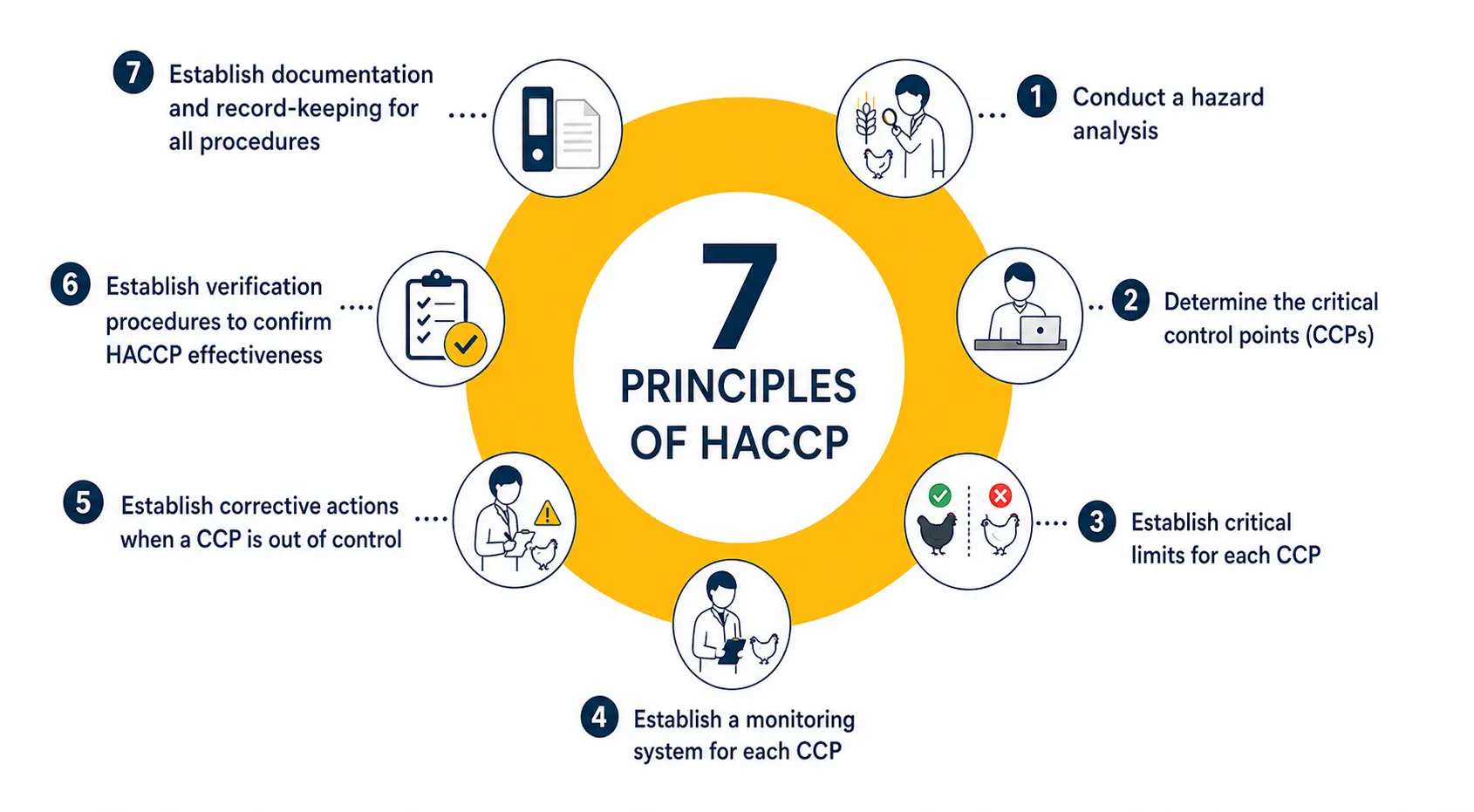
    How a HACCP plan is developed

    Seven HACCP principles for food safety and CCP control

    A HACCP plan is built around the seven basic principles: hazard analysis, identification of critical control points, critical limits, monitoring, corrective actions, verification, and record-keeping/documentation. FDA also explains that the plan summary should identify the hazards of concern, the CCPs, the limits, the monitoring approach, the corrective actions, the verification schedule, and the records used to prove control.

    A good plan is specific to the operation. It should follow the actual process flow, the real products, the real hazards, and the real controls used on site. Generic templates are fine as a starting point, but they are not enough for a serious audit.

    HACCP requirements in Iraq

    For a food business in Iraq, HACCP readiness usually comes down to five things: a functioning HACCP system, trained staff, documented controls, monitoring and verification records, and evidence that the system is ready for external review. HACCP readiness comes down to a functioning system. A facility is not ready because it has a template, but because the plan is implemented, controls are running, and evidence is available.

    Iraq’s broader food safety context reinforces that point. WHO’s Iraq work has focused on food safety monitoring, inspection, coordination, and disease response, while the earlier national food safety capacity program promoted good hygiene practices, good manufacturing practices, and HACCP principles in the food industry.

    Documents needed for HACCP certification

    The exact document set depends on the operation, but most businesses need a clear readiness file before an external audit starts. That usually includes:

    • HACCP plan
    • hazard analysis
    • CCP records
    • critical limits
    • monitoring records
    • corrective-action records
    • verification records
    • food safety policy
    • training documentation
    • responsibility and frequency details for key activities


    Those documents matter because auditors do not only want to hear that the system exists. They want to see where the hazard was identified, how the control was defined, who was responsible, what happened when control slipped, and how the business proved the process still worked.

    HACCP audit process

    A HACCP audit usually reviews two big things: the documented system and the real operation behind it. That normally means document review, implementation review, site inspection, interviews, sampling of records, and findings where the plan, controls, or evidence do not match actual practice. The certification path typically moves from readiness review into audit, corrective action, and certification decision 

    If nonconformities are raised, the process does not just stop. The business is expected to correct the issue, show evidence of the fix, and then move toward the certification outcome once the findings are closed properly.

    HACCP certification cost factors in Iraq

    HACCP certification cost in Iraq depends on scope and complexity, not on one fixed public fee. The major cost drivers are the size of the company, the complexity of the process, the number of shifts, the number of sites, the maturity of the existing documentation, and how much support is still needed before the audit. There is no single fixed public fee that fits every operation, and the scope, sector, site count, and audit complexity all affect the final route.

    The practical rule is simple. A single-site operation with one stable process and good records is not the same project as a multi-site food business with weak GMPs, incomplete logs, and multiple product flows. That is why serious proposals start with scope and readiness, not with fake price promises.


     

    Industries Sector

    Oil & Gas
    Construction & Infrastructure
    Manufacturing & Industrial Production
    Food, Agriculture & Processing
    Security & Private Protection Services
    Government & Public Sector
    IT & Digital Services
    Healthcare & Medical Services
    Laboratories & Testing Facilities
    Logistics & Transportation
    Energy & Utilities
    Banking, Financial Services & Insurance
    Educational institutions
    Healthcare Organizations

    Trainings

     
    Quality
     
    Environment
     
    Health & Safety
     
    Food Safety
     
    Business Continuity

    Blogs & News

    ISO Certification

    What Is ISO Accreditation?

    What Is ISO Accreditation? ISO accreditation is formal recognition that a conformity assessment body is…
    READ MORE →
    ISO audit meaning for management system evaluation

    What Is an ISO Audit? Scope, Evidence & Findings

    What Is an ISO Audit? Types, Stages, and How to Prepare An ISO audit is…
    READ MORE →
    ISO 9001 quality management system explained

    What Is ISO 9001? QMS Requirements & Certification

    What Is ISO 9001? A Beginner’s Guide for Businesses Most businesses don’t struggle with quality…
    READ MORE →
    ISO certification

    How Many Types of ISO Certification Are There?

    How Many Types of ISO Certification Are There? ISO certification applies to 4 categories of…
    READ MORE →
    ISO certification benefits for business systems and performance

    What Is ISO Certification? Definition, Process, and How to Verify It

    What Is ISO Certification? ISO certification is an independent third-party confirmation that a product, process,…
    READ MORE →
    Basra Municipality Requirements for ISO Certification

    Government Procurement & Tender Requirements in Basra

    Government Procurement & Tender Requirements in Basra ISO Certification, Compliance Expectations & Practical Guidance Government…
    READ MORE →
    Basra Municipality Requirements for ISO Certification

    Basra Municipality Requirements for ISO Certification: What Businesses Must Comply With

    Basra Municipality Requirements for ISO Certification: What Businesses Must Comply With Basra Municipality does not…
    READ MORE →
    ISO for Food Businesses in Basra

    ISO for Food Businesses in Basra

    ISO for Food Businesses in Basra: A Complete Guide to Food Safety, Compliance & ISO…
    READ MORE →
    ISO for Manufacturing in Basra

    ISO for Manufacturing in Basra

    ISO for Manufacturing in Basra: How International Standards Strengthen Industrial Performance? Basra’s manufacturing sector is…
    READ MORE →

    Why Choose AGS For HACCP Certification Support In Iraq

    AGS focuses on making HACCP systems work in real food operations, not just in audit folders. Its HACCP service content is built around the deliverables buyers actually need: HACCP plan refinement, documentation cleanup, GMP-readiness review, internal-audit support, corrective-action support, and practical help moving toward an external audit.

    There is also real local delivery behind the service. With a regional office in Basra and on-site support across Baghdad, Erbil, and other Iraqi cities, AGS can deliver practical HACCP implementation, staff training, and audit preparation directly at your facility. Reviews are available in Arabic or English, with bilingual reporting. For Iraqi food businesses, that matters because implementation work, staff interviews, plant reviews, and audit preparation often move faster when local support is actually available.

    What you can expect from AGS in Iraq:

    • gap analysis and scope review
    • HACCP plan development or refinement
    • documentation and record-control support
    • GMP and prerequisite-program review
    • staff training support
    • internal-audit preparation
    • corrective-action support
    • coordination toward the external certification route


    If you want a serious HACCP route in Iraq, start with the process flow, the current food safety documents, and the places where control feels weakest.

    AGS can help turn that into a working HACCP system, a cleaner audit trail, and a certification path that makes sense for your operation, your buyers, and your market.

    Logo
    Logo
    Logo
    Logo
    Logo
    Logo
    Logo
    Logo
    Logo
    Logo
    Logo
    Logo
    Logo
    Logo

    FAQs About HACCP Certification In Iraq

    What is the difference between accredited and non-accredited ISO 9001 certification?

    Accredited ISO 9001 certification is issued by a certification body formally evaluated by a recognized accreditation body (like IAS or UAF), while non-accredited certification carries no independent verification of the certifier's competence. Non-accredited certificates are often not accepted for government tenders, international contracts, or by multinational companies, and cannot be verified through IAF CertSearch.

    How do I verify if an ISO 9001 certificate from Iraq is genuine?

    You can verify an ISO 9001 certificate's authenticity through the IAF CertSearch global database by entering the certificate number or organization name. AGS also provides a dedicated certificate verification tool for quick status checks. Certificates from accredited bodies are registered in IAF CertSearch, where you can check current status, scope, and accreditation details.

    Can a USA-headquartered certification body certify my company in Iraq?

    Yes. AGS is headquartered in the USA with a regional office in Basra, Iraq, and provides on-site audits across Baghdad, Erbil, and other Iraqi cities by locally based auditors. International certification bodies routinely operate across borders through local offices or qualified representatives. AGS's structure ensures both global standards and local presence.

    What are surveillance audits and why are they required?

    Surveillance audits are annual assessments performed in years 1 and 2 of your 3-year certification cycle to verify that your quality management system continues to conform to ISO 9001 requirements. These audits ensure your QMS remains effective and continuously improves, rather than being a one-time effort. They are mandatory to maintain certification.

    Is ISO 9001 certification required for Iraqi government tenders?

    Yes, ISO 9001 certification is increasingly listed as a mandatory requirement or a significant evaluation criterion in Iraqi government tenders, particularly for construction, services, and supply contracts. This is common in tenders issued by the Oil Ministry, Ministry of Construction and Housing, and Ministry of Electricity. Accredited certification carries more weight in tender evaluations than non-accredited alternatives.

    Do you offer Arabic-language documentation support?

    Yes. Auditors review in Arabic or English, conduct interviews in Arabic, and deliver bilingual reports.

    HACCP certification is not universally mandatory for all food businesses in Iraq. In practice, the requirement depends on the sector, buyer expectations, export needs, and operating context, so businesses should confirm what applies to their specific product and market.

    HACCP is the hazard-control system. ISO 22000 is broader. ISO states that ISO 22000 is a food safety management system standard that integrates HACCP principles and application steps developed by Codex into a wider management-system framework. Put simply, HACCP focuses on controlling food safety hazards, while ISO 22000 builds a broader system around those controls.

    The seven principles are:

    1. conduct a hazard analysis
    2. determine critical control points
    3. establish critical limits
    4. establish monitoring procedures
    5. establish corrective actions
    6. establish verification procedures
    7. establish record-keeping and documentation procedures


    Those principles are the backbone of the HACCP plan, but they only become useful when they are applied to the real process, the real products, and the real risks on site. That is where structured implementation support makes the difference.

    Request a Quote or Start a Gap Assessment


      ISO Certification

      ISO 9001 CERTIFICATION
      ISO 14001 CERTIFICATION
      OHSAS 18001 CERTIFICATION
      ISO 45001 CERTIFICATION
      ISO 27001 CERTIFICATION
      ISO 22000 CERTIFICATION
      ISO 50001 CERTIFICATION
      ISO 29001 CERTIFICATION
      ISO 18788 CERTIFICATION
      ISO 37001 CERTIFICATION
      ISO 22301 CERTIFICATION
      ISO 13485 CERTIFICATION
      ISO 10002 CERTIFICATION
      ISO 21500 CERTIFICATION
      ISO 17025 CERTIFICATION
      ISO 15189 CERTIFICATION
       

      Industries Sector

      Oil & Gas
      Construction & Infrastructure
      Manufacturing & Industrial Production
      Food, Agriculture & Processing
      Security & Private Protection Services
      Government & Public Sector
      IT & Digital Services
      Healthcare & Medical Services
      Laboratories & Testing Facilities
      Logistics & Transportation
      Energy & Utilities
      Banking, Financial Services & Insurance
      Educational institutions
      Healthcare Organizations

      Trainings

      Quality
      Environment
      Health & Safety
      Food Safety
      Business Continuity
      Translate »