
ISO 15189 is the international standard for quality and competence in medical laboratories. In Iraq, buyers often search for “ISO 15189 certification,” but the official pathway is closer to medical laboratory accreditation against ISO 15189 rather than a generic management-system certificate. The current edition is ISO 15189:2022, and it applies to medical laboratories as well as point-of-care testing.
That distinction matters because laboratories are not just chasing a badge. They are building a system that can prove competence, reliable results, controlled methods, and strong oversight under an external assessment route recognized inside Iraq’s accreditation framework. Iraq’s official accreditation system includes medical laboratories, and public Iraqi accreditation records show ISO 15189-accredited laboratory certificates in the market.
AGS supports Iraqi laboratories through the work that usually decides whether the project moves cleanly or stalls: gap assessment, document and SOP support, implementation guidance, internal-audit preparation, corrective-action support, and readiness for the external assessment path. AGS also presents ISO 15189 support on its Iraq site and states that it operates with a regional office in Iraq and local service delivery across the country.
ISO 15189 certification in Iraq usually means support for achieving ISO 15189 accreditation readiness for a medical laboratory. The standard sets requirements for both quality and competence in medical laboratories, and it is used by laboratory users, regulators, and accreditation bodies to confirm or recognize competence.
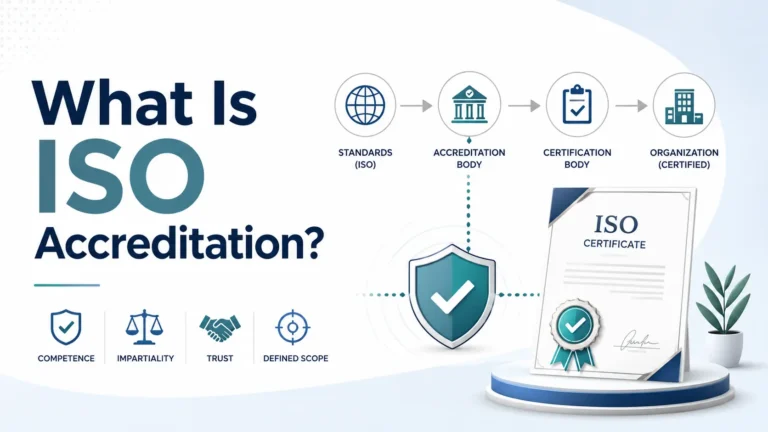
The search term is useful because that is how many buyers phrase the need. The technical reality is different: ISO publishes the standard, while accreditation bodies assess laboratories against it. In Iraq, the official accreditation route sits with the national accreditation framework, not with ISO itself.
ISO 15189:2022 is the current edition of the standard for medical laboratories. It specifies requirements for quality and competence and is also applicable to point-of-care testing (POCT). ISO states that the document is used both for developing management systems and for recognizing the competence of medical laboratories.
That makes it different from a broad quality standard. ISO 15189 is built specifically for the laboratory environment, where patient care, technical reliability, result integrity, and controlled examination processes all matter at the same time. WHO’s LQSI tool also treats ISO 15189 as the stepwise destination for laboratory quality-system implementation.
In market language, people say certification. In the official laboratory pathway, accreditation is the more accurate term. That is not a minor wording issue. It affects who assesses the laboratory, how recognition works, and what kind of proof the laboratory can present afterward.
There is also a version detail worth handling carefully. The current ISO edition is 2022, but public Iraqi accreditation certificates can still be seen with ISO 15189:2012 wording. That means laboratories should confirm the current recognition path, transition expectations, and exact scope with the relevant Iraqi accreditation route instead of assuming every certificate in the market reflects the latest edition.
ISO 15189 is for medical laboratories in Iraq that need recognized proof of quality and technical competence. It applies to environments where result reliability, controlled processes, and technical accuracy directly impact patient care.
Laboratory Type | Why ISO 15189 Matters |
Hospital laboratories | Ensures consistent, reliable patient testing and clinical decision support |
Private diagnostic laboratories | Builds credibility and trust in competitive healthcare markets |
Pathology laboratories | Standardizes processes and improves result accuracy |
Blood banks | Strengthens safety, traceability, and quality control in critical testing |
IVF & fertility laboratories | Supports precision and reliability in sensitive procedures |
Molecular & PCR laboratories | Validates testing methods and ensures dependable results |
Other medical testing environments | Provides structured systems for quality, control, and competence |
Commercially, the demand for ISO 15189 support typically comes from professionals responsible for the laboratory’s performance and recognition pathway. This includes laboratory owners, quality managers, technical managers, medical directors, and healthcare decision-makers who need a clear and structured route toward accreditation.
These roles are not just administrative. They are directly tied to ensuring that the laboratory can demonstrate competence, maintain compliance, and successfully pass external assessment within Iraq’s accreditation framework.
Medical laboratories can vary widely in scope, so fit matters. Typical examples include clinical chemistry, microbiology, hematology, clinical immunology, histopathology and cytology, molecular biology, transfusion-related functions, and other patient-facing diagnostic services. Public Iraqi accreditation examples also show scopes that include fields such as biochemistry and other diagnostic testing units.
The key question is not whether the laboratory is public or private. The key question is whether it performs medical laboratory work that needs a formal system for quality, competence, traceability, control, and external recognition.
Satisfied Clients
Years of Experience
ISO certifications
The biggest gains are reliable results, demonstrated competence, stronger patient and clinician trust, tighter operational control, and more credible laboratory recognition. ISO frames the standard around quality and competence, while Iraq’s national accreditation route presents ISO 15189 accreditation as a way to demonstrate accurate and reliable patient test results and stronger service quality.
For Iraqi laboratories, that value becomes practical very quickly. A controlled ISO 15189 system gives clearer ownership of laboratory work, stronger control over methods and records, better evidence for assessments, and more confidence that the lab can defend its results when the stakes are high. It also creates a more disciplined operating model for internal review, corrective action, and ongoing improvement.
ISO 15189 ties quality and competence together. That matters because a laboratory does not earn trust through documentation alone. It earns trust when trained people, controlled methods, maintained equipment, traceable results, and quality checks all work together in a repeatable way. ISO’s abstract and IRNAC’s program description both make that link explicit.
In practice, this is where the standard becomes operational instead of theoretical. The laboratory has to control what happens before testing, during testing, and after testing, and it has to show that those controls are monitored and reviewed instead of left to routine habit.
Recognition matters because laboratories are judged by the credibility of their results. A laboratory that can show a recognized ISO 15189 pathway is easier to trust than one relying only on internal claims. That matters for hospitals, referral networks, regulators, procurement teams, and partner organizations reviewing technical credibility.
In Iraq, that trust layer is not hypothetical. The official accreditation system includes medical laboratories, and public accredited-lab records show that ISO 15189 recognition is already active in the Iraqi market. That gives laboratories a real local benchmark instead of a purely foreign concept.
If your lab already produces serious clinical work but still lacks a recognition pathway, AGS can help turn that gap into a structured implementation plan. The first step is understanding your current readiness before starting formal implementation.
AGS helps you:
Get ISO 15189 implementation support tailored to your laboratory
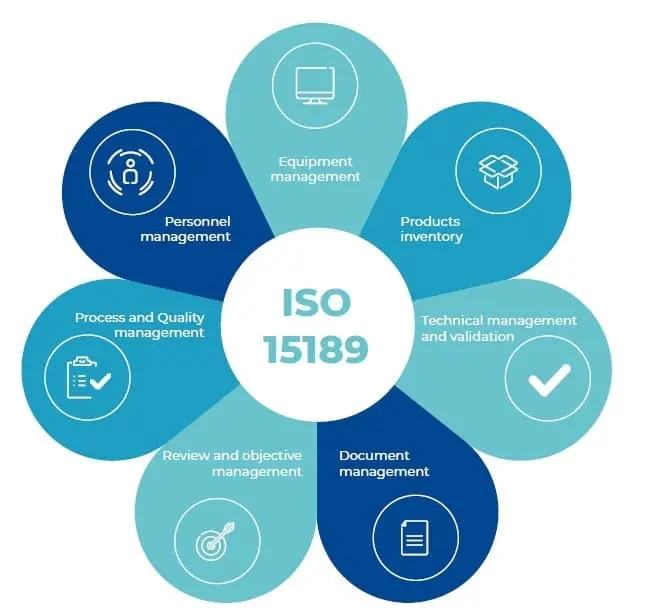
ISO 15189 requires a working quality management system plus demonstrable technical competence. For laboratories in Iraq, that means the system has to control documents, people, methods, equipment, records, quality checks, reviews, and improvement actions in a way that can stand up to formal assessment.
The easiest way to understand the requirements is to group them into four layers: system control, technical control, competence, and assurance. That keeps the standard practical without turning it into clause-by-clause theory.
The laboratory needs a functioning management system, not just a document folder. That includes controlled SOPs, versioned documents, defined processes, traceable records, and enough structure to show that the laboratory knows what it does, how it does it, and how it proves consistency.
Traceability matters because results need a clean path back to approved methods, equipment status, records, and review steps. If that chain is weak, confidence in the result weakens with it.
People, equipment, and methods all need controlled evidence behind them. In practical terms, that usually means competence records, training files, supervised authorization, calibration and maintenance records, method verification or validation files, and clear evidence that the laboratory can perform the work inside its intended scope.
These are often the areas where laboratories feel strongest technically but weakest on formal evidence. That is exactly why implementation work usually has to cover both the technical side and the documentation side together.
This is where a laboratory proves the system is alive. Quality control, proficiency testing or external quality assessment, internal audits, and management reviews show whether the laboratory is actually monitoring itself, finding problems, and acting on them. WHO’s stepwise implementation model also treats those activities as part of the path to accreditation, not as optional extras.
A lab that skips this layer usually looks incomplete under external review, even if the technical staff are capable. External assessors do not only look for competence. They also look for control.

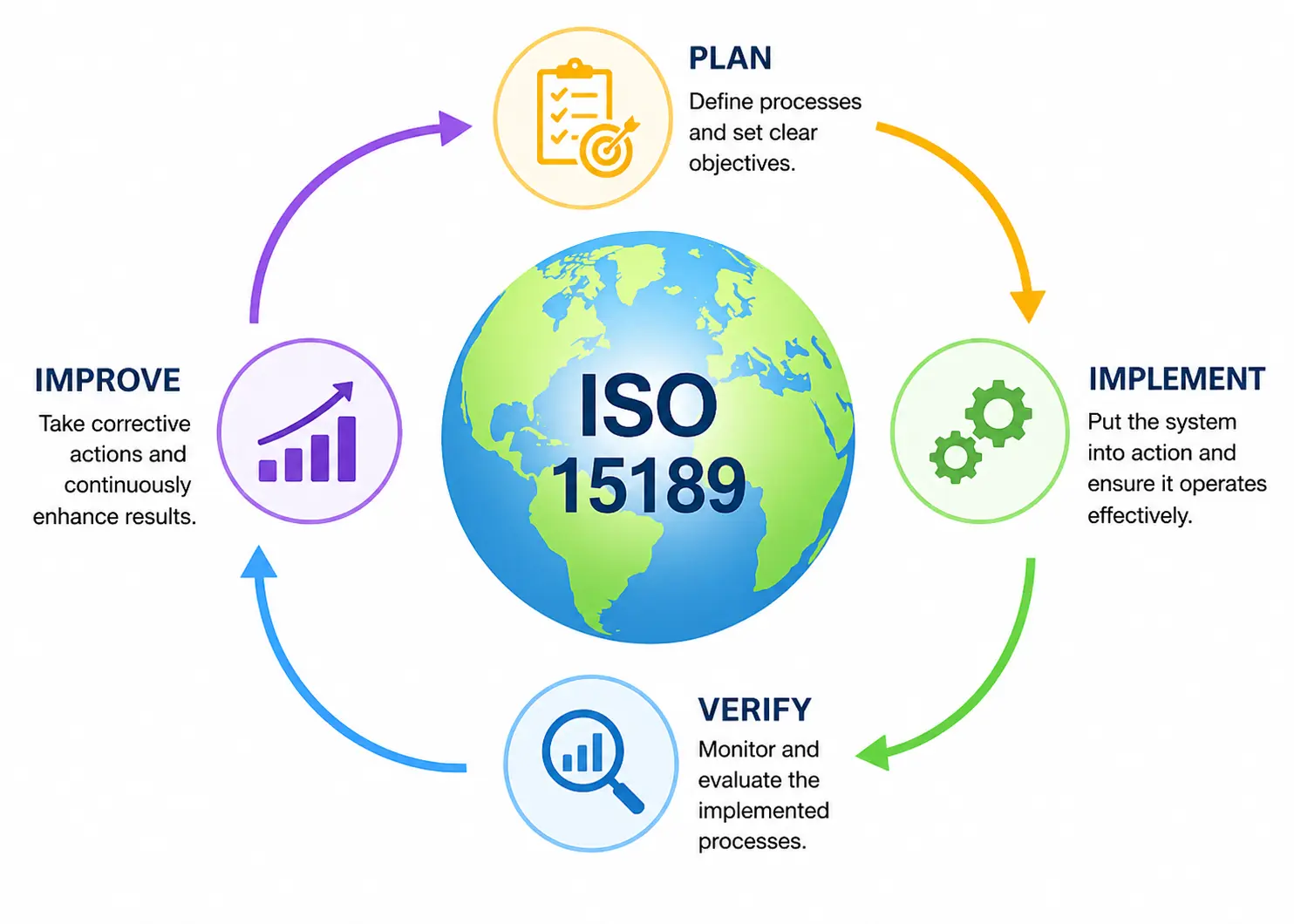
The ISO 15189 pathway in Iraq is a staged process. It usually starts with defining the laboratory’s scope and current gaps, then moves through system building, evidence preparation, internal review, corrective action, and readiness for the external accreditation assessment within Iraq’s official accreditation environment.
For most laboratories, the hardest part is not understanding the standard. It is sequencing the work correctly so the system is built before the external review starts, not during it. That is where structured support creates real value.
The first stage is usually a gap assessment. That means checking the current laboratory against ISO 15189 requirements, identifying what is already in place, and pinpointing what is missing, weak, outdated, or unsupported by evidence. Once the gaps are clear, the lab can move into documentation, SOP control, scope clarification, technical-record alignment, and implementation support. WHO’s LQSI tool follows the same logic by using a stepwise implementation path toward ISO 15189 compliance and accreditation.
This is also where AGS typically becomes useful. The support work can include gap analysis, clause mapping, SOP and document-control support, implementation guidance, and preparation for later internal review and external assessment. AGS describes those deliverables directly on its ISO 15189 service page.
Once the system is operating, the laboratory needs internal review. That usually includes internal audits, management review, corrective-action handling, and evidence cleanup before the external assessment begins. A weak internal-audit trail or half-closed corrective actions can slow the path badly, even when the lab’s technical work is strong. WHO’s LQSI tool and AGS’s own ISO 15189 support content both treat internal audit and corrective-action readiness as part of the real implementation path.
After that comes the external assessment through the accreditation route. In Iraq, the official accreditation system grants accreditation certificates to medical laboratories and follows up on the continuity of accredited bodies’ compliance. That means the project does not end when the first assessment ends. The system has to hold up afterward too.
The timeline depends on the size of the laboratory, the complexity of the testing scope, and the size of the readiness gaps. A lab with mature SOPs, strong records, and active internal reviews will move differently from a lab still building its core quality system. WHO’s LQSI model reinforces that this is a staged implementation path rather than a one-step event.
The practical rule is simple: the broader the scope and the weaker the existing controls, the longer the journey. The smartest first move is not to ask for a fixed promise. It is to ask for a serious readiness review.

If your laboratory is planning ISO 15189 implementation or moving toward accreditation, the first step is understanding your current position clearly.
If your laboratory is ready to move beyond generic planning, AGS can help you turn scope, documents, competence evidence, and internal controls into a real ISO 15189 implementation path for Iraq.
What AGS helps you with:
Send your lab profile, current testing scope, and main readiness gaps, and AGS will help you shape the next step with more precision and less wasted effort.


The official Iraqi accreditation sources reviewed do not present ISO 15189 as a single blanket requirement for every medical laboratory. In practice, the need depends on the laboratory’s healthcare context, recognition goals, and any institutional or regulatory expectations tied to its services.
There is no honest flat price that fits every laboratory. Cost depends on scope, number of laboratory sections, current readiness gaps, documentation workload, training needs, validation and calibration burden, and the external accreditation route.
Yes. Continuing compliance matters. Iraq’s official accreditation framework states that it follows up on the continuity of accredited bodies’ commitment to accreditation requirements, which means accredited status depends on maintaining the system, not just passing once.
The official national route is the Iraqi accreditation system under the Iraqi Commission for Accreditation and IRNAC’s accreditation programs for medical laboratories. Laboratories should confirm the exact current pathway and recognition details directly through the official Iraqi accreditation system.