ISO 45001 Certification for Occupational Health and Safety Management Systems


    ISO Certification

    ISO 14001 CERTIFICATION
    ISO 18001 CERTIFICATION
    ISO 45001 CERTIFICATION
    ISO 27001 CERTIFICATION
    ISO 22000 CERTIFICATION
    ISO 50001 CERTIFICATION
    ISO 29001 CERTIFICATION
    ISO 18788 CERTIFICATION
    ISO 37001 CERTIFICATION
    ISO 22301 CERTIFICATION
    ISO 13485 CERTIFICATION
    ISO 10002 CERTIFICATION
    ISO 21500 CERTIFICATION
    ISO 17025 CERTIFICATION
    ISO 15189 CERTIFICATION

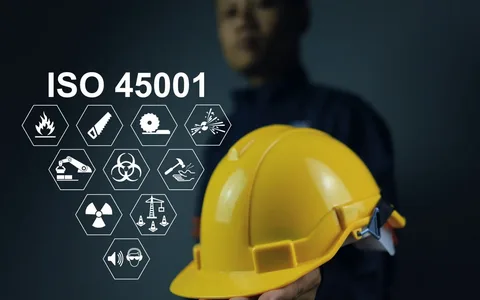
    Worker holding yellow safety helmet with ISO 45001 hazard icons

    ISO 45001 certification is a third-party confirmation that an organization’s occupational health and safety management system conforms to ISO 45001:2018. It applies to the organization’s OH&S management system, not to an individual, and organizations use it to show that workplace health and safety risks are being managed through a structured system rather than informal practice. ISO describes ISO 45001 as the international standard for OH&S management systems and says it helps organizations prevent work-related injury and ill health, manage risk, and improve OH&S performance.

    ISO publishes the standard, but ISO does not certify organizations or issue certificates. Certification is carried out by independent certification bodies, and accredited certificate status can be checked through IAF CertSearch, which ISO points users to for certification verification. Certification is voluntary, but ISO notes that certification can add credibility and, in some sectors, may also be a contractual or legal requirement.

    Here at AGS, we support organizations through a structured ISO 45001 certification pathway, including readiness assessment, audit preparation, and third-party certification support. 

    What ISO 45001 Certification Is And Who It Is For

    ISO 45001 is the standard. ISO 45001 certification is the independent confirmation that an organization’s OH&S management system meets that standard. The certifiable object is the management system the organization uses to identify hazards, assess OH&S risks, control work, involve workers, monitor performance, and improve over time.

    ISO says the standard applies to organizations of all sizes and sectors, regardless of geography or risk level. That makes ISO 45001 certification relevant to manufacturers, construction firms, logistics providers, healthcare organizations, utilities, service companies, and multi-site businesses that need stronger control of workplace injury, ill health, and operational safety exposure.

    This certification applies only to organizational certification. Individuals are not certified under ISO 45001, although they may undertake related training such as awareness courses, internal auditor training, or lead auditor qualifications, which serve a different purpose from organizational certification.

    How AGS Helps You Achieve ISO 45001 Certification

    AGS provides end-to-end ISO 45001 certification support, helping organizations move from initial gap analysis to successful certification through a structured, audit-focused process.

    Our support includes:

    1. ISO 45001 Gap Assessment

    We evaluate your current health and safety system against ISO 45001 requirements and identify missing controls.

    2. System Design & Implementation Support

    We help you build or improve your OH&S management system, including risk assessment, operational controls, and documentation alignment.

    3. Internal Audit Preparation

    We prepare your organization for Stage 1 and Stage 2 audits through internal audit simulation and readiness checks.

    4. Certification Audit Support

    We guide you through the certification process with external certification bodies and help address any nonconformities if raised.

    Our focus is simple: make your system audit-ready, practical, and certifiable. Contact us today!

    Doing the right thing, at the right time.

    300+

    Satisfied Clients

    10+

    Years of Experience

    1700+

    ISO certifications

    Why Organizations Pursue ISO 45001 Certification

    Organizations pursue ISO 45001 certification to reduce workplace incidents, strengthen worker protection, and show that OH&S risks are being managed through an audited system. ISO ties the standard to the prevention of work-related injury and ill health, improvement of OH&S performance, and continual improvement. ISO also says certification can add credibility, while the UK HSE notes that implementing ISO 45001 may help an organization demonstrate compliance with health and safety law, though in some respects the standard goes beyond legal requirements.
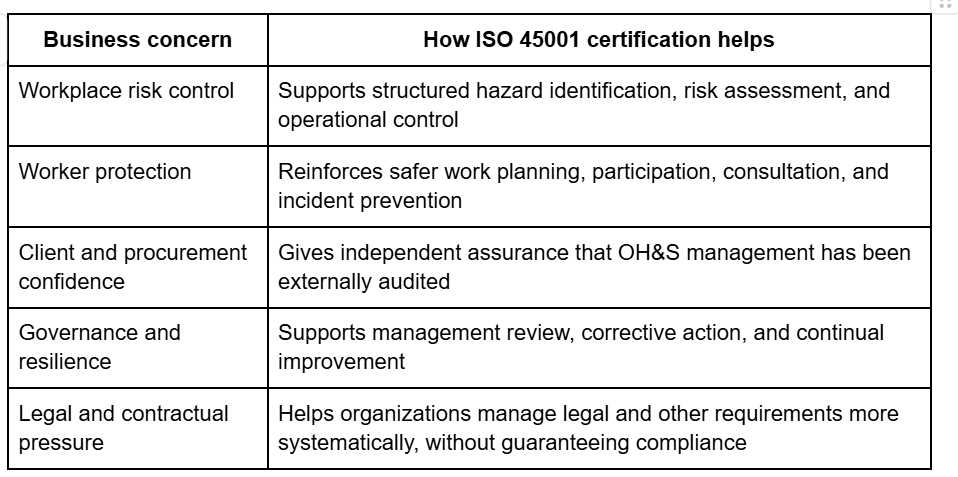
    The commercial value is practical. Stronger OH&S management can affect tender eligibility, client confidence, contractor oversight, workforce morale, and operational resilience. That is why ISO 45001 certification matters beyond the safety department.
    What ISO 45001 Requires At A High Level


    ISO 45001 requires a functioning OH&S management system, not a paper-only policy set. At a high level, the organization needs leadership commitment, worker participation and consultation, hazard identification, OH&S risk and opportunity management, legal and other requirement control, operational controls, emergency preparedness, competence, monitoring, and continual improvement. ISO’s explainer and standard overview both frame the system this way.

    In practical terms, most organizations need these elements in place:

    • A defined OH&S management system scope
    • Leadership direction and clear responsibilities
    • Active worker consultation and participation
    • Hazard identification and risk assessment
    • Controls for routine and non-routine operations
    • Legal and other requirement management
    • Emergency preparedness and response
    • Training, competence, and awareness
    • Monitoring, measurement, internal audit, and management review
    • Corrective action and continual improvement

    The point is not to memorize clause numbers. The point is to show that the organization can systematically control OH&S risks and improve performance over time.

    How leadership, worker participation, and risk control shape certification readiness

    Leadership and worker participation are core certification signals, not decorative extras. ISO 45001 places explicit weight on top management commitment, consultation and participation of workers, and active hazard and risk control. The UK HSE also emphasizes that implementation should reflect a real management system rather than a box-ticking exercise.

    Weak ISO 45001 readiness typically shows up in the same areas: leadership treats OH&S as a delegated administrative task, worker reporting is passive or ignored, hazards are recorded but not effectively controlled, and documentation exists without influencing day-to-day operations. A credible system demonstrates clear ownership, active worker participation, and evidence that risk controls are consistently applied in practice. Certification bodies assess this through the ISO 45001 requirements and the emphasis placed by HSE guidance on management system effectiveness and worker involvement.

    How An Organization Gets ISO 45001 Certified

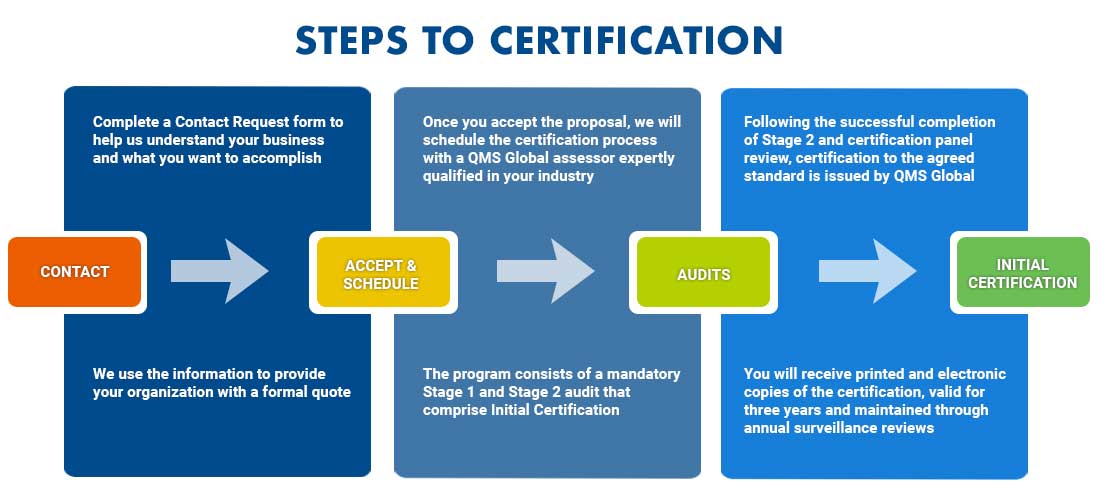
    ISO 45001 certification steps from contact and scheduling to audit and initial certification

    Certification follows implementation and an independent audit of the organization’s OH&S management system. It is a staged process that moves from readiness and system operation to external audit and ongoing surveillance. IAF’s audit-time rules explicitly frame certification around Stage 1, Stage 2, surveillance, and recertification activities.

    1. Define scope and OH&S objectives
      Confirm what sites, activities, departments, and risks sit inside the OH&S management system.
    2. Assess current readiness and gaps
      Compare current controls, records, responsibilities, and operational discipline against ISO 45001 requirements.
    3. Build or improve the system
      Put missing controls, responsibilities, consultation processes, emergency arrangements, and evidence in place.
    4. Run internal audits and management review
      Check whether the system is working before the certification body sees it.
    5. Choose a certification body
      Select an independent certification body with the right competence and accreditation route for the scope.
    6. Complete Stage 1 and Stage 2 audits
      Stage 1 typically reviews readiness and documented information. Stage 2 evaluates implementation and effectiveness across the organization.
    7. Close nonconformities if needed
      If findings are raised, the organization responds with corrective action and supporting evidence.
    8. Receive certification and enter the surveillance cycle
      Once conformity is confirmed and the certification decision is made, the certificate enters the ongoing maintenance cycle.

    Good support reduces delay, rework, and confusion, but it does not replace system maturity. The fastest path is usually the one with a clear scope, strong evidence, real leadership ownership, and fewer surprises between audit stages. That is an inference from how certification stages are structured and how audit time is determined based on client specifics.

    Achieve ISO 45001 Certification with Confidence and Readiness

    ISO 45001 certification requires more than documented procedures. It depends on occupational health and safety systems that are actively implemented, monitored, and improved. AGS helps organizations build audit-ready OH&S systems that can meet certification requirements with confidence. 

    Start with our readiness review to see where you stand and what to do

    next.

    What Happens During The Audit And After Certification

    Stage 1 and Stage 2 are not the same thing. At a decision-maker level, Stage 1 is the readiness and system-review phase. Stage 2 is the main certification audit, where the certification body evaluates implementation and effectiveness. If issues are found, the organization addresses them through corrective action before or as part of the certification decision process.

    After initial certification, the system does not just sit there. Surveillance audits are used to maintain confidence that the OH&S management system continues to conform and operate effectively, and recertification is part of the continuing certification cycle. IAF MD 5 explicitly treats surveillance and recertification as planned parts of the certification framework.


    This is why certificate validity depends on continued conformity, not on the one-time success of an initial audit. The organization has to keep the system alive through monitoring, corrective action, management review, and ongoing control of OH&S risks. That point follows from the surveillance and recertification model in the accredited certification framework.


    Industries Sector

    Oil & Gas
    Construction & Infrastructure
    Manufacturing & Industrial Production
    Food, Agriculture & Processing
    Security & Private Protection Services
    Government & Public Sector
    IT & Digital Services
    Healthcare & Medical Services
    Laboratories & Testing Facilities
    Logistics & Transportation
    Energy & Utilities
    Banking, Financial Services & Insurance
    Educational institutions
    Healthcare Organizations

    Trainings

     
    Quality
     
    Environment
     
    Health & Safety
     
    Food Safety
     
    Business Continuity

    Blogs & News

    ISO Certification

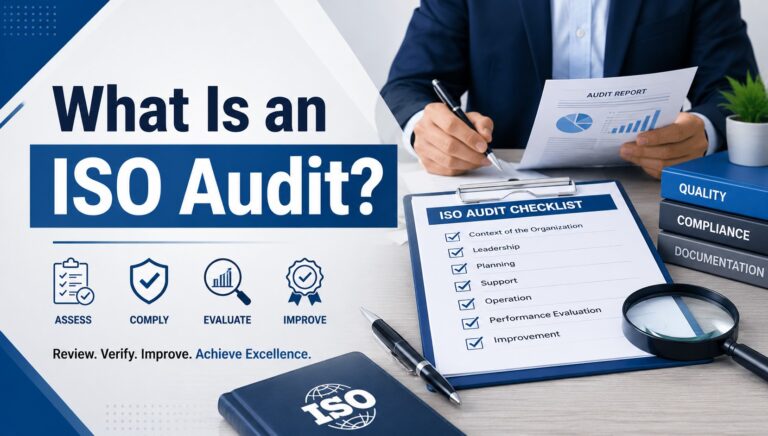
    ISO audit meaning for management system evaluation

    What Is an ISO Audit? Scope, Evidence & Findings

    What Is an ISO Audit? Types, Stages, and How to Prepare An ISO audit is…
    READ MORE →
    ISO 9001 quality management system explained

    What Is ISO 9001? QMS Requirements & Certification

    What Is ISO 9001? A Beginner’s Guide for Businesses Most businesses don’t struggle with quality…
    READ MORE →
    ISO certification

    How Many Types of ISO Certification Are There?

    How Many Types of ISO Certification Are There? ISO certification applies to 4 categories of…
    READ MORE →
    ISO certification benefits for business systems and performance

    What Is ISO Certification? Definition, Process, and How to Verify It

    What Is ISO Certification? ISO certification is an independent third-party confirmation that a product, process,…
    READ MORE →
    Basra Municipality Requirements for ISO Certification

    Government Procurement & Tender Requirements in Basra

    Government Procurement & Tender Requirements in Basra ISO Certification, Compliance Expectations & Practical Guidance Government…
    READ MORE →
    Basra Municipality Requirements for ISO Certification

    Basra Municipality Requirements for ISO Certification: What Businesses Must Comply With

    Basra Municipality Requirements for ISO Certification: What Businesses Must Comply With Basra Municipality does not…
    READ MORE →
    ISO for Food Businesses in Basra

    ISO for Food Businesses in Basra

    ISO for Food Businesses in Basra: A Complete Guide to Food Safety, Compliance & ISO…
    READ MORE →
    ISO for Manufacturing in Basra

    ISO for Manufacturing in Basra

    ISO for Manufacturing in Basra: How International Standards Strengthen Industrial Performance? Basra’s manufacturing sector is…
    READ MORE →
    ISO for Construction Companies in Basra

    ISO for Construction Companies in Basra

    ISO for Construction Companies in Basra: A Complete Guide for 2026 This is the practical…
    READ MORE →

    Certification, Accreditation, And Training: What The Difference Is

    These terms are not interchangeable. If a buyer confuses them, they usually misunderstand what is actually being purchased.
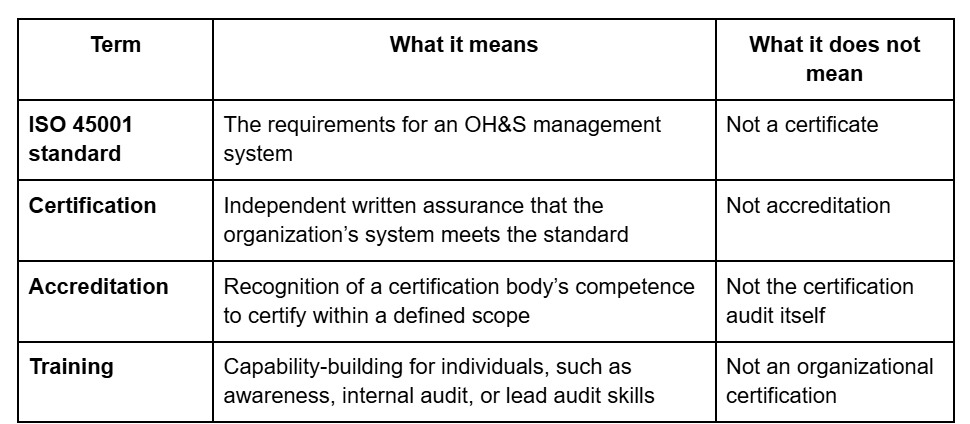
     

    ISO says certification is performed by external certification bodies and that ISO itself does not certify organizations. ANAB explains accreditation for ISO 45001 certification bodies in the context of ISO/IEC 17021-1 and ISO/IEC TS 17021-10, which deal with management-system certification bodies and competence requirements for OH&S management-system certification.


    That distinction matters commercially. If your organization needs independent confirmation of its OH&S management system, you are buying a certification route. If your staff needs skills, you are buying training. They are related, but they are not the same service.

    How To Choose An Accredited ISO 45001 Certification Route

    Accredited certification matters because acceptance and verification matter. ISO points users to IAF CertSearch for certification verification, and IAF states that users can validate whether a certification is valid, whether the certification body is accredited, and whether the accreditation body is an IAF MLA signatory.

    Before choosing a certification body or support provider, check these points:

    • Is the route clearly for organizational ISO 45001 certification rather than training or consulting alone?
    • Is the certification body independent and operating within a relevant accreditation framework?
    • Can certificate status be checked through IAF CertSearch, where applicable?
    • Does the provider explain Stage 1, Stage 2, surveillance, and recertification clearly?
    • Does the route fit your actual OH&S scope, site structure, and risk profile?
    • Would integrated certification with ISO 9001 or ISO 14001 make operational sense?

    ISO says ISO 45001 aligns with other management-system standards and explains its relationship with ISO 9001 and ISO 14001. That can make integrated management-system planning more efficient for organizations already running quality or environmental management systems.

    Get Started With ISO 45001 Certification

    If your organization is evaluating ISO 45001 certification now, the right next step is a readiness review, not a blind quote request. The practical starting point is to define the scope, clarify the risk profile, check current system maturity, and identify what evidence and preparation work still need to be done before an external audit. That approach matches how accredited certification audit time and effort are determined.

    At AGS, we position that next step around certification readiness, audit planning, and a structured route through independent third-party conformity assessment. 

    AGS helps organizations define:

    • ISO 45001 certification scope and boundaries
    • Current gaps in OH&S management systems
    • Realistic audit timeline and preparation effort
    • Correct certification route based on risk profile and operations

    This helps avoid delays, audit findings, and rework caused by incomplete readiness.


    Request an ISO 45001 readiness review.

    Logo
    Logo
    Logo
    Logo
    Logo
    Logo
    Logo
    Logo
    Logo
    Logo
    Logo
    Logo
    Logo
    Logo

    ISO 45001 Certification FAQ

    Usually no. Certification is voluntary, though organizations may pursue it for client, contractual, or regulatory confidence reasons. ISO says certification can add credibility and may be required contractually or legally in some industries.

    Yes. ISO says ISO 45001 replaces the previous British standard OHSAS 18001 and is now the globally recognized reference for OH&S management systems.

    Yes. ISO explains that ISO 45001 relates closely to ISO 9001 and ISO 14001, and it was developed to align more easily with other management-system standards.

    This page is about organizational certification. Individuals can pursue training or auditor qualifications, but that is separate from certifying an organization’s OH&S management system.

    The certification cycle is maintained through surveillance and recertification rather than a one-time audit only. IAF MD 5 explicitly includes Stage 1, Stage 2, surveillance, and recertification in the certification framework, and your exact cycle should be confirmed with the certification body handling your certificate.

    Start Your ISO 45001 Certification Journey with AGS


      ISO Certification

      ISO 9001 CERTIFICATION
      ISO 14001 CERTIFICATION
      OHSAS 18001 CERTIFICATION
      ISO 45001 CERTIFICATION
      ISO 27001 CERTIFICATION
      ISO 22000 CERTIFICATION
      ISO 50001 CERTIFICATION
      ISO 29001 CERTIFICATION
      ISO 18788 CERTIFICATION
      ISO 37001 CERTIFICATION
      ISO 22301 CERTIFICATION
      ISO 13485 CERTIFICATION
      ISO 10002 CERTIFICATION
      ISO 21500 CERTIFICATION
      ISO 17025 CERTIFICATION
      ISO 15189 CERTIFICATION
       

      Industries Sector

      Oil & Gas
      Construction & Infrastructure
      Manufacturing & Industrial Production
      Food, Agriculture & Processing
      Security & Private Protection Services
      Government & Public Sector
      IT & Digital Services
      Healthcare & Medical Services
      Laboratories & Testing Facilities
      Logistics & Transportation
      Energy & Utilities
      Banking, Financial Services & Insurance
      Educational institutions
      Healthcare Organizations

      Trainings

      Quality
      Environment
      Health & Safety
      Food Safety
      Business Continuity
      Translate »