

















Home » Baghdad
ISO Certification in Baghdad helps companies prepare for recognized management system certification through standard selection, documentation readiness, audit support, certification-body coordination, and certificate verification guidance. AGS supports Baghdad businesses that need ISO certification services, ISO consultant support, third-party audit readiness, management system certification guidance, and accredited certification routes where the standard, sector, and scope allow it.
Baghdad companies often seek ISO certification for tenders, supplier qualification, client audits, operational credibility, and risk control. The right path depends on the ISO standard, business activity, sites, employee count, documentation maturity, and certificate scope.
ISO certification services in Baghdad give businesses a clear route from initial requirement to audit readiness. The work is not only about getting a certificate. The work is about building a management system that can be reviewed, audited, maintained, and verified.
AGS supports companies that need help understanding the correct ISO standard, preparing documents, reviewing gaps, improving management system readiness, planning audits, and maintaining certification after approval.
We keep the process practical. We separate consulting, documentation support, audit preparation, certification-body activity, and certificate verification so the buyer knows what each stage means.
ISO certification consulting starts with the business requirement. A company may need ISO 9001 for a tender, ISO 45001 for safety expectations, ISO 22000 for food safety, ISO/IEC 27001 for information security, or ISO 14001 for environmental management.
AGS can support:
A certificate request alone does not prove conformity. The company needs policies, procedures, records, responsibilities, training evidence, internal controls, and audit-ready proof that the system works.
ISO support can be arranged through a local, remote, or hybrid model depending on the business scope, audit requirement, and project stage.
Remote support works well for document review, gap discussions, training coordination, corrective-action tracking, and management system planning. On-site work may be needed when the business activity, audit scope, or operational evidence requires direct review.
A contractor, manufacturer, logistics provider, or food business may need more site-level review than an office-based service company. The support model should follow the scope, not a fixed package.
ISO certification support is useful for companies that need stronger process control, buyer confidence, or audit readiness.
Common business types include:
Each sector has a different certification need. A food business needs food safety controls. A contractor needs quality and safety controls. An IT provider needs information security controls. A supplier may need certification to meet procurement requirements.
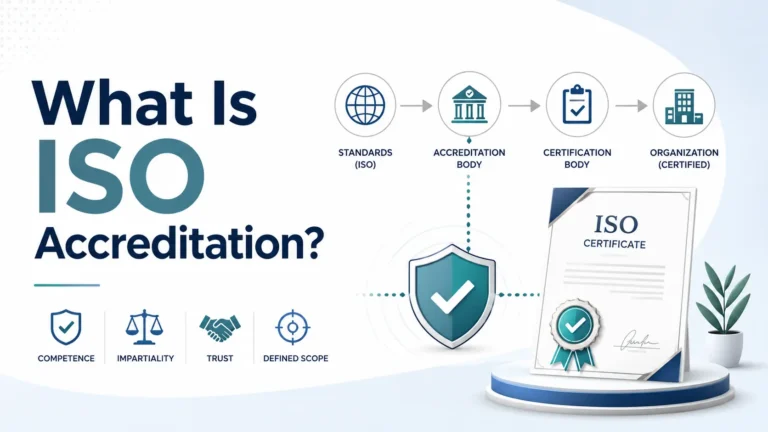
ISO certification means an independent certification body has audited a management system, product, service, or process against a defined standard and confirmed conformity within a stated scope.
For management system certification, the certificate must show the organization, standard, scope, issuing certification body, date, and validity details. A certificate with an unclear scope creates risk for tenders, suppliers, and client audits.
ISO develops and publishes international standards. ISO does not certify organizations and does not issue ISO certificates.
That means a company should not say it is “certified by ISO.” The correct wording is that the company is certified to a specific ISO standard by an external certification body.
This distinction matters because misleading certificate language can weaken buyer confidence. It can also create problems when a tender, client, or supplier asks for proof of certification.
An ISO consultant or implementation adviser helps the business prepare for certification. This support can include documentation, gap analysis, training, readiness review, internal audit support, and corrective-action planning.
A certification body performs the external certification audit and issues the certificate when requirements are met. The certification body’s authority depends on the standard, audit program, accreditation status, and certification scope.
The two roles should stay clear. Preparation support is not the same as the final certification decision.
Accreditation confirms that a certification body has been assessed for competence within a defined scope. Accreditation is scope-bound. It does not mean every standard, sector, country, or certificate is automatically covered.
An accredited certificate can provide stronger confidence when the buyer, tenderer, or client requires accreditation. A non-accredited certificate may still exist, but the buyer should check whether that route is accepted for the intended purpose.
AGS works within defined programs and scopes. Certificate recognition and verification depend on the relevant standard, sector, accreditation program, certification body, and certificate scope.
Satisfied Clients
Years of Experience
ISO certifications
The right ISO certification depends on the business need. A Baghdad contractor, food company, IT service provider, and manufacturing supplier will not always need the same standard.
This table helps match common business needs with common ISO standards.
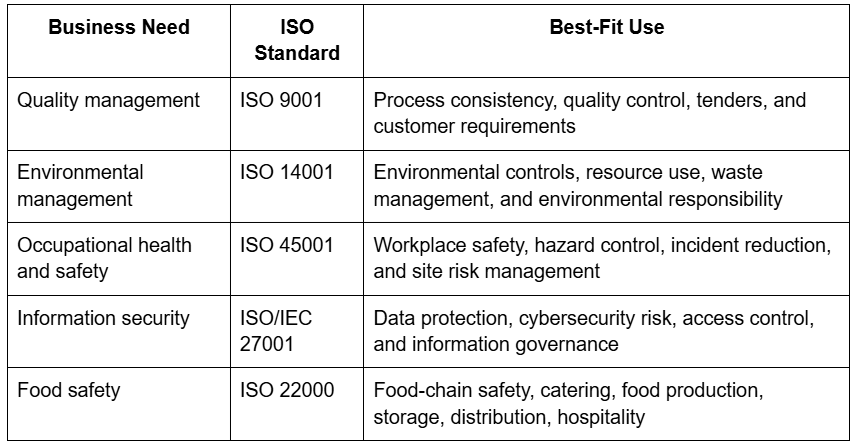
ISO 9001 Baghdad searches usually come from companies that need quality management certification. ISO 45001 Baghdad searches often come from site-based companies with safety duties. ISO 22000 Baghdad searches usually connect to food-sector requirements. ISO/IEC 27001 fits companies handling sensitive information, digital systems, or client data.
ISO 9001 is the main quality management system standard. It helps organizations control processes, define responsibilities, manage customer requirements, monitor performance, and improve over time.
Baghdad companies often consider ISO 9001 when a tender, buyer, or internal quality goal requires a documented quality management system.
ISO 14001 supports environmental management. It helps organizations manage environmental aspects, legal obligations, objectives, performance monitoring, and improvement.
Baghdad companies with waste, emissions, resource use, construction activity, transport activity, or environmental controls may need ISO 14001 environmental management support.
ISO 45001 is the occupational health and safety management system standard. It helps organizations manage hazards, safety risks, worker participation, emergency planning, incident controls, and continual improvement.
This standard is especially relevant for contractors, industrial suppliers, logistics providers, and companies with site-based work.
ISO/IEC 27001 is the information security management system standard. It helps organizations manage risks related to information security, cybersecurity, data handling, access control, confidentiality, integrity, and availability.
This standard fits IT companies, service providers, data-handling firms, financial service suppliers, and organizations managing sensitive client records.
ISO 22000 is a food safety management system standard for organizations involved directly or indirectly in the food chain.
It fits food manufacturers, caterers, storage providers, distributors, restaurants, hospitality groups, and food-service suppliers that need structured food safety controls.
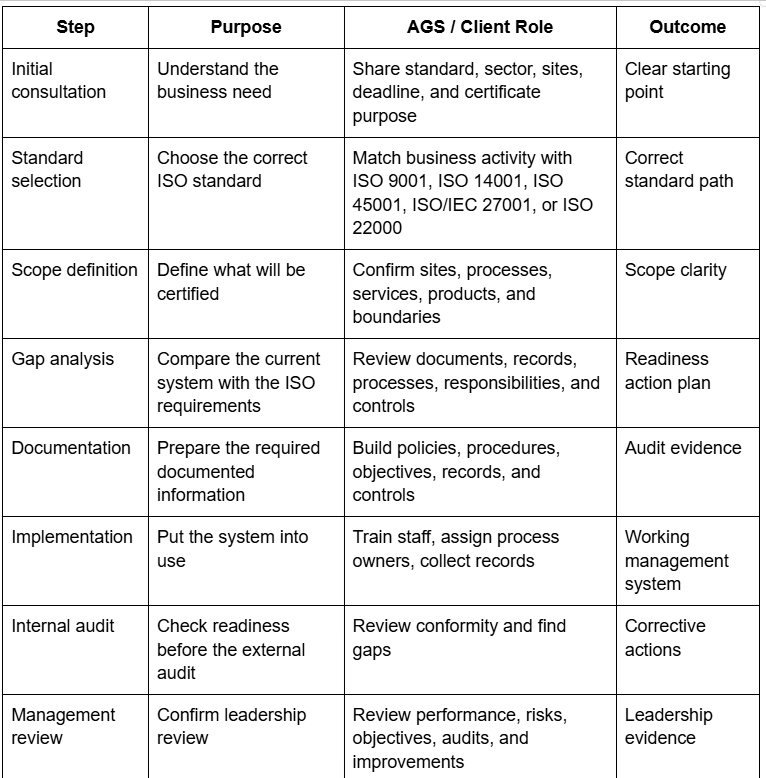
The ISO certification process moves through assessment, gap review, documentation, implementation, audit, corrective action, and maintenance. Each stage creates evidence for the next stage.
This table shows the main certification lifecycle.
The first step is to identify the business reason for certification. The reason may be a tender, client requirement, supplier registration, internal improvement plan, risk control need, or international contract requirement.
We check the business activity, target standard, site count, deadline, and expected certificate use. This prevents the company from preparing for the wrong ISO standard.
Gap analysis compares the current system with the selected ISO standard.
The review checks documents, records, staff responsibilities, process controls, risk controls, internal audit status, and management review evidence. The result is a practical action plan.
The certification scope defines what the certificate covers. Scope can include business activities, locations, products, services, departments, or process boundaries. A clear scope protects the company from certificate confusion later.
Documentation turns the management system into controlled information.
Common documents include:
Implementation means the company actually uses the system. Auditors review evidence, not intentions.
Training helps staff understand their roles, procedures, records, risks, and reporting duties.
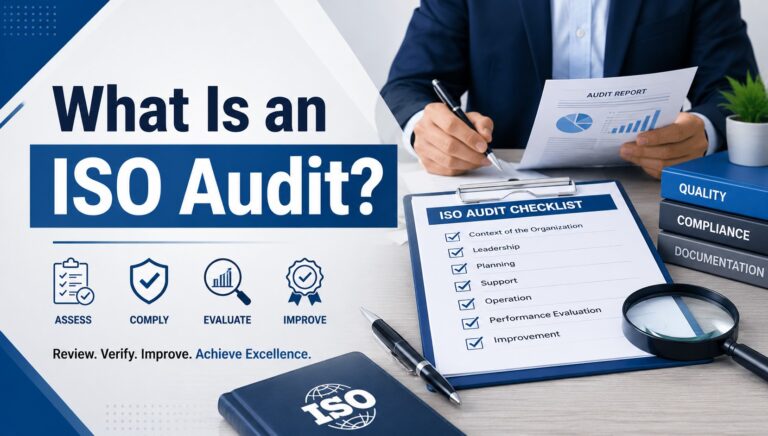
Internal audit checks whether the system conforms to the ISO standard and the company’s own procedures. Management review shows that leadership has reviewed results, risks, audit findings, customer feedback, objectives, and improvement actions.
These steps show that the system is active before the external audit begins.
The external certification audit is performed by the appropriate certification body or an accredited process.
Auditors review the management system, sample records, interview staff, check process control, and report findings. If nonconformities are found, the company must correct the issue and provide evidence.
The final certification decision belongs to the certification body within the applicable program and scope.
Certification does not end after the certificate is issued.
Most management system certification routes include surveillance audits and renewal or recertification planning. The company should keep records updated, continue internal audits, close corrective actions, and review changes to scope, sites, processes, and risks.

As an accredited body, we issue certificates for the most sought-after management system standards:
ISO certification requirements depend on the selected standard and certification scope. A company preparing for ISO 9001 does not need the same evidence as a food business preparing for ISO 22000 or a data-handling company preparing for ISO/IEC 27001.
The common requirement is simple: the management system must be documented, implemented, checked, reviewed, and improved.
Most businesses need a controlled set of documents and records.
Common ISO required documents include:
The document list should fit the business. Too little documentation creates audit gaps. Too much documentation creates a system people do not use.
Business readiness means the system is active before the audit.
A company should have:
Readiness is more than a manual. The company must show how the system works in daily operations.
Customer, legal, and regulatory requirements should be identified for the selected standard and business sector.
For Baghdad companies, this section should stay specific to the company’s activity. A food business, contractor, IT provider, and healthcare supplier may have different legal, customer, and contract requirements.
AGS can help identify the requirement categories during scope review. Sector-specific legal claims should not be assumed without checking the actual business activity and applicable rules.
Local ISO certification support matters because the company needs service-area clarity, practical communication, and audit planning that matches operations in Iraq.
Baghdad is not just a keyword on the page. The service claim must connect to real Iraq coverage, verified business details, and scope-backed service capability.
AGS supports ISO certification work for Baghdad through Iraq-focused service coverage and structured consultation.
The consultation can begin with standard selection, scope review, gap assessment, documentation readiness, and certification route planning. On-site support should be confirmed based on project scope, business activity, and audit requirements.
No unverified local office address, neighborhood claim, or client review should be used unless the detail is confirmed by AGS.
Baghdad’s business environment includes companies that may need quality, safety, environmental, food safety, and information security management systems.
Relevant sectors can include:
Each sector should select the ISO standard based on the required certificate purpose, not a generic “ISO certificate” request.
Local proof should come from real evidence, not invented claims.
Strong local proof can include:
If a detail is not verified, it should not be written as fact. That rule protects both the buyer and the brand.
COSQC is listed by ISO as Iraq’s member body and the central standards and quality-control organization.
This is a useful local context, but it should not be misused. COSQC membership does not mean AGS is endorsed by COSQC unless a separate verified proof exists. ISO membership context and private certification services are different entities.
ISO certification can support business credibility when the certificate, scope, issuing body, and verification route match the buyer’s requirements.
The benefit is not the paper certificate alone. The benefit is the controlled system behind the certificate.
ISO certification can support tender readiness and supplier qualification when the tender or buyer asks for a specific ISO standard.
It does not guarantee tender approval. A buyer may also review pricing, technical capability, financial status, project experience, compliance documents, and certificate validity.
The certificate helps when it is relevant, scope-aligned, current, and verifiable.
ISO management systems help businesses control processes, records, responsibilities, risks, audits, and corrective actions.
That structure can reduce confusion inside the business. Staff know what to do, records show what happened, and management can review performance with evidence.
An independent assessment can improve customer trust when the certificate is issued through a credible route.
For international clients, suppliers, and procurement teams, the certificate should be easy to check. Scope, standard, certification body, accreditation body, where applicable, and certificate status should be clear.
ISO certificate validity depends on the certification body, certificate terms, standard, scope, and maintenance requirements.
A certificate should not be judged by appearance alone. Verification matters.
Many management system certificates follow a certification cycle that includes surveillance audits and renewal or recertification, but the exact validity period should be checked on the certificate and with the certification body.
The certificate should show the issue date, expiry date, certificate number, scope, and issuing body. A company should also confirm surveillance requirements after approval.
ISO 9001 is an international quality management system standard.
Recognition of a specific ISO 9001 certificate depends on the certificate scope, certification body, accreditation status, where applicable, buyer requirement, and verification route. A certificate that is valid for one scope may not satisfy a buyer asking for another scope.
This table shows the main details to check.
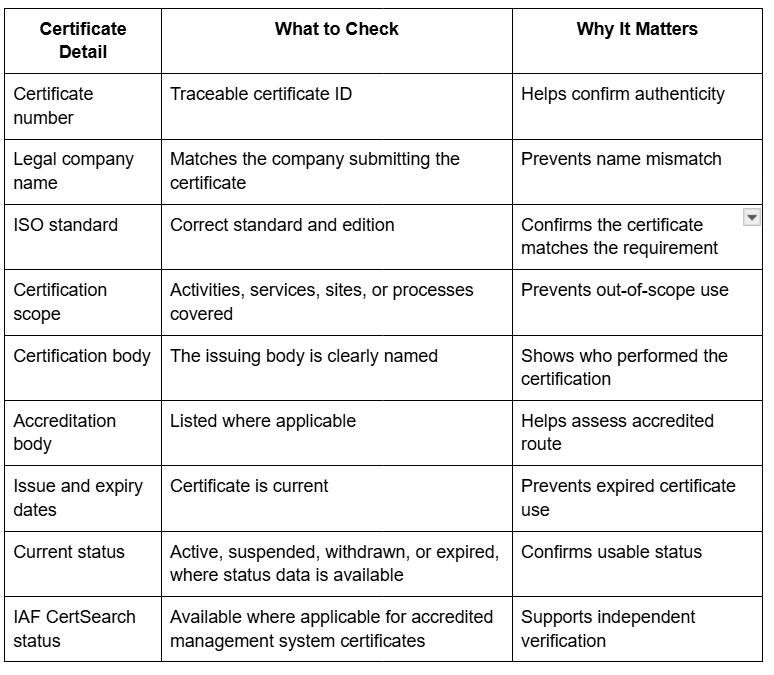
IAF CertSearch can be used where applicable for accredited management-system certifications. If the certificate is not found, the company should confirm details with the certification body or accreditation body.

ISO certification and a Certificate of Conformity are not the same thing. Both can involve conformity language, but the purpose and evidence are different.
This distinction matters in Iraq because businesses may deal with management system certification, product conformity, import/export documentation, and sector-specific requirements.
A business needs ISO certification when the requirement relates to a management system.
Examples include:
The certificate usually confirms that the organization’s management system meets the selected ISO standard within a defined scope.
A Certificate of Conformity may apply when the requirement relates to a product, shipment, regulation, or conformity-document context.
This is not the same as management system certification. If the requirement is about product compliance, import rules, or conformity documentation, the business should check the exact authority, standard, scheme, and document type.
This topic should be handled on a separate page if the business needs detailed import or product conformity guidance.
AGS helps companies in Baghdad move from uncertainty to a clear certification route. We check the standard, scope, documents, audit readiness, cost drivers, certification-body path, and verification needs before the project moves forward.
Send us your business activity, target standard, number of sites, employee count, current documents, and deadline.
Request ISO Certification Consultation in Baghdad


ISO certification cost in Baghdad depends on the selected ISO standard, certification scope, number of sites, employee count, process complexity, documentation readiness, training needs, certification-body fees, and deadline. A reliable quote requires scope review before pricing.
ISO certification requirements include a defined scope, management system documentation, implemented processes, staff awareness, records, internal audit evidence, management review, corrective actions, and external audit readiness. The exact requirements depend on the ISO standard and business activity.
ISO certification is normally not free when a legitimate certification body performs audit and assessment work. Some providers may offer a free consultation, but certificate issuance, audits, and program costs should be checked before relying on any “free certificate” claim.
ISO certificate validity depends on the certification body, certificate cycle, standard, scope, and surveillance requirements. The company should check the certificate issue date, expiry date, surveillance audit terms, and certification-body rules.
The right ISO certification depends on the business need. ISO 9001 fits quality management, ISO 14001 fits environmental management, ISO 45001 fits workplace safety, ISO/IEC 27001 fits information security, and ISO 22000 fits food safety.
ISO 9001 is an international quality management system standard. Recognition of a specific certificate depends on the issuing certification body, accreditation status where applicable, certificate scope, buyer requirement, and verification route.
An ISO certificate usually confirms that a management system meets a specific ISO standard within a defined scope. A Certificate of Conformity may relate to a product, shipment, regulatory, or conformity-document requirement. The correct document depends on the buyer or authority requirement.
ISO 22000 is an ISO food safety management system standard. FSSC 22000 is a separate food safety certification scheme that builds on ISO 22000 with additional scheme requirements. Food-sector companies should check which one the buyer, tender, or supply chain requires.
ISO certification is issued by an external certification body, not by ISO itself. A Baghdad company should check the certification body, scope, accreditation route, where applicable, certificate number, validity dates, and verification route before relying on the certificate.