Home » ISO 10002
ISO 10002:2018 is the current international guideline for complaint handling in organizations. It gives guidance for planning, designing, operating, maintaining, auditing, reviewing, and improving the complaints-handling process for products and services. ISO states that this 2018 edition was last reviewed and confirmed in 2023, so it remains current.
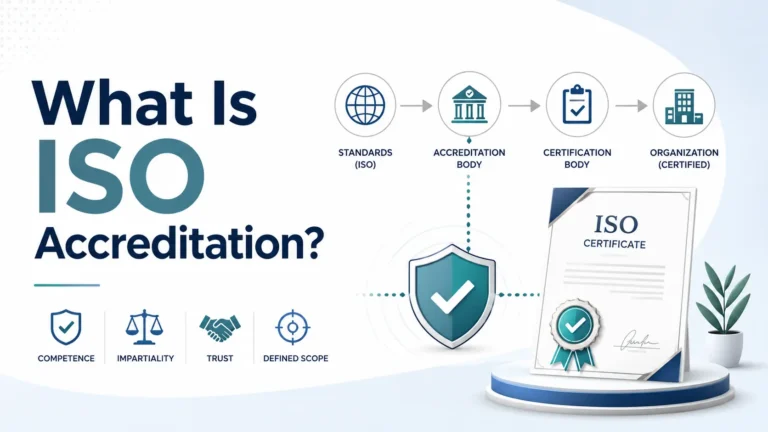
This page is for organizations deciding whether ISO 10002 support is worth it, what has to be in place, and how to move toward a credible external certification route without getting confused about who does what. ISO publishes the standard. ISO does not issue certificates. External certification bodies handle certification, and buyers can use IAF CertSearch to validate accredited certificates issued under ISO/IEC 17021-1 scope.
ISO 10002 is a customer satisfaction standard focused on complaint handling, not a full quality management system on its own. ISO says the standard applies to organizations of any type, size, and sector, and that the complaints-handling process can be used as one process within an overall quality management system. ISO also states two clear exclusions: it does not apply to disputes referred outside the organization, and it does not apply to employment-related disputes.
ISO 10002 certification support usually means helping an organization build an ISO 10002-aligned complaints-handling system, assess gaps, prepare evidence, and coordinate with an external certification body where a certification scheme is being used. That wording matters because ISO says certification can only take place against a document that contains requirements, while ISO 10002 is officially published as a guideline document. So buyers should not accept vague “get certified by ISO” claims. They should ask exactly what scheme is being used, who the certification body is, and what accreditation scope supports it.
Any organization can apply ISO 10002. ISO says the standard is intended for organizations regardless of type, size, sector, or the products and services they provide. Annex B even includes guidance specifically for small businesses, which matters because complaints-handling systems are not only for large corporations with dedicated CX departments.
In practice, that means retailers, healthcare providers, logistics companies, utilities, education providers, software businesses, financial-service firms, and public-sector bodies can all use ISO 10002 if they need a clearer way to receive, track, investigate, respond to, and learn from complaints. The standard is broad on purpose. It is built around the complaint process, not one narrow industry.
The standard is built around a complaints process that is open, usable, fair, reviewable, and improvement-driven. ISO highlights customer focus, top-management involvement, attention to complainant needs, an open and easy-to-use complaints process, analysis and evaluation of complaints, auditing, and review of effectiveness and efficiency. Commercial certification pages describe the same idea in more operational language: visibility, accessibility, responsiveness, objectivity, confidentiality, accountability, and continual improvement.
A good ISO 10002-aligned system usually looks like this:
That is the real value. Not a framed certificate. A process that actually works.
ISO 10002 improves complaint handling by turning complaints into a controlled process instead of a random reaction. ISO says the standard is designed to enhance customer satisfaction by creating a customer-focused environment that is open to feedback, resolving complaints received, and improving products, services, and customer service.
That matters commercially because complaint data is one of the clearest ways to spot broken service steps, recurring failure points, and training gaps. BSI says ISO 10002 helps organizations identify complaints, address them in a consistent way, identify recurring causes, and formulate ways to eliminate them. SGS adds that strong complaint management helps organizations turn unhappy customers into satisfied ones and use that input to improve future customer experience.
The benefits are practical, not fluffy:
That is why serious buyers look at ISO 10002 when complaint handling has become messy, inconsistent, slow, or reputationally expensive.
Satisfied Clients
Years of Experience
ISO certifications
ISO 10002 readiness starts with a managed complaints-handling process that people can follow, measure, audit, and improve. The standard is not asking for slogans about customer care. It is asking for a working process with leadership involvement, resources, training, complaint handling, analysis, audit, and review.
Most organizations need six things in place before ISO 10002 support becomes useful.
ISO’s abstract supports this structure directly through its emphasis on customer focus, management commitment, personnel training, easy-to-use complaint processes, analysis, auditing, and review. The ISO 9001 Auditing Practices Group also describes ISO 10002 as useful guidance for designing and implementing an effective and efficient complaints-handling process as part of a QMS.
ISO 10002 complements ISO 9001. It does not replace it. ISO says ISO 10002 can be used as one process inside an overall quality management system. ISO also says ISO 9001 is the only standard in the ISO 9000 family that can be certified to, which is a useful contrast because ISO 10002 is published as guidance for complaints handling, not as the core QMS requirements standard.
The broader customer-satisfaction family matters here, too. ISO says the 2018 revisions of ISO 10001, 10002, 10003, and 10004 were aligned with ISO 9001 and with each other. In plain English, that means you can use ISO 10002 for internal complaints handling, ISO 10003 for external dispute resolution, and ISO 10004 for monitoring and measuring customer satisfaction without turning the page into a standards-family maze.
A practical ISO 10002 support process usually starts with a gap review and ends with certification-body coordination, not with a certificate on day one. That is how the credible providers in the market frame it. SGS says it can conduct a gap assessment against ISO 10002 or take an organization through the full certification process.
The usual path has five stages.
That is a much more honest description than “apply today and get certified tomorrow.”
Cost and timeline depend on scope, maturity, and audit route. The big drivers are the number of sites, the number of complaint channels, the quality of existing documentation, staff readiness, how formal the current process is, whether ISO 10002 is being integrated with ISO 9001, and what external certification body or scheme is involved. SGS openly markets both gap assessment and full certification process support, which tells you the commercial reality: not every client starts at the same level.
I did not find an official ISO source that sets one universal price or one universal implementation timeline for ISO 10002 certification schemes. So the honest answer is not a fake fixed number. It is scope, complexity, current maturity, and certification-body route.
As an accredited body, we issue certificates for the most sought-after management system standards:
The right provider explains the standard clearly, separates consulting from certification, and shows you how verification works. If a provider blurs ISO, consultant, software vendor, and certification body into one vague sales pitch, that is a red flag. ISO says certification is handled by external certification bodies, not by ISO itself.
Start with scope and verification, not branding. ISO says buyers should examine the statement of certification, certification mark, or a copy of the certificate to identify the certification body. IAF says IAF CertSearch is the global database for validating accredited certifications issued by bodies accredited under ISO/IEC 17021-1, and IAF explains that accreditation is the independent evaluation of certification bodies for impartiality, competence, and consistent operation.
Here’s the blunt buyer checklist:
That is how you avoid paying for glossy confusion.
Use a consultant when the process is weak, a certifier when you need third-party assessment, and software only when tooling is the bottleneck. ISO 10002 does not require a specific software product. The standard is about the complaints-handling process itself. Software can help with intake, tracking, reporting, and escalation, but it is optional support, not the standard.
That distinction matters because some pages in this space are really software pages wearing an ISO mask. If your problem is unclear ownership, no root-cause analysis, poor follow-up, or no audit trail, software alone will not fix that. The process comes first.


It is support for building an ISO 10002-aligned complaints-handling system and preparing for an external certification route. That usually includes gap assessment, process design, evidence setup, internal review, and coordination with a certification body. ISO publishes the standard. External bodies handle certification.
The market offers ISO 10002 certification services, but buyers need to check the exact scheme and scope carefully. ISO publishes ISO 10002 as a guidance standard, and ISO says certification can only take place against documents that contain requirements. So ask the provider to show the certification body, scheme, and accreditation scope in writing.
No, not by default. I did not find an official ISO source stating that organizations are required to hold ISO 10002 certification. The standard is guidance for complaint handling. Whether certification becomes commercially necessary depends on customer requirements, sector expectations, or procurement demands.
There is no honest universal timeline. Timing depends on how mature your complaint process already is, how much documentation exists, how many sites or channels are in scope, and whether you need major remediation before external review. Information not found for one official ISO-wide timeline.
No. ISO 10002 gives guidance for internal complaints handling. It does not override applicable law. ISO also states that the standard excludes disputes referred outside the organization and employment-related disputes, which is another reason buyers should not treat it like a substitute for legal requirements.
No. I did not find any ISO source in this review that mandates a specific software product for ISO 10002. The standard is about the process: receiving, handling, analysing, auditing, and improving complaints. Software can help, but it is not a requirement.
External certification bodies issue certificates, not ISO. ISO states that it does not perform certification or issue certificates, and ISO points buyers to the certification body, accreditation body, and IAF CertSearch route for verification.
If your organization needs a more structured complaints-handling process, better audit readiness, or a clearer path to external certification support, start with scope and readiness. That is the real first step.
We help organizations map the complaints process, identify the gaps, organize the evidence, and prepare for the external certification route without pretending the standard is simpler than it is or blurring who actually issues the certificate.