ISO 22000 Certification


    ISO Certification

    ISO 14001 CERTIFICATION
    ISO 18001 CERTIFICATION
    ISO 45001 CERTIFICATION
    ISO 27001 CERTIFICATION
    ISO 22000 CERTIFICATION
    ISO 50001 CERTIFICATION
    ISO 29001 CERTIFICATION
    ISO 18788 CERTIFICATION
    ISO 37001 CERTIFICATION
    ISO 22301 CERTIFICATION
    ISO 13485 CERTIFICATION
    ISO 10002 CERTIFICATION
    ISO 21500 CERTIFICATION
    ISO 17025 CERTIFICATION
    ISO 15189 CERTIFICATION

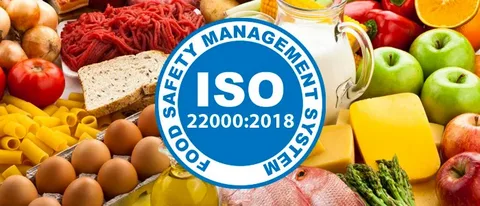
    ISO 220002018 food safety management system badge over assorted food supply chain

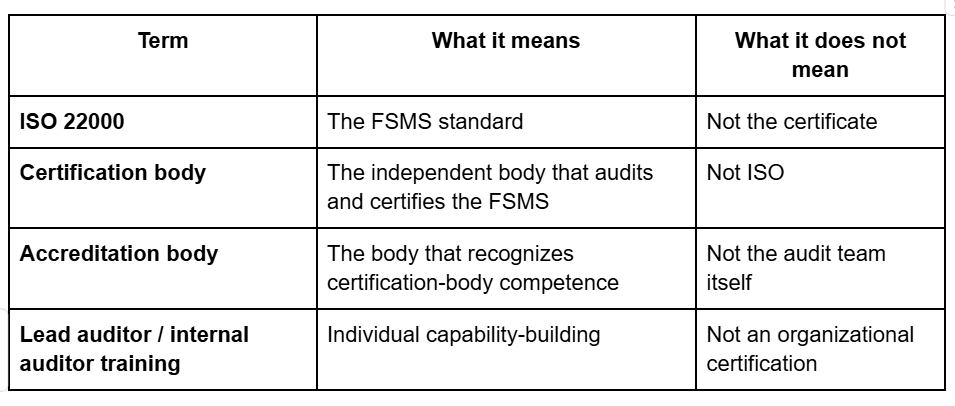
    ISO 22000 certification is a voluntary third-party confirmation that a food safety management system meets ISO 22000 requirements. It is used by organizations across the food chain that need a structured FSMS, a credible audit path, and stronger supplier, buyer, or tender confidence. ISO does not issue certificates. Independent certification bodies do.

    What does ISO 22000 certification mean?

    ISO 22000 certification is a management system certification for food safety. It confirms that an organization’s food safety management system has been audited against ISO 22000 requirements. It does not mean ISO has certified the company, and it does not mean every product is individually certified or guaranteed safe. ISO 22003-1 is clear that FSMS certification is a management system certification, not a product certification.

    ISO 22000:2018 is the current published standard. ISO says the 2018 edition remains current, has one amendment, and Amendment 1:2024 is already published. ISO’s technical committee also says a revision of ISO 22000 is moving forward.

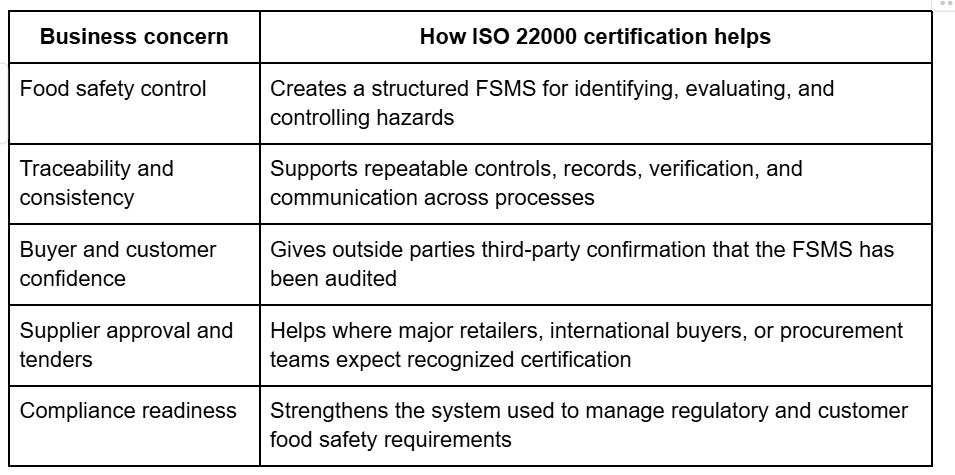
    For buyers, the practical point is simple. ISO 22000 certification gives independent confirmation that your food safety management system is defined, implemented, audited, and maintained against a recognized international standard. That matters when customers, procurement teams, and supply-chain partners want more than a self-declaration.

    Iso 22000 vs. HACCP: What’s The Difference?

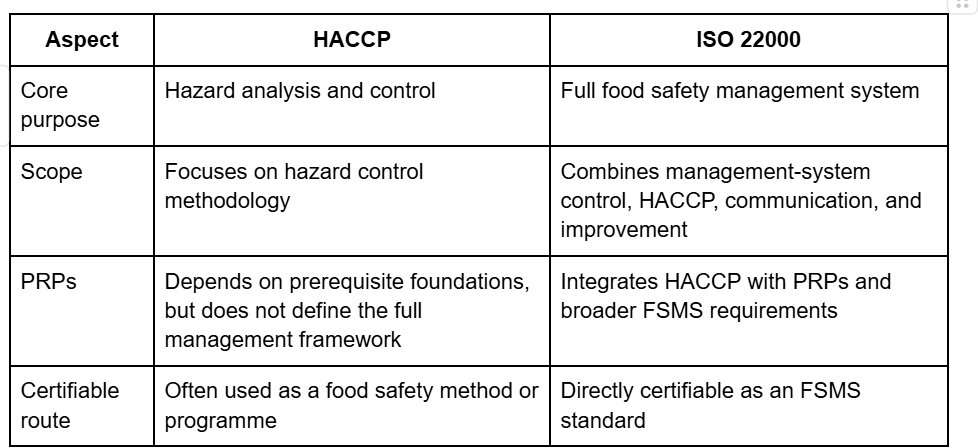
    ISO 22000 is not the same as HACCP. HACCP is the hazard analysis and critical control methodology used to identify, assess, and control food safety hazards. ISO 22000 is a broader management system standard that integrates HACCP principles within a full FSMS with policy, planning, communication, implementation, performance review, and improvement requirements.

    Use this simple distinction when you qualify the right route:

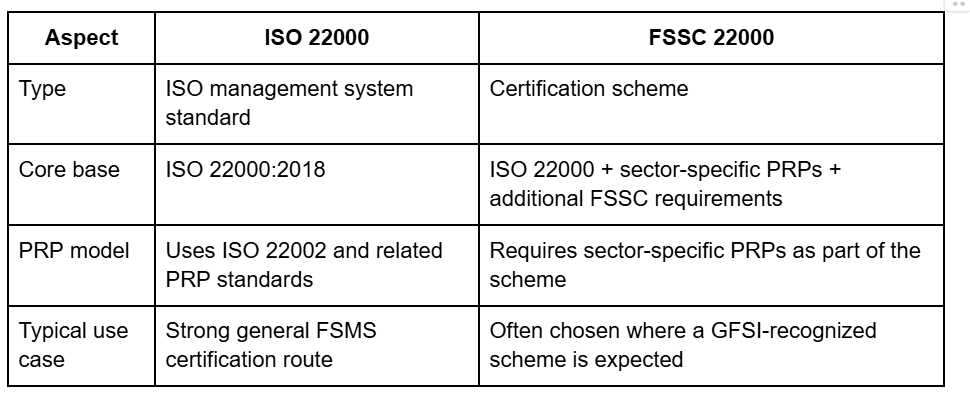
    That is why businesses often ask about both. HACCP remains part of the operational food safety foundation, but ISO 22000 goes further by turning food safety control into a managed, auditable system. FSSC 22000 then builds further on ISO 22000 with sector PRPs and scheme-specific requirements.

    Who Needs Iso 22000 Certification, And Does It Apply To Your Business?

    ISO 22000 applies to any organization in the food chain. That includes organizations directly handling food and those supporting food safety through packaging, storage, transport, ingredients, feed, or related services. Size is not the deciding factor. Relevance to food safety risk and food-chain control is.

    Businesses usually pursue certification when they need independent confirmation that their FSMS is credible to outside parties. ISO’s current explanation says certification is often requested by major retailers, manufacturers with strict supplier approval processes, international buyers, and public procurement tenders. Accredited certification also helps because IAF says certification from accredited bodies is recognized by procurers in domestic and overseas markets.

    Food-Chain Sectors That Commonly Pursue Iso 22000

    Food-chain sectors that commonly pursue ISO 22000 include:

    • food manufacturers and processors
    • ingredient and raw-material suppliers
    • food packaging businesses
    • storage, warehousing, and distribution operators
    • transport and logistics providers handling food products
    • caterers and food service operators
    • retailers and wholesalers
    • feed businesses and related supply-chain operators

    These examples fit ISO 22000’s broad food-chain scope and the current PRP structure across manufacturing, packaging, catering, retail, and wholesale, and feed-related supply-chain activities.

    Is Iso 22000 Certification Mandatory Or Voluntary?

    ISO 22000 certification is voluntary. Businesses choose it when they need independent confirmation of their FSMS. In practice, that voluntary status often meets commercial pressure. A buyer, retailer, manufacturer, export customer, or tender requirement can make certification the practical route even when no law says every business must hold an ISO 22000 certificate.

    Doing the right thing, at the right time.

    300+

    Satisfied Clients

    10+

    Years of Experience

    1700+

    ISO certifications

    What documents and procedures are required for ISO 22000?

    ISO 22000 requires more than a food safety statement on paper. An organization needs a working food safety management system with defined controls, documented procedures where needed, supporting records, internal review, and evidence that the system is operating in real conditions. The exact document set varies by scope, process complexity, product risk, and site structure.

    What An Iso 22000 Food Safety Management System Includes

    An ISO 22000 food safety management system includes four core layers:

    • hazard control based on HACCP principles
    • prerequisite programmes that create safe operating conditions
    • interactive communication across the food chain and inside the organization
    • system management for planning, monitoring, review, corrective action, and continual improvement

    That combination is what separates ISO 22000 from a narrow hazard plan. It connects operational food safety control with management accountability and auditability.

    How Iso 22002 And Prps Support Implementation

    ISO 22002 provides the PRPs that support safe food production and related food-chain operations. ISO’s current guidance explains that PRPs are the hygiene and operational conditions used to prevent contamination and maintain a safe environment, and the ISO 22002 family now includes sector-specific parts such as manufacturing, packaging, catering, retail, and wholesale, plus the cross-sector ISO 22002-100 framework.

    For implementation, that means your system should not stop at a HACCP study. Your PRP layer needs to match your sector and your real operating environment. A manufacturer, a packaging site, a retailer, and a catering operation do not run the same controls in the same way, even though they can all operate under ISO 22000.

    What Records And Evidence Auditors Expect To Review

    Auditors expect to review records and evidence that show your FSMS is functioning, not just documented. Typical examples include cleaning schedules, temperature logs, supplier checks, traceability records, recall readiness evidence, pest-monitoring records, corrective actions, verification activities, and internal audit results. The exact record set depends on your scope, processes, hazards, and food-chain category.

    Before you move into certification, most organizations should already be able to show a basic readiness pack such as a defined scope, food safety policy, hazard analysis, PRP controls, monitoring records, internal audit evidence, management review, and corrective-action tracking. That is the difference between asking for a certificate and being ready for an audit.

    What Is The Iso 22000 Certification Process?

    The ISO 22000 certification process moves from readiness review to initial audit and then into ongoing maintenance. In accredited management system certification, the initial certification audit is performed in two stages, followed by surveillance and recertification within the certification cycle.

    Gap Assessment And Implementation Readiness

    Gap assessment is the real starting point for most organizations. It compares your current FSMS against the certification requirements and shows what still needs to be implemented, corrected, formalized, or evidenced before the initial audit. That step reduces wasted audit time and prevents obvious nonconformities from showing up too early.

    Stage 1 and Stage 2 audit

    Stage 1 reviews readiness. It focuses on scope, documented system structure, site conditions, and whether the organization is prepared to move into the full certification audit. Stage 2 is the main conformity audit. It tests whether the FSMS is implemented and effective in practice.

    That distinction matters because some companies think the audit starts and ends in one visit. It does not. A credible certification route uses the staged approach to check readiness first and performance second.

    Surveillance and recertification

    After initial certification, the system moves into a maintenance cycle. In the standard management system certification cycle, surveillance audits are conducted during the cycle, and recertification is completed at the end of it. FSSC’s current published route states this plainly as annual surveillance audits and mandatory recertification every three years. IAF guidance on management-system audit time also reflects surveillance and recertification as recurring parts of the certification cycle.

    For you, the message is simple. Certification is not a one-time event. It is an ongoing system that has to stay effective between audits of your company or organization, not just look good during the first assessment.

    How Long Does It Take To Get Iso 22000 Certification?

    The timeline depends on readiness, scope, number of sites, operational complexity, and how mature your FSMS already is. A company with a working HACCP-based system, sector-fit PRPs, strong records, and internal audit discipline moves faster than a business starting from scratch. The audit cycle itself is structured, but implementation time is organization-specific.

    How To Choose An Accredited Iso 22000 Certification Body Or Provider

    ISO certification body selection criteria wheel showing accreditation experience reputation language maturity

    Choose a provider by checking competence, accreditation logic, sector fit, audit scope, and verification path, not by choosing the cheapest logo. ISO says organizations should evaluate several certification bodies, and IAF says accredited certification gives confidence because accreditation independently evaluates certification bodies for integrity, impartiality, and competence.

    A strong provider review should answer five practical questions fast:

    • Is the provider operating as an independent certification body, not only as a consultant or trainer?
    • Is the accreditation route clear for the standard, sector, and certificate scope?
    • Does the team understand your food-chain category and audit complexity?
    • Is the certification path clear from readiness through surveillance and recertification?
    • Can the certificate or accredited status be verified through the proper channels?

    How To Verify Accreditation And Certificate Legitimacy

    The verification path is straightforward. First, confirm the certification body’s accreditation scope with the relevant accreditation body. Then use IAF CertSearch where applicable. IAF describes CertSearch as the exclusive global database for accredited management system certifications and provides certificate validation tools so users can check authenticity and status.

    This matters because a certificate only has the commercial value you think it has when the certification body, accreditation scope, and certificate status all line up properly. A smart buyer checks that before accepting the certificate at face value.

    When Iso 22000 Is Enough And When Fssc 22000 Is A Better Fit

    ISO 22000 is often enough when the goal is a certifiable FSMS, stronger supplier confidence, and a recognized food safety management framework. FSSC 22000 becomes the better fit when a customer, retailer, export chain, or procurement requirement specifically asks for the FSSC scheme or a GFSI-recognized route. FSSC describes its scheme as built on ISO 22000, ISO 22003-1, and sector-specific PRPs, and FSSC’s own scheme materials state that the scheme is benchmarked and recognized by GFSI.

    So the practical decision is not which name sounds stronger. The real question is what your buyers, markets, and approval processes actually require. Start with ISO 22000 when you need a strong FSMS certification path. Move to FSSC 22000 when buyer recognition or market access specifically points there.


    Industries Sector

    Oil & Gas
    Construction & Infrastructure
    Manufacturing & Industrial Production
    Security & Private Protection Services
    Government & Public Sector
    IT & Digital Services
    Healthcare & Medical Services
    Laboratories & Testing Facilities
    Logistics & Transportation
    Energy & Utilities
    Banking, Financial Services & Insurance
    Educational institutions
    Healthcare Organizations

    Trainings

     
    Quality
     
    Environment
     
    Health & Safety
     
    Food Safety
     
    Business Continuity

    Blogs & News

    ISO Certification

    ISO certification

    How Many Types of ISO Certification Are There?

    How Many Types of ISO Certification Are There? ISO certification applies to 4 categories of…
    READ MORE →
    ISO certification

    What Is ISO Certification? Definition, Process, and How to Verify It

    What Is ISO Certification? Definition, Process, and How to Verify It ISO certification is a…
    READ MORE →
    Basra Municipality Requirements for ISO Certification

    Government Procurement & Tender Requirements in Basra

    Government Procurement & Tender Requirements in Basra ISO Certification, Compliance Expectations & Practical Guidance Government…
    READ MORE →
    Basra Municipality Requirements for ISO Certification

    Basra Municipality Requirements for ISO Certification: What Businesses Must Comply With

    Basra Municipality Requirements for ISO Certification: What Businesses Must Comply With Basra Municipality does not…
    READ MORE →
    ISO for Food Businesses in Basra

    ISO for Food Businesses in Basra

    ISO for Food Businesses in Basra: A Complete Guide to Food Safety, Compliance & ISO…
    READ MORE →
    ISO for Manufacturing in Basra

    ISO for Manufacturing in Basra

    ISO for Manufacturing in Basra: How International Standards Strengthen Industrial Performance? Basra’s manufacturing sector is…
    READ MORE →
    ISO for Construction Companies in Basra

    ISO for Construction Companies in Basra

    ISO for Construction Companies in Basra: A Complete Guide for 2026 This is the practical…
    READ MORE →
    ISO for Security Companies in Basra

    ISO for Security Companies in Basra

    ISO for Security & PSC Companies in Basra (2026 Guide) This is the practical guide…
    READ MORE →
    ISO Certification for Oil & Gas Companies in Basra

    ISO Certification for Oil & Gas Companies in Basra

    ISO Certification for Oil & Gas Companies in Basra This is the practical guide for…
    READ MORE →
    Logo
    Logo
    Logo
    Logo
    Logo
    Logo
    Logo
    Logo
    Logo
    Logo
    Logo
    Logo
    Logo
    Logo

    Request A Quote Or Start A Gap Assessment.

    If your business is now at the shortlist stage, the next step is to scope the certification route properly. A useful quote request should include your food-chain activity, products or services, number of sites, employee count, current system maturity, and whether you are starting fresh, transferring certification, or planning recertification. We, as AGS Iraq, already use industry, target ISO standard, number of sites, and employee count as quote inputs.


    AGS Iraq operates as an independent third-party certification, auditing, and training organization with its head office in the United States and a strong regional presence in Iraq. We operate as a certification body, not a consultancy, and support organizations through certification audits, surveillance, and recertification activities.


    Request a quote or start a gap assessment when you need to:

    • Confirm whether ISO 22000 fits your sector and buyer requirements
    • Define the audit scope and site structure
    • Identify readiness gaps before Stage 1
    • understand the likely audit path, surveillance cycle, and verification route
    • Compare ISO 22000 with FSSC 22000 before committing to the wrong scheme


    Start Your ISO 22000 Certification Journey with AGS


      ISO Certification

      ISO 9001 CERTIFICATION
      ISO 14001 CERTIFICATION
      OHSAS 18001 CERTIFICATION
      ISO 45001 CERTIFICATION
      ISO 27001 CERTIFICATION
      ISO 22000 CERTIFICATION
      ISO 50001 CERTIFICATION
      ISO 29001 CERTIFICATION
      ISO 18788 CERTIFICATION
      ISO 37001 CERTIFICATION
      ISO 22301 CERTIFICATION
      ISO 13485 CERTIFICATION
      ISO 10002 CERTIFICATION
      ISO 21500 CERTIFICATION
      ISO 17025 CERTIFICATION
      ISO 15189 CERTIFICATION
       

      Industries Sector

      Oil & Gas
      Construction & Infrastructure
      Manufacturing & Industrial Production
      Food, Agriculture & Processing
      Security & Private Protection Services
      Government & Public Sector
      IT & Digital Services
      Healthcare & Medical Services
      Laboratories & Testing Facilities
      Logistics & Transportation
      Energy & Utilities
      Banking, Financial Services & Insurance
      Educational institutions
      Healthcare Organizations

      Trainings

      Quality
      Environment
      Health & Safety
      Food Safety
      Business Continuity
      Translate »