Home » ISO 9001
ISO 9001 certification gives an organization third-party assurance that its quality management system is in compliance with the ISO 9001 requirements. It is relevant for manufacturers, service businesses, regulated firms, supplier-driven organizations, and procurement-sensitive companies that need stronger process control, clearer customer confidence, and a credible route to supplier approval, contracts, or tender qualification. ISO states that ISO 9001 applies across sectors and that certification is performed by external certification bodies, not by ISO itself.
AGS provides independent, third-party ISO certification and auditing services for organizations that need a clear certification route. AGS operates as a certification body, not a consultancy, and its role is to independently audit organizations against ISO standards and make certification decisions based on evidence and conformity.
If your organization is evaluating fit, scope, readiness, audit stages, and certificate credibility, the next step is to review your current QMS and move toward an independent certification route that supports commercial qualification and market trust.
ISO 9001 certification is a third-party assurance that an organization’s quality management system meets ISO 9001 requirements. ISO does not certify organizations. Certification is performed by external certification bodies, and the certificate applies to the management system within the defined scope.
ISO 9001 certification is about verified system conformity, not a self-declared claim. It shows that an independent body has audited the organization’s QMS against a globally recognized management system standard for quality.
ISO 9001 is the international standard for quality management systems. It defines how an organization establishes, implements, maintains, and continually improves a QMS. The standard applies to organizations of all sizes and sectors, and it remains the only certifiable standard in the ISO 9000 family. The current edition is ISO 9001:2015, and the next revision is expected in September 2026.
ISO 9001 certification is for organizations that need consistent delivery, stronger operational control, and credible external assurance. That includes manufacturers, service businesses, healthcare providers, education organizations, government bodies, regulated firms, supplier-driven companies, and procurement-sensitive businesses. ISO explicitly states that ISO 9001 is suitable for organizations of any size and applies across sectors.
That broad fit matters because ISO 9001 is built around a management system, not an industry label. The practical test is simple: does the business need defined processes, measured performance, stronger customer confidence, and a recognized way to show quality management discipline to outside parties?
No, ISO 9001 certification is not generally mandatory. Certification is voluntary, but ISO states that it is often used to help build confidence with buyers, customers, suppliers, and other stakeholders. In real buying conditions, that often turns a voluntary standard into a commercial requirement for supplier approval, framework contracts, or tender participation.
That is why organizations treat ISO 9001 certification as a business decision, not a theoretical exercise. In many markets, a certified QMS reduces doubt before a customer approves a supplier or before a procurement team moves a company forward.
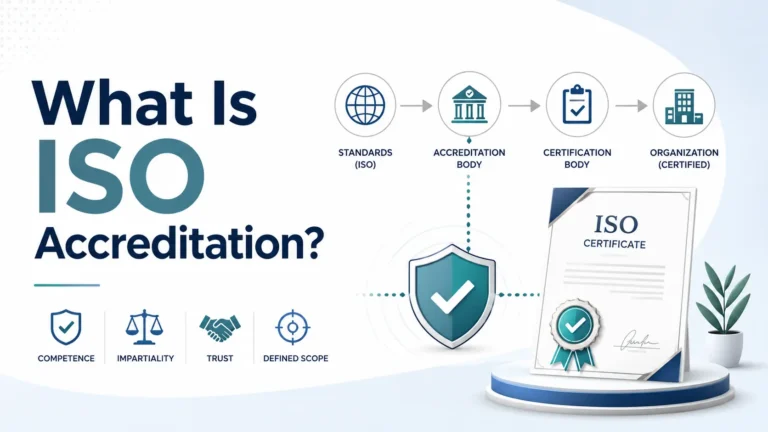
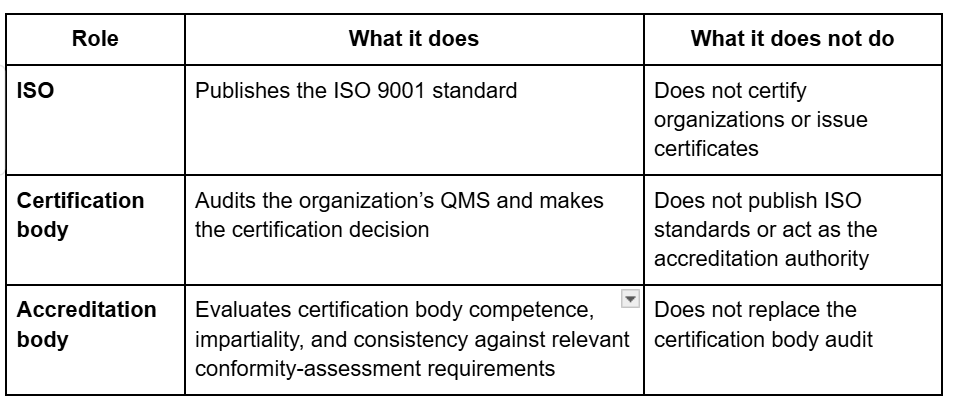
Accredited certification matters because it adds independent confirmation of the certification body’s competence and impartiality. ISO publishes the standard. A certification body audits the organization and makes the certification decision. An accreditation body evaluates the certification body against the conformity-assessment rules that apply to management system certification. Where applicable, accredited certificates can be checked through IAF CertSearch.
This structure matters because customers do not only ask whether a certificate exists. They also ask whether the certification route is credible, recognized, and verifiable.
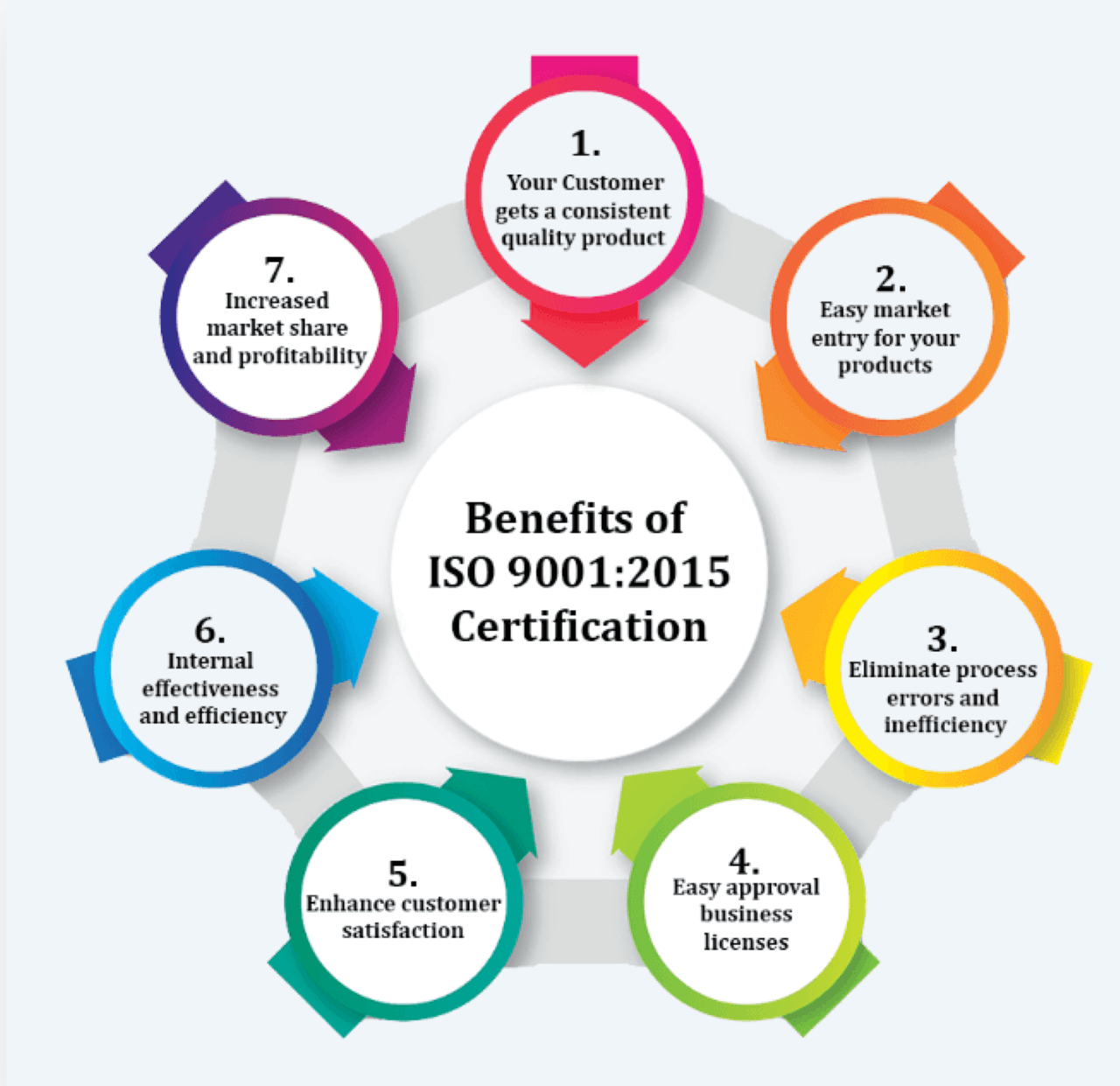
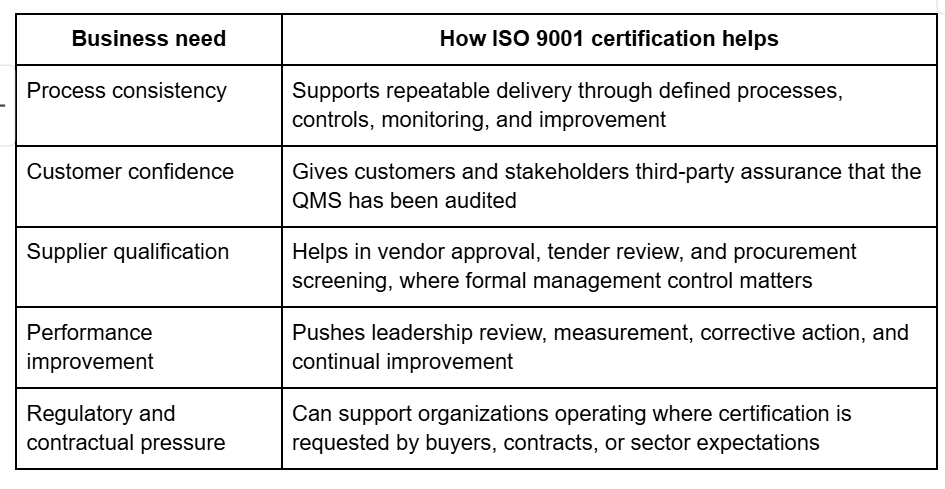
ISO 9001 certification improves consistency, strengthens customer confidence, supports continual improvement, builds supplier credibility, and helps with tender qualification. ISO ties the standard to stronger quality control, improved customer trust, complaint handling, process improvement, cost savings, productivity gains, and a culture of continuous improvement.
The business value is practical. A functioning QMS gives the organization clearer process ownership, better evidence for decisions, and a stronger position in customer, supplier, and procurement conversations. That matters more than the certificate on its own.
ISO 9001 certification improves consistency by making the QMS run through defined processes, assigned responsibilities, controlled changes, and objective evidence. That matters in manufacturing lines, service workflows, supplier controls, remote teams, and multi-site operations. ISO frames the standard around effective processes, trained staff, monitoring, evaluation, and continual improvement.
A defined system reduces variation and makes problems easier to trace. When the organization manages work through a live QMS, performance becomes easier to measure, and corrective action becomes easier to justify.
ISO 9001 certification strengthens customer confidence because it gives outside parties independent proof that the QMS has been audited against a recognized standard. ISO directly links ISO 9001 to customer trust, stakeholder confidence, and better complaint resolution. In business-to-business buying, that proof often matters before a contract is signed.
That is why ISO 9001 certification often appears in vendor qualification, pre-approval, and supply-chain screening. The benefit is not just internal order. The benefit is stronger credibility when someone outside the organization is judging the capability and control.
ISO 9001 certification supports supplier approval and tender eligibility because it is widely used as a commercial trust signal. It is not required in every contract or every bid, but it is often treated as fast evidence that the organization has formal management control where quality risk matters. ISO’s own guidance links certification to supplier approval, tenders, and business partnerships.
That commercial value is one of the main reasons organizations pursue certification. The gain is not only cleaner operations. The gain is stronger acceptance in procurement, contracting, and market-entry discussions.
Satisfied Clients
Years of Experience
ISO certifications
ISO 9001 certification requires a functioning QMS that meets the standard’s requirements and stands up to an independent audit. ISO 9001 is not a paperwork bundle. It is a management system framework for how the organization controls processes, measures results, and improves performance over time.
A certification body does not audit slogans or templates. It audits scope, process control, competence, documented information, internal review, corrective action, and objective evidence that the QMS works in practice.
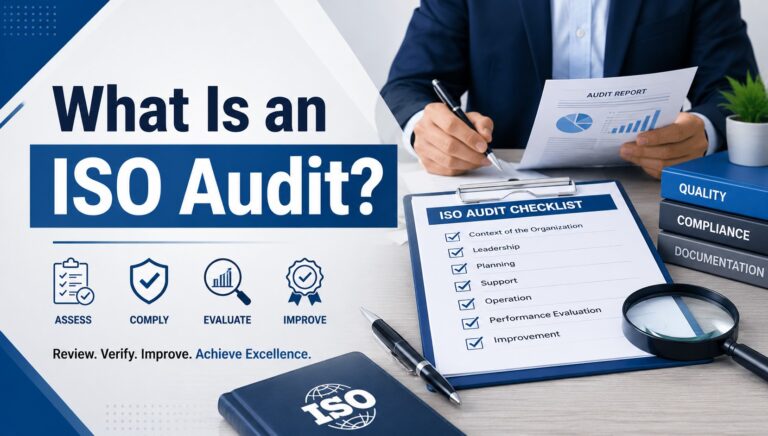
A QMS must cover seven main requirement families: context, leadership, planning, support, operation, performance evaluation, and improvement. ISO uses these categories to structure how the system is established, operated, reviewed, and improved.
In practical terms, that means the organization needs clear system boundaries, leadership direction, quality objectives, competent people, controlled operations, measured performance, and a defined improvement cycle. Those requirements sit on top of seven quality management principles, including customer focus, leadership, process approach, improvement, evidence-based decision making, and relationship management.
ISO 9001:2015 is flexible on documented information. ISO’s own guidance says each organization determines the amount of documented information needed to demonstrate effective planning, operation, process control, and continual improvement of its QMS. ISO also makes the point clearly: the requirement is a documented quality management system, not a system of documents.
That matters because many pages still sell the myth that certification is mainly about fixed templates or a rigid document pack. Evidence matters. Control matters. A usable system matters. Excess paperwork does not prove conformity on its own.
The certification scope should clearly state the activities, products, services, functions, and locations covered by the organization’s management system. Scope matters because the certificate applies to the QMS within defined boundaries, not automatically to every product, every service line, or every unrelated business activity.
A clear scope protects the value of the certificate. If the scope is vague, too narrow, or misleading, the certification route becomes weaker, and outside parties have less confidence in what was actually assessed.
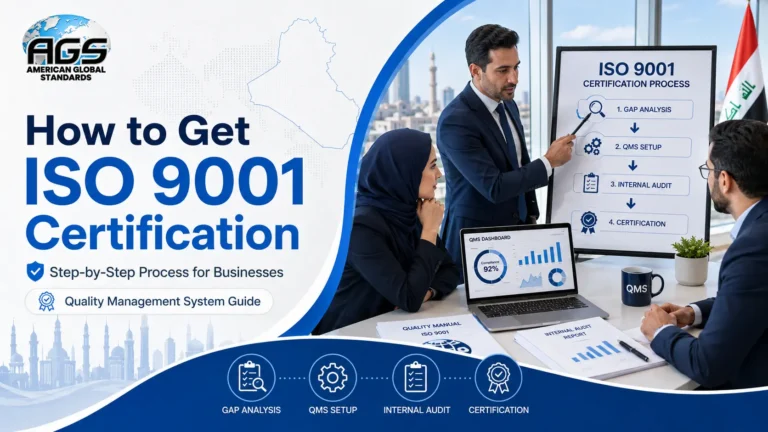
To get ISO 9001 certified, an organization reviews its current system, builds or strengthens its QMS, checks readiness internally, selects an independent certification body, completes Stage 1 and Stage 2 audit activity, closes nonconformities, and enters the surveillance cycle. That is the real route. It is a management and audit path, not a certificate-shopping exercise.
At AGS, the route is treated as a scope, evidence, and audit decision. The strongest certification path is the one where the QMS matches how the organization actually operates, not how it wants to sound on paper.
Gap assessment compares the current management system against ISO 9001 requirements and the intended certification scope. This is the real starting point because it shows what already exists, what is missing, and what needs correction before the external audit.
A readiness review usually checks scope definition, process ownership, documented information, internal audit status, management review status, and available evidence. It is a preparation step, not the certificate itself.
Implementing the QMS means defining processes, assigning responsibilities, building competence, controlling records, and running the system in daily work. ISO 9001 ties conformity to how the organization operates, not to a disconnected policy file.
That means actual controls, trained people, monitored results, corrective action, and management decisions made through the QMS. When the system lives inside operations, the audit becomes clearer and cleaner.
Internal audit and management review are readiness checkpoints before the external certification audit. ISO says checking that the system works is vital, and explains that organizations should perform internal audits to see how the QMS is working.
Organizations that skip these checks usually create avoidable nonconformities. A live QMS should already have internal checking and leadership review in place before Stage 1 and Stage 2 begin.
Choosing an independent accredited certification body means checking scope, recognition, sector fit, and certificate verification logic. The certification is performed by independent certification bodies and that accreditation can add confidence in their competence.
For many organizations, this is where the buying decision becomes real. The right route depends on accredited scope, market recognition, audit discipline, and whether certificate status can be checked where applicable.
Stage 1 reviews readiness and the management system setup. Stage 2 checks conformity in practice. Certification bodies commonly use this two-stage sequence, with Stage 1 taking place ahead of Stage 2 so the organization can correct gaps before the main certification assessment.
That sequence reduces audit risk. If nonconformities are raised, the organization needs to correct them and provide evidence before the certification decision can move forward.
ISO 9001 certification time depends on readiness, scope, complexity, internal audit maturity, and audit scheduling. The main delay is usually not the certificate itself. The main delay is the time needed to build evidence, close gaps, and prepare properly for the audit sequence.
Stage 1 and Stage 2 are separated for a reason. Organizations often need time between them to correct weaknesses before the certification decision can progress.
ISO 9001 certification is not easy, but it is manageable with a functioning QMS and real evidence. It becomes hard when the scope is weak, process ownership is unclear, internal audit is poor, or the system exists only on paper.
The standard itself is structured and transparent. Most difficulty comes from weak implementation discipline, not from hidden requirements.
ISO 9001 certification is maintained through ongoing system control, surveillance audits, corrective action, and recertification within a three-year cycle. Certification bodies commonly run a three-year cycle with yearly audits and recertification at the end of the cycle.
Maintenance means the QMS keeps working after the certificate is issued. Internal audits, management reviews, updated evidence, monitored performance, and corrective action remain active throughout the cycle. Where relevant, organizations can also align ISO 9001 with other management system standards that use the same overall structure.


Common ISO 9001 mistakes include under-scoping the QMS, weak process ownership, poor internal audit, thin evidence, and confusing certification with documentation. A certificate comes from a functioning management system that can be audited, not from templates alone.
No, a person cannot be ISO 9001 certified. ISO says individuals are not certified to ISO 9001, although they can complete auditor training or lead auditor qualifications. The certificate applies to an organization’s quality management system.