
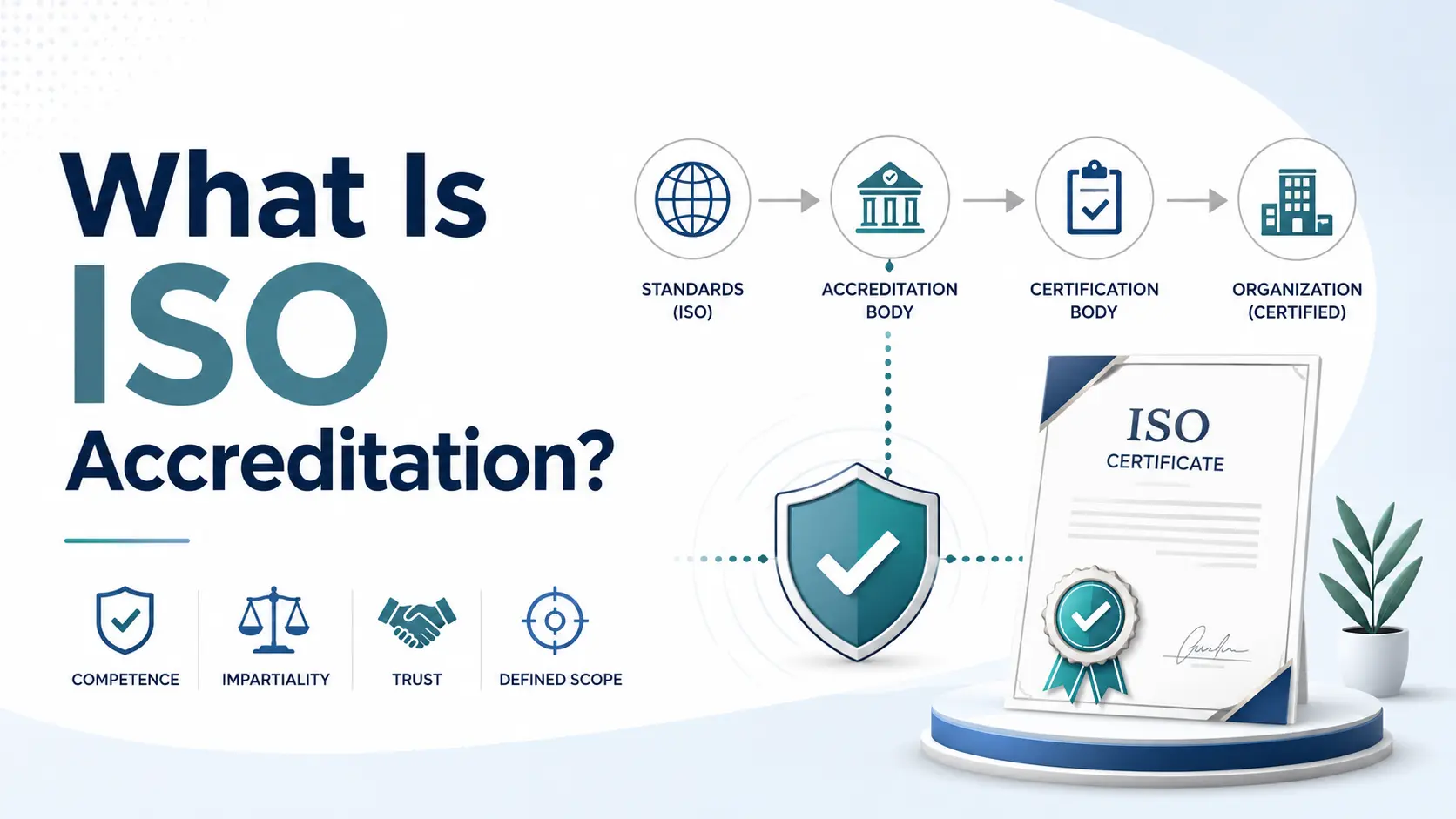
What Is ISO Accreditation?
ISO accreditation is formal recognition that a conformity assessment body is competent, impartial, and able to carry out specific assessment work. That body may be a certification body, testing laboratory, calibration laboratory, inspection body, or medical laboratory.
Most businesses are not trying to become “ISO accredited.” They are usually trying to become ISO certified. The certification body may be accredited, while the business receives certification to a specific ISO standard.
That difference is small in wording but important in practice. It affects how certificates are issued, how buyers review them, and how organizations avoid misleading ISO claims.
What ISO Accreditation Means in Practice
ISO accreditation means an accreditation body has recognized that a conformity assessment body is competent for defined assessment activities.
In simple words, accreditation checks whether the organization doing the assessment is qualified to do that work.
A certification body may be accredited to audit and certify management systems. A testing laboratory may be accredited to perform certain tests. A medical laboratory may be accredited to show quality and competence in medical testing.
The keyword is scope. Accreditation is not a general approval for every activity. It applies to specific standards, technical areas, sectors, or assessment services.
ISO/IEC 17011 is the main standard for accreditation bodies. It specifies requirements for the competence, consistent operation, and impartiality of accreditation bodies that assess and accredit conformity assessment bodies.
ISO Accreditation vs ISO Certification
ISO accreditation evaluates the body doing the assessment. ISO certification evaluates the organization, system, product, service, process, or person being assessed.
| Attribute | ISO Accreditation | ISO Certification |
|---|---|---|
| Who receives it? | Certification bodies, laboratories, inspection bodies, and other conformity assessment bodies | Companies, management systems, products, services, processes, or persons |
| Who grants or issues it? | Accreditation body | Certification body |
| What does it show? | The assessment body is competent and impartial for a defined scope | The certified subject meets specific requirements |
| Simple example | A certification body is accredited to certify ISO 9001 systems | A company is certified to ISO 9001 |
| Common wording issue | “Our company is ISO accredited.” | Usually should be “Our company is ISO certified.” |
ISO defines certification as written assurance by an independent body that a product, process, service, or system meets specific requirements. ISO also states that it does not provide certification or conformity assessment itself; certification is performed by external certification bodies.
How the ISO Accreditation System Works
The ISO accreditation system works through separate roles: ISO publishes standards, accreditation bodies assess conformity assessment bodies, and certification bodies issue certificates.
This separation is what gives the system credibility. The same organization should not write the standard, accredit itself, audit the company, and approve the result without independent checks.
ISO publishes the standards
ISO develops and publishes international standards. ISO does not issue ISO certificates and does not certify companies directly.
Accreditation bodies recognize assessment bodies
Accreditation bodies assess organizations such as certification bodies, laboratories, and inspection bodies. Their job is to confirm competence, impartiality, and consistent operation for a defined scope.
Certification bodies issue ISO certificates
Certification bodies audit organizations against specific standards and issue certificates when requirements are met. For management system certification, ISO/IEC 17021-1 sets requirements for bodies that audit and certify management systems.
A simple example makes this clearer: a company may be certified to ISO 9001, while the certification body that audited the company may be accredited for ISO 9001 certification.
Who Actually Needs ISO Accreditation?
Conformity assessment bodies need accreditation when they want formal recognition of their competence. Most ordinary businesses need ISO certification instead.
A business seeking ISO 9001 certification, ISO 14001, ISO 45001, or ISO/IEC 27001 is usually looking for certification. The business wants an independent certification body to confirm that its management system meets the chosen ISO standard.
- Accreditation is different. It is usually relevant to organizations that assess others, such as:
- certification bodies,
- testing laboratories,
- calibration laboratories,
- inspection bodies,
- product certification bodies,
- validation and verification bodies,
- medical laboratories.
A construction company may become ISO 9001 certified. The certification body that audits the construction company may be accredited. The construction company receives certification; the certification body holds accreditation for that certification activity.
What Makes a Certification Body Accredited?
An accredited certification body has been assessed by an accreditation body and recognized as competent for a defined certification scope.
The word “defined” matters. A certification body may be accredited for one standard but not another. It may be accredited for ISO 9001 certification but not ISO/IEC 27001 certification. It may also have limits by sector, technical area, or certification scheme.
For management system certification bodies, ISO/IEC 17021-1 contains requirements for competence, consistency, and impartiality. ISO also notes that certification bodies operating to ISO/IEC 17021-1 do not have to offer every type of management system certification.
So an accreditation claim should always be checked against the actual standard and scope. The name of the certification body alone is not enough.
Why ISO Accreditation Matters for Certificate Credibility
ISO accreditation matters because it adds trust to the organization performing the assessment.
Most buyers cannot personally evaluate whether a certification body or laboratory is technically competent. Accreditation gives them another layer of confidence because the assessor has been reviewed by an accreditation body.
Accreditation can support:
- confidence in competence,
- confidence in impartiality,
- more consistent assessment,
- stronger procurement review,
- better certificate credibility,
- lower risk of weak or misleading certificate claims.
Still, accreditation does not guarantee acceptance everywhere. A buyer, regulator, or tender authority may still review the certificate scope, accreditation route, certification body, dates, and specific contract requirements.
Accredited vs Non-Accredited ISO Certification
Accredited ISO certification is issued by a certification body accredited for the relevant certification activity and scope. Non-accredited certification is not backed by that accreditation route.
Non-accredited certification may exist. In some cases, it may be enough for internal use or a low-risk buyer requirement. In other cases, it may not satisfy a tender, regulator, procurement team, or customer.
The problem usually appears later. A company may receive a certificate and then discover that the buyer wanted certification from an accredited certification body. Another company may use a certification body that is accredited, but not for the exact standard or scope required.
This is why certificate credibility depends on more than the presence of an ISO logo-style design. The important details are the issuing body, accreditation route, standard, scope, sites, dates, and verification path.
Key ISO/IEC Standards Behind Accreditation
Several ISO/IEC standards help define how accreditation and conformity assessment work. These standards apply to different bodies in the system.
| Standard | Applies to | Why it matters |
|---|---|---|
| ISO/IEC 17011 | Accreditation bodies | Sets requirements for accreditation bodies that assess and accredit conformity assessment bodies |
| ISO/IEC 17021-1 | Management system certification bodies | Sets requirements for bodies that audit and certify management systems |
| ISO/IEC 17025 | Testing and calibration laboratories | Helps laboratories show competence and produce valid results |
| ISO 15189 | Medical laboratories | Sets requirements for quality and competence in medical laboratories |
| ISO/IEC 17065 | Product, process, and service certification bodies | Applies to bodies certifying products, processes, and services |
ISO/IEC 17025 enables laboratories to demonstrate that they operate competently and generate valid results. ISO 15189:2022 specifies requirements for quality and competence in medical laboratories. ISO/IEC 17065 sets requirements for bodies certifying products, processes, and services.
What Changed in 2026 With Global ACI, IAF, and ILAC?
Global Accreditation Cooperation Incorporated, known as Global ACI, became fully operational on January 1, 2026, and assumed the former roles of IAF and ILAC.
This matters because many older articles still explain global accreditation recognition mainly through IAF and ILAC. Those names remain historically important, but current wording should account for Global ACI.
Global ACI states that it assumed the former roles of the International Accreditation Forum and the International Laboratory Accreditation Cooperation. ILAC also announced the launch of Global ACI as of January 1, 2026.
Older certificates, directories, and documents may still mention IAF or ILAC. That does not automatically make them irrelevant. It means the accreditation framework is in transition, and current explanations should mention Global ACI alongside the historical IAF/ILAC context.
How to Verify an Accredited ISO Certificate
An accredited ISO certificate can be checked by reviewing the certification body, accreditation body, standard, scope, and certificate status.
Start with the certificate itself. Check the company name, certificate number, ISO standard, issue date, expiry date, and certified scope. The scope should match the activity, site, service, or process being claimed.
Then look at the certification body named on the certificate. If accreditation is claimed, identify the accreditation body or mark and check the relevant official directory. The listing should show whether the certification body is accredited for the standard and certification activity shown on the certificate.
The most important part is the scope. A certification body may appear in a directory but still not be accredited for the exact standard or sector being claimed. When the listing is unclear, confirmation from the certification body or accreditation body is usually the safest route.
Common Misunderstandings About ISO Accreditation
Most confusion comes from mixing up ISO, accreditation bodies, certification bodies, and certified companies.
| Wrong or risky phrase | Clearer wording |
|---|---|
| “ISO-accredited company” | “ISO-certified company” |
| “Certified by ISO” | “Certified to an ISO standard by a certification body.” |
| “ISO issued our certificate” | “A certification body issued the certificate.” |
| “IAF-certified company” | “Certified by a certification body accredited under a recognized accreditation framework, where applicable.” |
| “Any accredited body can certify any ISO standard” | “The certification body must be accredited for the relevant standard and scope.” |
| “Accreditation and certification are the same” | “Accreditation evaluates assessment bodies; certification evaluates organizations, systems, products, services, or processes.” |
| “All ISO certificates are equally accepted” | “Acceptance depends on scope, certification body, accreditation route, and buyer requirements.” |
In plain terms, ISO publishes standards. Accreditation bodies accredit conformity assessment bodies. Certification bodies issue certificates. Businesses usually receive certification.
When Should a Business Care About ISO Accreditation?
A business should care about ISO accreditation when choosing a certification body, responding to a tender, checking a supplier certificate, or comparing ISO certificates from different providers.
Accreditation becomes especially relevant when a buyer asks for an accredited certification or a tender requires a certificate from an accredited certification body.
A business does not need to master the whole accreditation system. But it should understand enough to check whether the certification body is credible, whether the certificate scope matches the requirement, and whether the accreditation route fits the buyer’s expectation.
For most businesses, the practical issue is simple: the certificate must match the requirement it is being used for.
Need Help Understanding the Right ISO Route?
If you are reviewing an ISO certificate, comparing certification bodies, or trying to understand whether your business needs accredited certification, start with the basics: check the standard, scope, certification body, and accreditation route.
AGS can help you understand the difference between ISO certification, accredited certification, and certificate verification before you move forward with the wrong provider or the wrong claim.
Explore ISO Certification Process Support
FAQs About ISO Accreditation
Is ISO accreditation the same as ISO certification?
No. ISO accreditation and ISO certification are different. Accreditation applies to bodies that assess or certify. Certification applies to the organization, system, product, process, service, or person being assessed.
Does ISO accredit companies?
ISO does not usually accredit companies directly. ISO publishes standards and states that it does not perform certification or issue certificates.
Who gives ISO accreditation?
Accreditation bodies give accreditation to conformity assessment bodies such as certification bodies, testing laboratories, calibration laboratories, inspection bodies, and medical laboratories.
Who issues ISO certification?
External certification bodies issue ISO certificates after assessing conformity with a specific ISO standard. ISO does not issue those certificates itself.
Is an ISO-certified company the same as an ISO-accredited company?
No. An ISO-certified company is not the same as an ISO-accredited body. A normal business is usually certified to an ISO standard. The certification body that issued the certificate may be accredited.
Is ISO accreditation mandatory?
ISO accreditation is not universally mandatory. Requirements depend on the scheme, buyer, tender, regulator, market, and intended use of the certificate or assessment result.
How do I verify an accredited ISO certificate?
Check the certification body, certificate number, ISO standard, certificate scope, accreditation body, accreditation scope, issue date, expiry date, and official directory listing where available.
What services help businesses prepare for accredited ISO certification?
Businesses may use ISO consultants, documentation support, internal audit support, ISO training courses, and readiness reviews to prepare for certification. The certificate itself is issued by a certification body, not by ISO and not by the consultant.