Halal Certification for Hospitals verifies whether selected hospital services, especially patient meals, hospital kitchens, catering, cafeterias, procurement, suppliers, ingredients, menus, and handling processes, follow halal requirements through documented controls and audit review.
AGS supports hospitals and healthcare facilities with halal certification scope review, documentation preparation, supplier and ingredient verification, hospital halal audit readiness, corrective action support, and certification-process guidance.
Request a Hospital Halal Certification Scope Review
Halal certification for hospitals confirms that defined hospital services or operations have been reviewed against halal requirements within a clear certification scope.
For most hospitals, the clearest certification area is food service: main kitchens, patient meals, catering, cafeteria operations, supplier sourcing, ingredient approval, storage, segregation, and serving practices.
A halal certificate should clearly state what is certified. A kitchen certificate, cafeteria certificate, or catering certificate should not be presented as a whole-hospital halal certification unless the scope actually covers the entire hospital service claim.
Halal-certified hospital services are audited against defined halal certification requirements.
Halal-friendly hospital practices may support Muslim patients, but are not automatically certification items. These may include prayer spaces, modesty-sensitive care, private patient handling, or culturally aware communication.
Both matter for patient experience, but they are not the same.
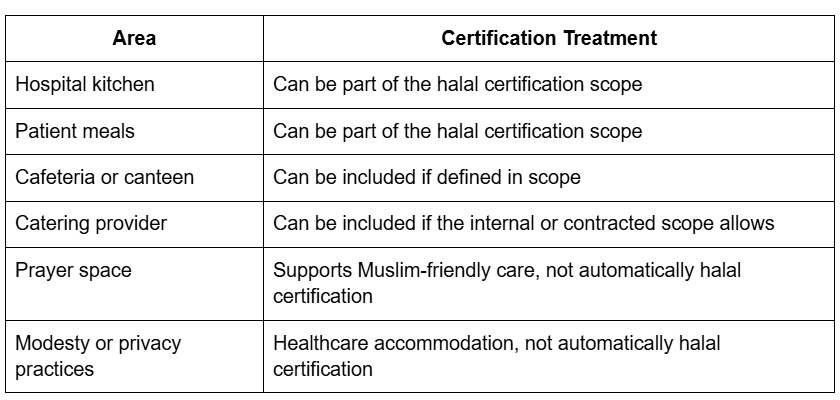
Hospital halal certification is only as strong as its defined scope.
A hospital may certify one kitchen, several food outlets, a patient meal program, a catering unit, or selected supplier controls. The certificate should match the hospital’s actual claim.
For example, “halal-certified patient meals” is more precise than saying “halal-certified hospital” if only the patient meal program was audited.
Scope clarity protects patients, procurement teams, auditors, and the hospital’s reputation.
Hospitals seek halal certification to give Muslim patients greater confidence in food service, patient meals, ingredient sourcing, and handling controls.
Healthcare facilities also use halal certification to strengthen dietary accommodation, improve supplier discipline, and reduce uncertainty for food-service teams.
Food is part of patient care.
A Muslim patient recovering from surgery, receiving long-term treatment, or staying overnight in a hospital may need assurance that meals are halal, properly sourced, and handled without contamination concerns.
Halal certification gives the hospital a documented way to support that assurance.
Hospitals serve patients with different religious, cultural, clinical, and dietary needs.
Halal meal availability can support patient dignity, family trust, and care experience when it is handled with proper controls. This is especially important in multi-specialty hospitals, international hospitals, medical tourism settings, and healthcare systems serving large Muslim populations.
A verbal promise is not enough in a hospital food-service environment.
Food-service teams need approved suppliers, ingredient lists, menus, handling procedures, storage rules, training records, and corrective action processes. Halal certification helps turn patient accommodation into a controlled operating system.
Satisfied Clients
Years of Experience
ISO certifications
Hospital halal certification can include core food-service areas and selected supporting functions when they are included in the certification scope.
The table below shows common hospital areas and how they are usually treated during scope review.
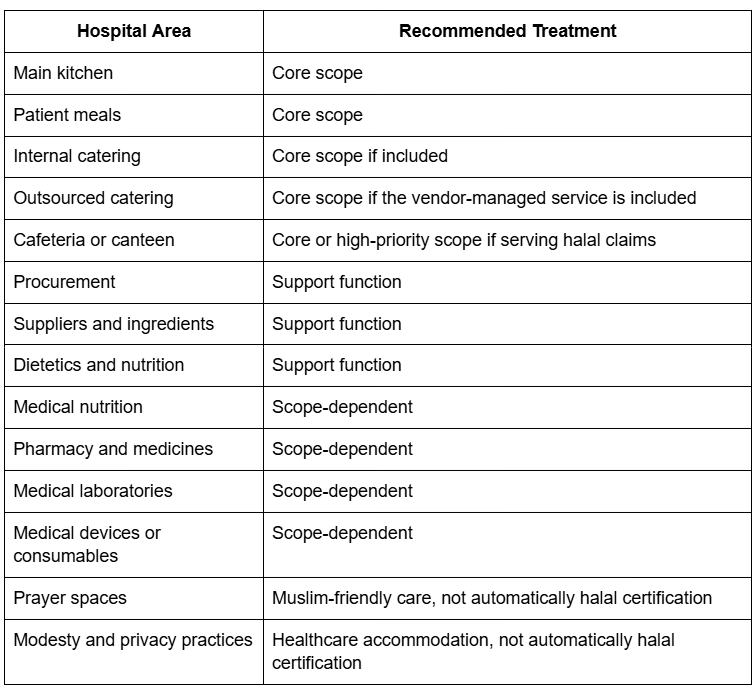
The main hospital kitchen, patient meal program, cafeteria, canteen, and catering services are usually the strongest candidates for halal certification review.
These areas involve direct food sourcing, preparation, storage, serving, and patient consumption. They also create the highest risk of confusion if halal and non-halal items are handled in the same environment.
Procurement, supplier approval, ingredient control, menu management, and storage practices support the core certification scope.
A hospital cannot maintain credible halal meal service if suppliers are unclear, ingredient specifications are incomplete, or storage practices allow avoidable cross-contact risks.
Pharmacy, medical nutrition, laboratories, and medical products should be handled carefully.
These areas may involve gelatin, animal-derived excipients, enzymes, alcohol-based ingredients, or medical consumables. They should only be described as halal-certified if the applicable certification scheme and certificate scope include them.
Prayer rooms, modesty-sensitive care, private spaces, and cultural-awareness practices can support Muslim-friendly hospital care.
They should not be described as halal certification unless a recognized scheme specifically includes them. In most cases, they are patient-experience supports rather than halal certification scope items.
Hospital food service is the operational center of halal certification for hospitals.
The strongest certification preparation starts with how meals are sourced, prepared, stored, served, documented, and monitored.
Hospital kitchens need clear halal handling controls.
This includes approved ingredient use, separation between halal and non-halal items, controlled storage, cleaning procedures, utensil and equipment control, staff training, and documented food preparation steps.
A kitchen audit may review how food enters the facility, where it is stored, how it is prepared, and how staff prevent contamination or mislabeling.
Patient meals may include standard menus, therapeutic diets, texture-modified meals, diabetic meals, renal diets, allergy-sensitive meals, and post-surgical diet plans.
Halal certification preparation should account for these variations. A halal meal must remain halal even when clinical nutrition requirements require substitutions or special preparation.
Dietetics, food service, and procurement teams need to coordinate before patient menus are presented as halal-certified.
Hospital cafeterias and visitor food outlets may be included in halal certification if the hospital wants to make halal claims for those areas.
These spaces often have higher menu variety, multiple vendors, shared equipment, and mixed customer traffic. That makes ingredient control, menu labeling, supplier documents, and staff handling practices especially important.
Many hospitals use external catering providers or vendor-managed food services.
In that case, halal certification preparation should review the vendor’s halal certificates, purchasing controls, food preparation site, delivery controls, storage, serving process, and responsibilities between the hospital and vendor.
A hospital should not rely on a vendor’s halal claim without checking whether the vendor certificate covers the food, site, process, and service being used.
Supplier, ingredient, and menu verification helps hospitals prove that halal food-service claims are supported by records.
This is where many halal programs become weak. The menu may say “halal,” but the audit trail must support the claim.
Hospitals should maintain approved supplier lists for halal-certified ingredients, meat, poultry, prepared food, and vendor-managed catering services.
Supplier records should show:
Supplier approval should be updated when certificates expire, products change, or vendors are replaced.
Ingredient traceability helps hospitals understand what is inside each menu item.
High-risk categories often include:
Hospitals should not rely only on product names. Product specifications and supplier documentation matter.
A hospital’s halal menu register should connect recipes to approved ingredients.
Recipe sheets, menu lists, therapeutic diet substitutions, and alternative ingredient approvals help the food-service team avoid accidental non-halal substitutions.
For example, a soup base, sauce, dessert, capsule-based nutrition supplement, or thickening agent may need review if the ingredients are unclear.
Halal integrity can be compromised during storage and handling.
Hospitals may need controls for cold storage, dry storage, preparation surfaces, utensils, trays, dishwashing, serving carts, labels, and meal delivery routes.
The goal is simple: halal meals should stay identifiable and protected from avoidable cross-contact until they reach the patient.
Hospital halal certification requirements usually include a defined scope, approved suppliers, ingredient controls, food handling procedures, trained staff, internal monitoring, corrective actions, and audit-ready records.
Requirements vary by certification body, scheme, jurisdiction, and hospital scope, but the core readiness pattern is consistent: define, control, document, train, audit, correct, and maintain.
The hospital must define what it wants to be certified for.
That scope may include one kitchen, all food service, patient meals, cafeteria operations, outsourced catering, or selected supporting functions such as procurement and storage.
The scope should be specific enough for auditors, patients, procurement teams, and hospital leadership to understand what the certificate actually covers.
Hospitals should prepare halal food handling procedures and standard operating procedures.
These may cover:
A procedure is useful only if staff can follow it during daily work.
Staff training should match each department’s role.
Kitchen staff needs handling and segregation training. Procurement staff need supplier-document awareness. Dietetics teams need menu and substitution controls. Patient services teams need clear communication about halal meal availability.
Training records should show who was trained, what was covered, and when the training happened.
Hospitals need internal checks before and after certification.
Monitoring may include supplier certificate review, ingredient checks, menu review, storage inspections, kitchen walkthroughs, corrective action logs, and internal audit records.
If a non-halal ingredient is found, a supplier certificate expires, or a process is not followed, the hospital needs a documented corrective action process.
Hospital halal readiness is not only a kitchen responsibility.
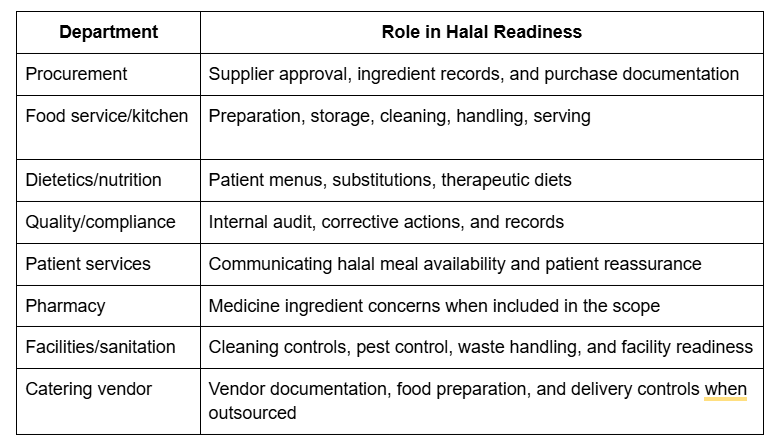
Clear responsibility prevents last-minute audit confusion.

Hospitals should prepare documents that prove halal controls are defined, implemented, monitored, and corrected when needed.
The checklist below shows common documents hospitals may need before a halal audit.
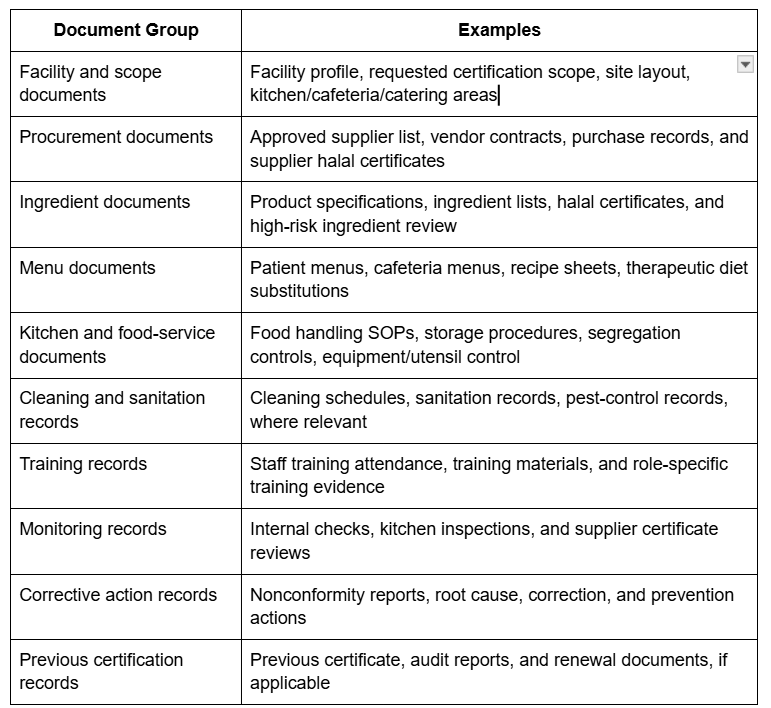
A strong document set helps the audit move faster and reduces uncertainty for hospital teams.
Send your Hospital Food-Service Scope to AGS for Review
The hospital’s halal certification process starts with scope review and ends with certification decision, renewal planning, and ongoing monitoring.
The exact process depends on the certification body, hospital scope, documentation readiness, supplier records, and audit findings.
The first step is to define what the hospital wants to be certified for.
This may include patient meals, main kitchen, cafeteria, catering, procurement controls, storage, or vendor-managed food services. Scope review prevents the hospital from making claims that the certificate does not support.
A gap assessment checks current practices against halal certification expectations.
The review may identify missing supplier certificates, unclear ingredient records, weak segregation controls, undocumented cleaning practices, expired vendor documents, or staff training gaps.
Hospital teams need to apply halal controls before the audit.
Training may cover procurement checks, ingredient review, kitchen handling, menu substitutions, patient meal labeling, storage segregation, and corrective action steps.
Implementation is the difference between having a halal policy and operating a halal-controlled service.
An on-site audit may review the kitchen, cafeteria, catering area, storage rooms, supplier records, menus, staff practices, and halal handling controls.
If the auditor finds nonconformities, the hospital must understand the issue, correct it, and provide evidence that the problem has been addressed.
Corrective actions should address the cause of a problem, not only the visible mistake.
For example, if a supplier certificate expired, the deeper issue may be a missing supplier-monitoring responsibility. The corrective action should fix the monitoring process, not only collect a new certificate.
The certification decision depends on audit results, corrective action closure, and the certification body’s requirements.
If certification is granted, the certificate should show the hospital facility, certified scope, certificate number, issue date, expiry date, and certification body.
After issuance, the hospital must maintain controls through monitoring, supplier review, staff training updates, menu changes, internal checks, and renewal or surveillance activity where required.
Request a Hospital Halal Certification Scope Review
Hospital halal certification should come from a credible certification pathway with a clear certificate scope and verifiable details.
Hospitals should understand who performs the certification, what scheme or standard is used, what the certificate covers, and how the certificate can be checked.
A halal certification body provides halal certification after reviewing the hospital’s defined scope and audit evidence.
AGS supports hospitals with halal certification preparation, scope review, documentation readiness, and certification-process guidance. The certificate-issuing role should be confirmed based on the applicable halal certification scheme, recognition pathway, and hospital scope.
Accreditation or formal recognition can strengthen trust in a halal certificate.
Recognition matters because hospitals may need certificates accepted by patients, buyers, international partners, government bodies, food-service contractors, or medical tourism stakeholders.
Acceptance can vary by country, authority, certification body, standard, and scope. Hospitals should confirm recognition requirements before starting.
A hospital’s halal certificate should not be vague.
It should clearly show what service or area is certified and where the certification applies.
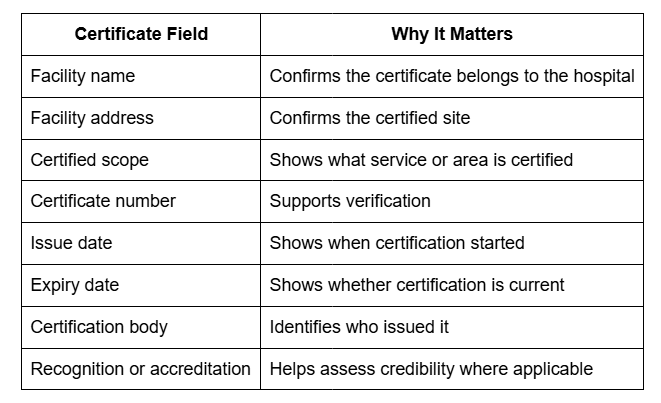
Certificate verification should confirm both validity and scope.
A valid certificate for one hospital kitchen does not automatically certify every cafeteria, outsourced caterer, pharmacy, laboratory, or medical product. The scope must match the claim.
Before using a certificate in patient communication, procurement, medical tourism marketing, or tender documents, check:
This protects the hospital from overstating certification coverage.

AGS supports hospitals and healthcare facilities through a structured halal certification readiness pathway.
The work starts with scope clarity, then moves into documentation, supplier review, food-service controls, audit preparation, corrective action support, and certificate verification guidance.
AGS helps hospitals define the service area that should be reviewed for halal certification.
That may include the main kitchen, patient meal program, cafeteria, catering service, procurement controls, supplier documents, menu records, or storage controls.
The goal is to make sure the certification request matches the hospital’s real operation.
AGS can support hospitals with document review, checklist preparation, staff awareness, gap identification, and internal readiness before the halal audit.
This helps food-service, procurement, compliance, dietetics, and patient-services teams understand what they need to prepare.
AGS helps hospitals understand how to read and verify certificate scope.
This matters because hospital halal claims must be accurate. If only patient meals are certified, the hospital should not imply that every department, pharmacy item, lab process, or medical product is certified.
Halal Certification for Hospitals should start with a clear question: what exactly does the hospital want certified?
AGS helps hospitals review certification scope, food-service operations, patient meal controls, supplier documents, ingredient risks, menu records, staff training needs, audit readiness, and certificate verification requirements.
Request a Hospital Halal Certification Scope Review


Halal certification requirements are jurisdiction-dependent. Some hospitals pursue certification because of patient needs, procurement requirements, government expectations, international patient programs, or internal accommodation goals, but it should not be described as mandatory for all hospitals globally.
Food service is usually the clearest scope for hospital halal certification. Other areas, such as pharmacy, medical nutrition, laboratories, or medical products, are included only if the certification scheme and certificate scope cover them.
Private, government, multi-specialty, and international hospitals may apply when the facility and requested scope are accepted by the relevant certification body. The certification scope should clearly define which hospital services are included.
Pharmaceuticals, medical laboratories, and medical products are included only when they are part of the defined certification scope and supported by the applicable halal certification scheme.
No. HACCP focuses on food-safety hazard control, while halal certification verifies halal conformance. A hospital food-service program may use both, but one does not replace the other.
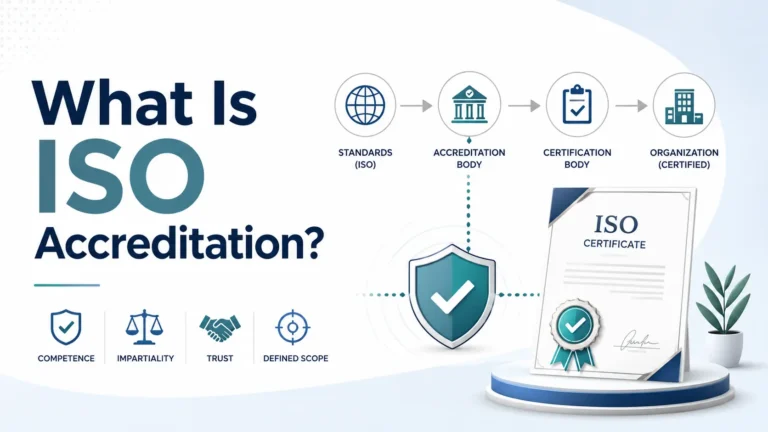
Hospitals may align halal certification with ISO systems or healthcare accreditation processes, but they are different forms of assurance. ISO certification, hospital accreditation, HACCP, and halal certification each have their own scope and requirements.
Halal certification can support trust for Muslim patients and international patient programs when the certificate is credible, current, and scope-accurate. It should not be presented as a guarantee of patient volume, revenue growth, or medical tourism success.