




How Does ISO Training Help with Internal Audits and Certification Readiness?
ISO training does not replace certification. It helps your team become more prepared for the work that certification and audits require. ISO 19011 supports the audit-training language here because it provides guidance for auditing management systems, including audit principles, audit programme management, audit conduct, and auditor competence.
- Understand ISO requirements: Teams know what the selected standard expects before audit pressure starts.
- Build internal audit competence: Staff can check conformity before an external audit.
- Improve documentation discipline: Teams understand records, procedures, evidence, and process control.
- Reduce nonconformities: Trained employees can find gaps earlier and support corrective action.
- Prepare for certification audits: Managers and teams understand audit questions, evidence review, and audit behavior.
What Is the Difference Between ISO Training, ISO Certification, and Accreditation?
This distinction matters. A weak provider will blur these terms. A credible provider will keep them separate. ISO develops standards. It does not perform certification or issue certificates. Certification is performed by external certification bodies.
Trust note for users: Before enrolling in any course, ask what certificate you will receive, who issues it, whether an exam is included, and whether external recognition applies to that specific course. ISO develops standards, but it does not perform certification or issue company certificates. For details, see ISO’s official ISO certification guidance
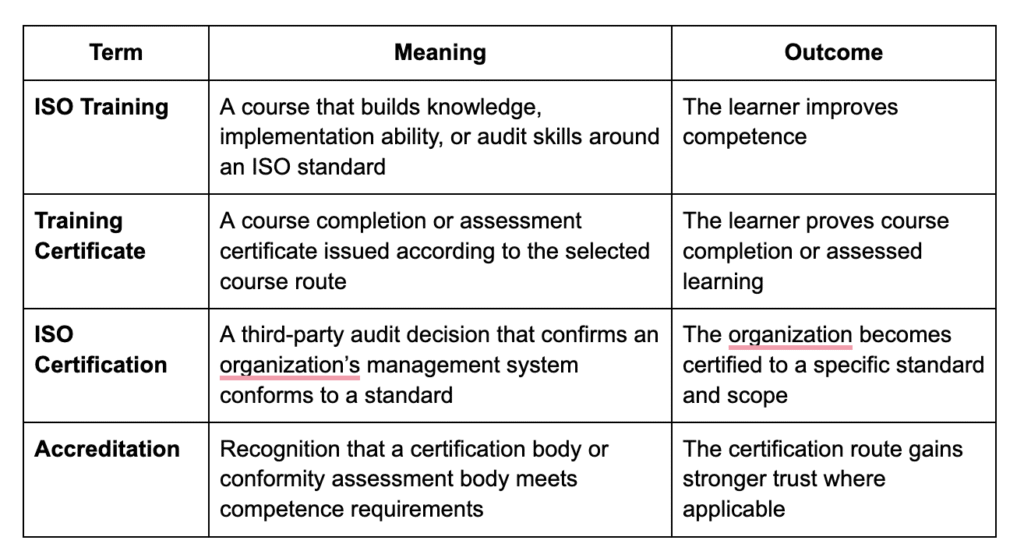
Learn more about ISO accreditation & ISO certification.
Online, Classroom, Onsite, and Corporate ISO Training
AGS can support different training delivery needs depending on the course, team size, location, and training objective.
Online ISO Training
Live online training may be suitable for remote teams, multi-location staff, individual professionals, or faster scheduling. It can help companies train employees without waiting for every participant to be in one room.
Online training may be suitable for awareness, theory, documentation, and some audit or implementation topics. Suitability depends on the course type, assessment route, issuing body, buyer expectation, and learner goal.
Classroom ISO Training
Classroom training may be suitable when learners need direct interaction, exercises, discussion, and structured course delivery.
This format may work well for internal auditor, lead auditor, HSE, food safety, or implementation training.
Onsite ISO Training
Onsite training is useful when a company wants training delivered at its own facility.
This can help connect examples to real processes, documents, sites, risks, and audit concerns.
Corporate ISO Training
Corporate training is best when a company needs several employees trained under one program.
It may support certification readiness, internal audit preparation, tender readiness, staff competence, department training, and multi-site alignment.
Industrial Training
Industrial training is practical for site-based teams that work with real operational risks.
It may be useful for factories, contractors, oil and gas sites, construction teams, logistics providers, plants, food operators, laboratories, and healthcare-related operations.
ISO Training for Industries
AGS Iraq supports training needs across industries where standards, audits, documentation, safety, quality, food safety, information security, and supplier requirements matter.
Many industries require ISO certification. AGS provides ISO certification across industries. Oil and gas companies may need ISO 9001, ISO 14001, ISO 45001, ISO 29001, internal auditing, and HSE training. Construction companies may need quality, environmental, health and safety, site safety, and internal audit training. Food and agriculture businesses may need ISO 22000, HACCP, food safety controls, and internal audit training.
Healthcare and laboratory organizations may need quality and audit training linked to standards such as ISO 9001, ISO 13485, ISO 15189, or ISO/IEC 17025. IT and technology teams may need ISO/IEC 27001 training for information security, risk controls, ISMS awareness, and audit preparation.
Logistics, manufacturing, and industrial businesses may need ISO 9001, ISO 14001, ISO 45001, process control, documentation, and corrective action training. Security operations may need training around risk management, operational controls, and industry-specific requirements.
What Participants May Learn in ISO Training
The exact learning outcomes depend on the course, standard, level, and assessment route. A basic awareness course will not cover the same material as a lead auditor course.
Depending on the selected course, participants may learn how to:
- Understand the selected ISO standard.
- Read ISO requirements correctly.
- Identify process responsibilities.
- Understand documented information and records.
- Prepare audit checklists.
- Plan internal audits.
- Collect objective evidence.
- Interview staff during audits.
- Identify and report nonconformities.
- Support corrective actions.
- Understand management review and continual improvement.
- Prepare teams for certification, surveillance, or client audits.
For corporate teams, AGS can align training examples with the company’s industry, processes, risks, and audit pressure where practical.
Duration, Certificate, and Assessment
Course duration depends on the training level, delivery format, syllabus, assessment route, and issuing or recognition body.
Awareness or foundation training may be planned as a short course. Internal auditor training often takes longer because participants need to understand audit planning, evidence collection, findings, and corrective action follow-up. Lead auditor and lead implementer courses usually require a more detailed route because they cover advanced audit or implementation responsibilities.
Corporate and industrial training duration depends on scope, team size, selected standard, delivery format, and whether the company needs general awareness, internal audit preparation, implementation training, or assessment-based training.
Before enrolling, ask:
- What does the exact syllabus include?
- Who delivers the training?
- Is there an exam or assessment?
- What certificate will be issued?
- Who issues the certificate?
- Is the certificate verifiable?
- Is the course suitable for the learner’s role?
- Is the course recognized for the purpose the learner needs?
This prevents confusion between attendance certificates, completion certificates, assessment-based training certificates, and organization-level ISO certification.
Certificate, Recognition, and Provider Verification
A serious ISO training decision should include provider verification.
Before enrolling, confirm whether the course level is clearly stated, the ISO standard is clearly named, the syllabus is available, trainer credentials are available, the certificate type is clear, and the assessment route is explained.
If external recognition is important, confirm whether it applies to the exact course route being offered. Do not assume that every course has the same issuing body, recognition status, examination requirement, or verification process.
Be careful with providers that promise instant ISO certification through training alone. ISO training can support competence and audit readiness. It does not certify a company’s management system by itself.