ISO 13485 Certification for Medical Device Organizations


    ISO Certification

    ISO 14001 CERTIFICATION
    ISO 18001 CERTIFICATION
    ISO 45001 CERTIFICATION
    ISO 27001 CERTIFICATION
    ISO 22000 CERTIFICATION
    ISO 50001 CERTIFICATION
    ISO 29001 CERTIFICATION
    ISO 18788 CERTIFICATION
    ISO 37001 CERTIFICATION
    ISO 22301 CERTIFICATION
    ISO 13485 CERTIFICATION
    ISO 10002 CERTIFICATION
    ISO 21500 CERTIFICATION
    ISO 17025 CERTIFICATION
    ISO 15189 CERTIFICATION

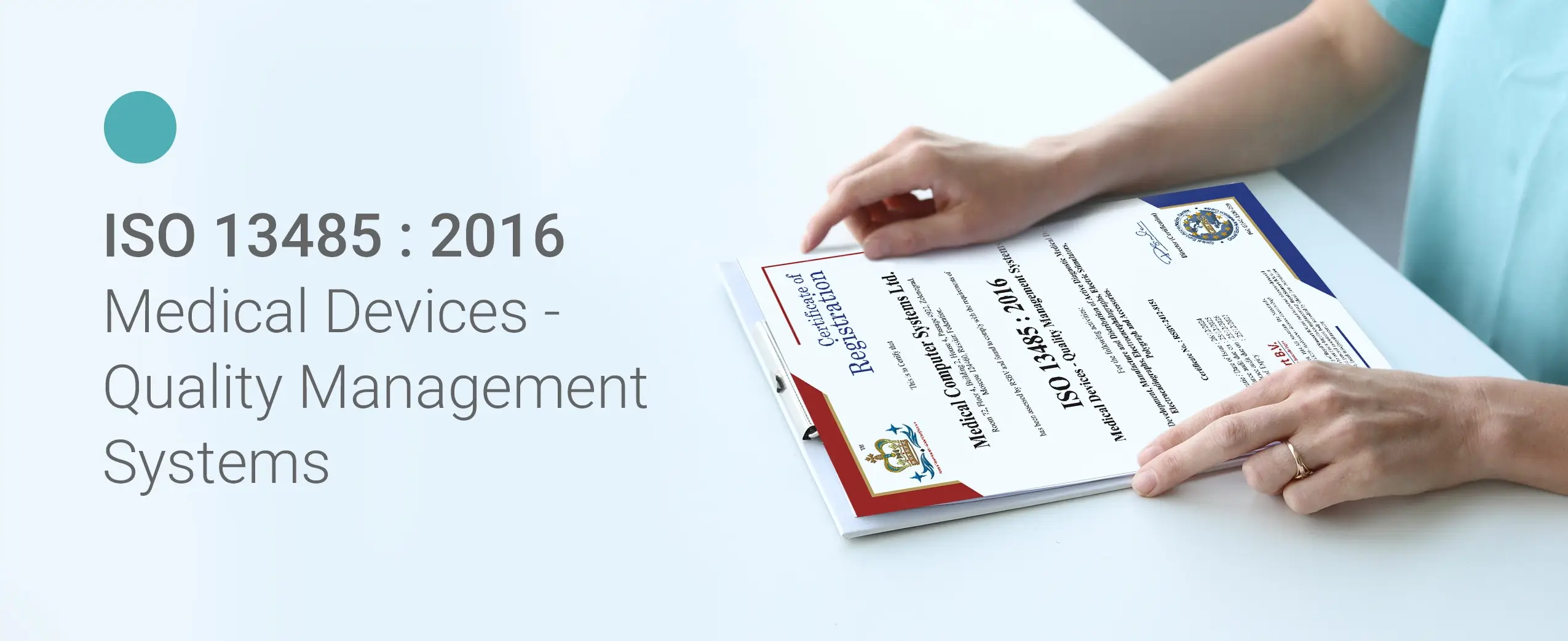
    ISO 13485 certification is a third-party confirmation that a medical device quality management system has been audited against ISO 13485:2016. ISO 13485 is not a general quality standard. It is the medical-device QMS standard written for regulatory purposes, with a stronger emphasis on risk management, lifecycle controls, traceability, and supplier control than a generic quality system page usually explains. This page is for organizations deciding whether ISO 13485 certification fits their business, what the audit path looks like, and how to choose a credible certification route.


    ISO 13485 certification belongs to organizations, not to individual trainees. ISOpublishes the standard. External certification bodies perform certification. The FDA does not issue ISO 13485 certificates, does not require them, and does not treat them as a substitute for FDA inspection. That distinction matters because buyers routinely mix up standard purchase, training, certification, and regulatory inspection.

    What is ISO 13485?

    ISO 13485 is the international quality management system standard for organizations involved in one or more stages of the medical device life cycle. ISO says it is intended for organizations involved in design, production, installation, servicing, and related services for medical devices. IMDRF uses the same life-cycle framing and makes clear that the standard applies across one or more stages of the medical device life cycle, not only to large finished-device manufacturers.


    The unique part is this: ISO 13485 is written for regulatory purposes. That is what makes it different from generic quality content. ISO’s own title says so. ISO’s guidance on the 2016 revision also says the standard puts greater emphasis on risk management and risk-based decision-making outside product realization.


    ISO 13485 Standard Vs ISO 13485 Certification


    ISO says management system certification is not required by the standard itself, and ISO says it does not perform certification. The FDA says a certificate of conformance to ISO 13485 does not exempt a manufacturer from FDA inspection.


    What Certification Proves And What It Does Not


    ISO 13485 certification proves that a certification body audited the organization’s quality management system against ISO 13485 requirements. ISO 13485 certification does not prove that every product is safe in every case, and it does not create automatic regulatory approval. FDA says plainly that an ISO 13485 certificate does not replace FDA inspection and that FDA does not issue those certificates.


    Why is ISO 13485 important?


    ISO13485 is important because it gives medical device organizations a structured QMS that supports quality, regulatory expectations, supplier control, and market confidence. ISO frames the standard around the ability to meet customer and applicable regulatory requirements. ISO’s 2016 overview also highlights a stronger risk-management focus and alignment with changing regulatory expectations.


    For medical device organizations, the value is practical. A better QMS helps control design, production, servicing, supplier oversight, and post-market processes. A better QMS also helps a company present a clearer case to customers, notified bodies, auditors, and procurement teams that its processes are controlled and repeatable. TÜV SÜD and NSF both push those same outcomes in their certification pages, which is why they rank well for commercial investigation intent.


    Business Value For Medical Device Organizations


    The business value is stronger control and lower friction. Manufacturers, contract manufacturers, sterilization providers, distributors, and service providers usually pursue ISO 13485 certification to reduce quality-system gaps, improve audit readiness, support supplier approval, and strengthen customer confidence in regulated markets. ISO and IMDRF both support the broad lifecycle applicability behind that business case.


    Regulatory Relevance Without Overclaiming Compliance

    ISO 13485 is highly relevant to regulation, but it is not the same thing as regulatory approval. FDA’s QMSR became effective on February 2, 2026, and incorporates ISO 13485:2016 by reference. That makes ISO 13485 highly relevant to U.S. device quality systems. The FDA also says it will not require ISO 13485 certificates and will not treat certification as a replacement for inspection.


    ISO 13485 also matters outside the U.S. because it is widely used in medical device market-access and supplier-quality expectations. MDSAP is one obvious bridge. FDA’s MDSAP materials describe third-party audits and a multi-year audit cycle used across participating jurisdictions. That makes ISO 13485 commercially useful in regulatory conversations, even though certification alone is not universal legal clearance.


    Who Needs ISO 13485?

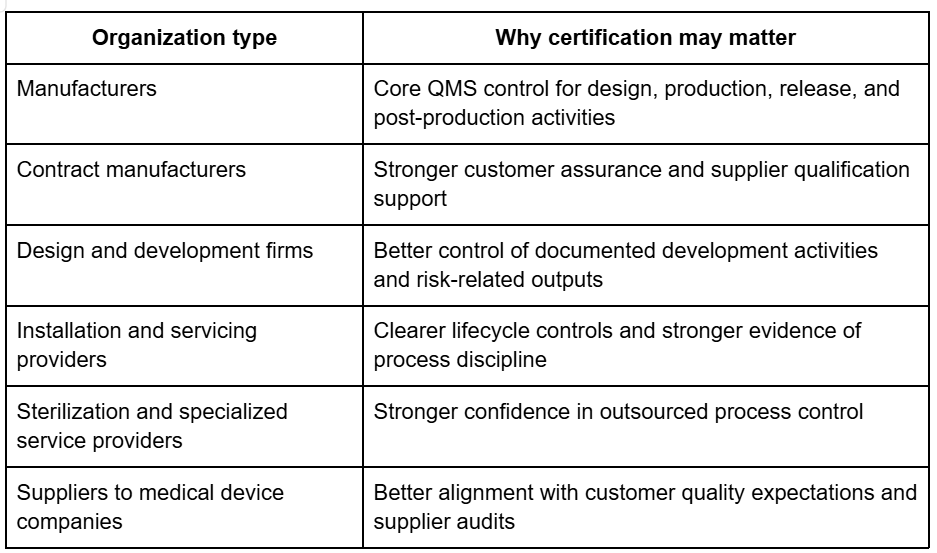
    Organizations that work in one or more stages of the medical device life cycle are the main fit for ISO 13485. ISO says that includes design, production, installation, servicing, and related services. IMDRF extends that same logic across one or more stages of the medical device life cycle.


    The root fit question is not size first. It is role first. If the organization affects product quality, regulatory evidence, traceability, servicing, or supplier control in the medical device chain, ISO13485 becomes relevant fast.


    What Types Of Companies Use ISO 13485?


    ISO’s scope language supports this breadth, and ANAB’s accreditation language confirms that certification bodies audit organizations using ISO 13485 in that medical device QMS context.


    Can Suppliers To Medical Device Manufacturers Get ISO 13485 Certified?


    Yes. ISO says ISO 13485 can benefit suppliers and external parties that provide product or quality-management-system-related services to medical device organizations. That means component suppliers, contract service providers, sterilization vendors, calibration providers, and other support organizations can pursue certification when customer requirements or supplier-approval expectations make it commercially valuable.


    Doing the right thing, at the right time.

    300+

    Satisfied Clients

    10+

    Years of Experience

    1700+

    ISO certifications

    What Are The Requirements Of ISO 13485?

    ISO 13485 requires a documented quality management system for medical device organizations, with a stronger emphasis on risk, lifecycle control, traceability, supplier oversight, internal audit, and management review. ISO’s standard description and supporting guidance make that much clearer even without turning the page into a clause-by-clause explainer.


    The unique attributes come first here. ISO 13485 is not just “quality documentation.” The standard is tied to regulatory-purpose quality management, medical device lifecycle activities, and risk-based control. Those are the features that separate it from generic quality content.


    High-Level Requirements Organizations Should Expect


    Organizations should expect five main requirement groups.

    • Documented QMS controls, including procedures, records, and evidence of implementation
    • Risk and lifecycle controls, including design, production, servicing, and post-market activities where relevant
    • Supplier and outsourced-process controls, especially where outside parties affect product quality
    • Traceability and records, where regulatory or product requirements demand them
    • Internal audit and management review, because certification bodies expect evidence that the system is operating and has been reviewed


    ISO’s official materials and ANAB’s ISO 13485 accreditation page both support this medical-device-specific QMS framing.


    Does ISO 13485 Require Written Procedures?


    Yes, ISO 13485 requires documented procedures and records where the standard calls for them. The medical device QMS is not a verbal system. It has to be documented, implemented, and maintained. ISO’s official description is built around a quality management system that demonstrates the ability to meet customer and regulatory requirements in a controlled way.

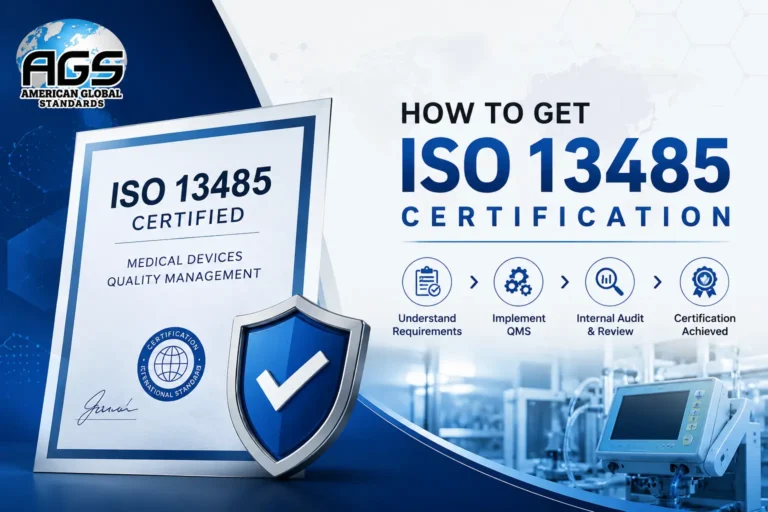
    How Do You Get ISO 13485 Certification?

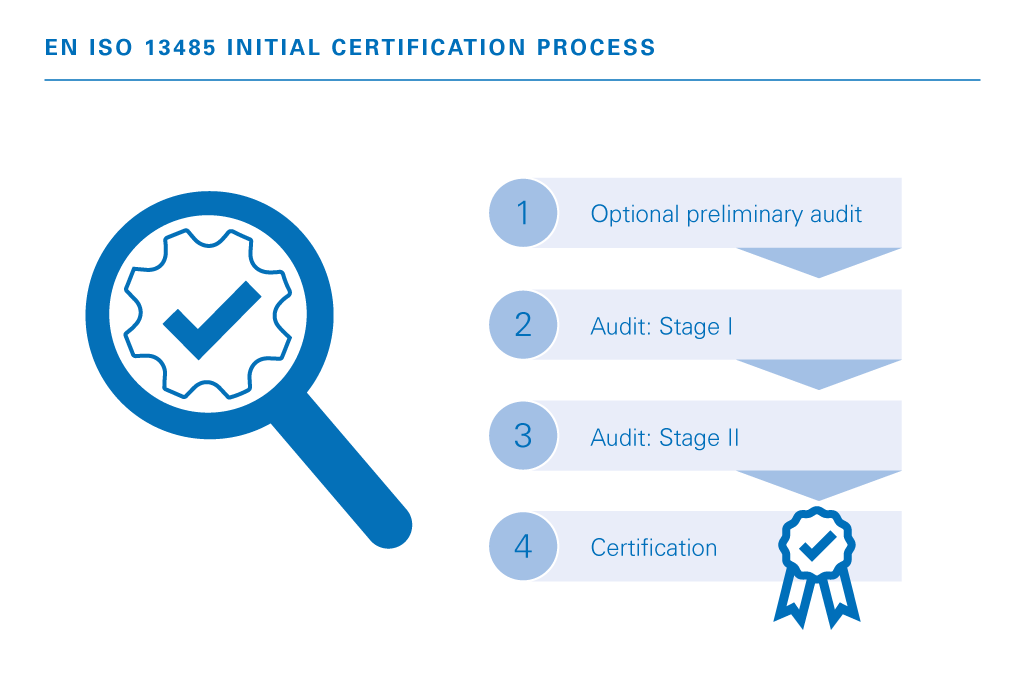
    Organizations typically get ISO 13485 certification by building or improving the QMS, checking readiness internally, selecting a certification body, and completing the certification audit. That is the real path. Not “buy a certificate.” Not “download the standard, and you are done.” ISO says certification comes through an external certification body, and management system certification only happens against a document that contains requirements.


    The Certification Path From Gap Assessment To Certificate


    The path is usually eight steps.

    1. Define the scope of the QMS and the lifecycle activities covered
    2. Assess gaps against ISO13485 requirements
    3. Implement or fix controls in procedures, records, supplier oversight, risk links, and lifecycle processes.
    4. Run internal audits and management review
    5. Select a certification body and confirm the scope and accreditation
    6. Complete Stage 1 audit for readiness and documentation review
    7. Complete Stage 2 audit for implementation and effectiveness
    8. Close findings and receive the certification decision


    Smithers lays out a similar six-step journey, including requirements review, gap analysis, implementation, internal audits, and choosing a certification body. Official certification and audit-cycle sources then fill in the surveillance and recertification logic.


    How Do You Prepare For An ISO 13485 Audit?


    Prepare by making the QMS real before the audit starts. That means defined scope, current procedures, completed internal audits, management review, corrective-action follow-up, supplier controls, and records that show the system is operating. Smithers’ public guidance pushes the same sequence: understand the requirements, develop the QMS, conduct the gap analysis, implement changes, and complete internal audits before applying for certification.


    Timeline, Surveillance, And Recertification


    There is no honest universal timeline for every organization. Timing depends on QMS maturity, site count, lifecycle scope, existing documentation, and how much remediation the audit uncovers. Public vendor pages sometimes suggest that preparation can take months, but there is no single official global timeline that fits every case. Information not found for a universal duration.


    The certificate lifecycle is easier to state than the project timeline. FDA’s MDSAP materials describe annual third-party audits on a multi-year cycle, and official MDSAP audit guidance states that the program is based on a three-year audit cycle. That supports the standard commercial expectation of ongoing surveillance and recertification rather than one-and-done certification.

    Basra Municipality Requirements for ISO Certification

    Is ISO 13485 Certification Mandatory?

    ISO 13485 certification is not required by the standard itself, but it may be commercially or jurisdictionally expected. ISO says management system certification is not a requirement of the standard. That is the clean answer. The messy part is the market: customers, procurement teams, notified bodies, and some regulatory pathways may still treat certification as an expected signal of QMS maturity.


    FDA QMSR, MDSAP, And Market Expectations

    The FDA does not require ISO 13485 certificates. FDA says it does not require certificates of conformance to ISO 13485, does not issue them, and does not treat them as a substitute for inspection. But FDA’s QMSR now incorporates ISO 13485:2016 by reference, which makes the standard highly relevant for U.S. medical device manufacturers. That is the nuance most weak pages miss.


    MDSAP is related, not identical. MDSAP uses an audit model tied to medical device regulatory requirements across participating jurisdictions. It is relevant for organizations that want broader regulatory-audit leverage, but it is not just “ISO13485 with a different label.” FDA’s MDSAP materials and audit documents make that distinction clear.

    Who Issues ISO 13485 Certification?

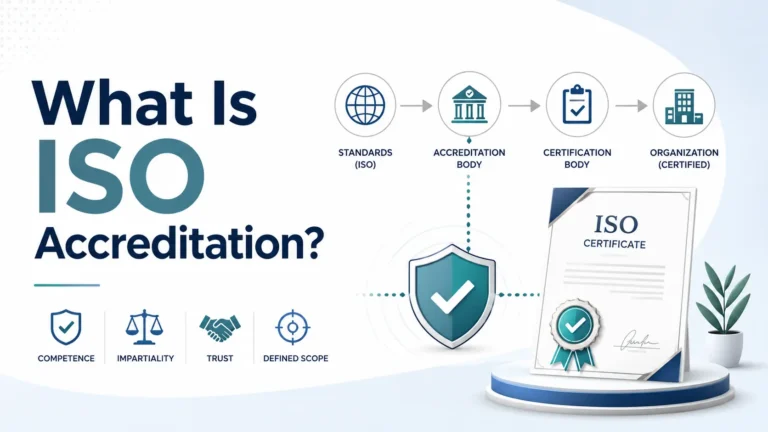
    ISO 13485 certification is issued by external certification bodies, not by ISO. ISO says so directly. That means buyer trust depends on the certification body’s competence, scope, and accreditation, not on vague brand claims.


    Accredited Vs Non-Accredited Certification Bodies


    Accredited certification bodies carry a stronger trust signal because accreditation provides independent confirmation of competence. ISO says buyers should check whether the certification body is accredited. IAF explains accreditation as the independent evaluation of certification bodies for impartiality, competence, and consistency. ANAB’s ISO 13485 program page makes that specific to medical device QMS certification bodies and points to ISO/IEC 17021-1 and IAF medical-device documents.


    What To Compare Before Requesting A Quote


    Compare five things before you contact a certification body.

    • Accreditation status and whether ISO13485 is in scope
    • Medical device sector experience, including lifecycle activities relevant to your business
    • Audit capability, including multi-site and supplier-heavy scopes where relevant
    • Regulatory awareness, especially around FDA QMSR, MDSAP, MDR, or supplier expectations
    • Support around readiness and transfer, if you already have a QMS or an existing certificate


    ISO says to evaluate several bodies, check accreditation, and use certificate-verification resources such as CertSearch. ANAB also provides accredited management systems information and directories that support this buyer-side check.


    Industries Sector

    Oil & Gas
    Construction & Infrastructure
    Manufacturing & Industrial Production
    Food, Agriculture & Processing
    Security & Private Protection Services
    Government & Public Sector
    IT & Digital Services
    Healthcare & Medical Services
    Laboratories & Testing Facilities
    Logistics & Transportation
    Energy & Utilities
    Banking, Financial Services & Insurance
    Educational institutions
    Healthcare Organizations

    Trainings

     
    Quality
     
    Environment
     
    Health & Safety
     
    Food Safety
     
    Business Continuity

    Other ISO Certifications We Provide in Iraq

    As an accredited body, we issue certificates for the most sought-after management system standards:

    Blogs & News

    ISO Certification

    ISO certification

    How Many Types of ISO Certification Are There?

    How Many Types of ISO Certification Are There? ISO certification applies to 4 categories of…
    READ MORE →
    ISO certification

    What Is ISO Certification? Definition, Process, and How to Verify It

    What Is ISO Certification? Definition, Process, and How to Verify It ISO certification is a…
    READ MORE →
    Basra Municipality Requirements for ISO Certification

    Government Procurement & Tender Requirements in Basra

    Government Procurement & Tender Requirements in Basra ISO Certification, Compliance Expectations & Practical Guidance Government…
    READ MORE →
    Basra Municipality Requirements for ISO Certification

    Basra Municipality Requirements for ISO Certification: What Businesses Must Comply With

    Basra Municipality Requirements for ISO Certification: What Businesses Must Comply With Basra Municipality does not…
    READ MORE →
    ISO for Food Businesses in Basra

    ISO for Food Businesses in Basra

    ISO for Food Businesses in Basra: A Complete Guide to Food Safety, Compliance & ISO…
    READ MORE →
    ISO for Manufacturing in Basra

    ISO for Manufacturing in Basra

    ISO for Manufacturing in Basra: How International Standards Strengthen Industrial Performance? Basra’s manufacturing sector is…
    READ MORE →
    ISO for Construction Companies in Basra

    ISO for Construction Companies in Basra

    ISO for Construction Companies in Basra: A Complete Guide for 2026 This is the practical…
    READ MORE →
    ISO for Security Companies in Basra

    ISO for Security Companies in Basra

    ISO for Security & PSC Companies in Basra (2026 Guide) This is the practical guide…
    READ MORE →
    ISO Certification for Oil & Gas Companies in Basra

    ISO Certification for Oil & Gas Companies in Basra

    ISO Certification for Oil & Gas Companies in Basra This is the practical guide for…
    READ MORE →
    Logo
    Logo
    Logo
    Logo
    Logo
    Logo
    Logo
    Logo
    Logo
    Logo
    Logo
    Logo
    Logo
    Logo

    Frequently Asked Questions Related ISO 13485 Certification

    What is the difference between accredited and non-accredited ISO 9001 certification?

    Accredited ISO 9001 certification is issued by a certification body formally evaluated by a recognized accreditation body (like IAS or UAF), while non-accredited certification carries no independent verification of the certifier's competence. Non-accredited certificates are often not accepted for government tenders, international contracts, or by multinational companies, and cannot be verified through IAF CertSearch.

    How do I verify if an ISO 9001 certificate from Iraq is genuine?

    You can verify an ISO 9001 certificate's authenticity through the IAF CertSearch global database by entering the certificate number or organization name. AGS also provides a dedicated certificate verification tool for quick status checks. Certificates from accredited bodies are registered in IAF CertSearch, where you can check current status, scope, and accreditation details.

    Can a USA-headquartered certification body certify my company in Iraq?

    Yes. AGS is headquartered in the USA with a regional office in Basra, Iraq, and provides on-site audits across Baghdad, Erbil, and other Iraqi cities by locally based auditors. International certification bodies routinely operate across borders through local offices or qualified representatives. AGS's structure ensures both global standards and local presence.

    What are surveillance audits and why are they required?

    Surveillance audits are annual assessments performed in years 1 and 2 of your 3-year certification cycle to verify that your quality management system continues to conform to ISO 9001 requirements. These audits ensure your QMS remains effective and continuously improves, rather than being a one-time effort. They are mandatory to maintain certification.

    Is ISO 9001 certification required for Iraqi government tenders?

    Yes, ISO 9001 certification is increasingly listed as a mandatory requirement or a significant evaluation criterion in Iraqi government tenders, particularly for construction, services, and supply contracts. This is common in tenders issued by the Oil Ministry, Ministry of Construction and Housing, and Ministry of Electricity. Accredited certification carries more weight in tender evaluations than non-accredited alternatives.

    Do you offer Arabic-language documentation support?

    Yes. Auditors review in Arabic or English, conduct interviews in Arabic, and deliver bilingual reports.

    It depends on QMS maturity, scope, site count, and readiness. A company with a functioning medical device QMS moves faster than a company building the system from scratch. Public sources support the staged process, but Information not found for a universal timeline that honestly applies to every organization.

    ISO13485 is the medical device QMS standard for regulatory purposes. ISO9001 is the broader generic quality management standard. ISO’s own 2016 material says ISO13485 remains compatible with ISO9001, but adds stronger medical-device and risk-based requirements.

    EN ISO 13485 is the European adoption of ISO 13485. The underlying standard basis remains ISO 13485, but the regional designation matters in European regulatory contexts. That is a jurisdiction bridge, not a different core QMS concept. Information not found in the official sources reviewed for a broader distinction beyond the regional adoption context.

    ISO 13485 and MDSAP are related, but they are not the same thing. ISO13485 is the QMS standard. MDSAP is an audit program used by participating regulators. MDSAP audits are built on a defined multi-year cycle and connect quality-system auditing to multiple regulatory frameworks.

    Yes, if the startup or small company operates in one or more stages of the medical device life cycle. Size is not the deciding factor. Roles are ISO and IMDRF, both of which define applicability around lifecycle involvement, not enterprise size.

    The common mistakes are predictable. Organizations confuse the standard with certification, treat certification like FDA approval, underestimate supplier controls, delay internal audits, and go into Stage 1 with weak documentation or unclear scope. Those mistakes show up because the page intent is often handled too casually by vendors and buyers alike.

    Yes, in practical terms. A certification body audits an operating QMS, not a plan to build one later. The organization needs documented processes, records, internal checks, and management review evidence before the certification path becomes credible. Smithers’ public process guidance supports that reality.

    Ready to evaluate ISO 13485 certification?

    ISO 13485 certification is worth evaluating when your organization needs stronger quality-system credibility, cleaner audit readiness, or more confidence in regulated markets. The right next step is not guesswork. It is a scope review, a readiness check, and a clear decision on whether the certification path fits your role in the medical device lifecycle.


      ISO Certification

      ISO 9001 CERTIFICATION
      ISO 14001 CERTIFICATION
      OHSAS 18001 CERTIFICATION
      ISO 45001 CERTIFICATION
      ISO 27001 CERTIFICATION
      ISO 22000 CERTIFICATION
      ISO 50001 CERTIFICATION
      ISO 29001 CERTIFICATION
      ISO 18788 CERTIFICATION
      ISO 37001 CERTIFICATION
      ISO 22301 CERTIFICATION
      ISO 13485 CERTIFICATION
      ISO 10002 CERTIFICATION
      ISO 21500 CERTIFICATION
      ISO 17025 CERTIFICATION
      ISO 15189 CERTIFICATION
       

      Industries Sector

      Oil & Gas
      Construction & Infrastructure
      Manufacturing & Industrial Production
      Food, Agriculture & Processing
      Security & Private Protection Services
      Government & Public Sector
      IT & Digital Services
      Healthcare & Medical Services
      Laboratories & Testing Facilities
      Logistics & Transportation
      Energy & Utilities
      Banking, Financial Services & Insurance
      Educational institutions
      Healthcare Organizations

      Trainings

      Quality
      Environment
      Health & Safety
      Food Safety
      Business Continuity
      Translate »