
What Is an ISO Audit? Types, Stages, and How to Prepare
An ISO audit is a structured evaluation of how well an organization’s management system conforms to defined audit criteria. It checks whether processes are documented, implemented in practice, and supported by objective evidence.
That matters because a management system is only useful if it works outside the document folder. A company may have policies, procedures, registers, and forms, but an audit tests whether those controls are actually being followed, whether people understand their roles, and whether the system produces consistent results.
ISO audits are used worldwide before certification, supplier approval, contractor prequalification, tender submission, client onboarding, and ongoing compliance review. For organizations operating in Iraq, the USA, UAE, and the wider Middle East, audit readiness can also support buyer confidence, contractor approval, and certification progress.
ISO Audit Meaning in Simple Terms
The audit criteria may come from an ISO management system standard, internal procedures, legal or contractual requirements, certification rules, or customer requirements. The auditor reviews records, interviews people, observes work where relevant, and checks whether the management system conforms to those criteria.
The goal is not to “catch people out.” The goal is to verify conformity, test effectiveness, and identify where the system is strong, weak, inconsistent, or missing evidence.
That is why the same basic audit logic can apply across different ISO standards. The structure may change, but the core question stays the same: does the organization’s management system do what it says it does?
ISO 19011:2026 provides guidance for auditing management systems, including audit principles, audit programme management, conducting audits, and auditor competence. It is a guidance standard, not a certification standard. Organizations are not certified to ISO 19011 itself; they use it to support audit planning and audit practice.
Why Are ISO Audits Important?
ISO audits matter because they turn assumptions into evidence. Without audits, it is easy to believe a system is working just because the documentation exists. An audit tests whether the system is actually functioning in real operations.
They also matter because different audit types serve different business needs. Internal audits help organizations find weaknesses early. Customer or supplier audits support external trust. Third-party certification audits decide whether a company is ready for certification or continued certified status.
For leadership teams, audits are one of the clearest ways to see whether quality, environmental, information security, safety, or other management controls are operating consistently or just looking good on paper.
What Are the Types of ISO Audits?
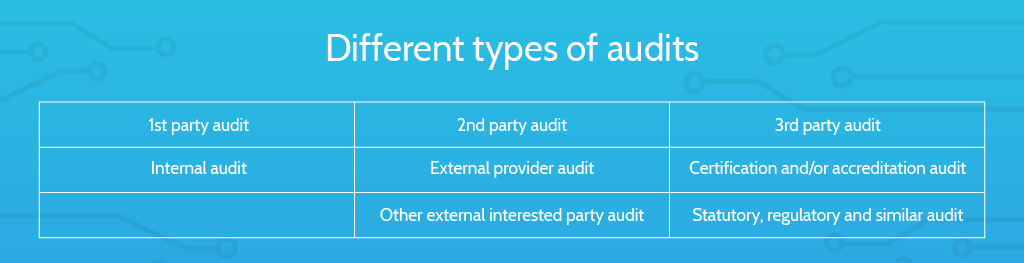
There are three main types of ISO audits: first-party, second-party, and third-party audits. These are audit relationships, not ISO standards.
|
Audit type |
Also called |
Who performs it |
Main purpose |
|
First-party audit |
Internal audit |
The organization itself or someone acting on its behalf |
To check the organization’s own system before external review |
|
Second-party audit |
Supplier or customer audit |
A customer, buyer, parent company, contractor, or interested party |
To evaluate a supplier, contractor, site, or service provider |
|
Third-party audit |
Certification or surveillance audit |
An independent certification body |
To assess whether the management system meets certification requirements |
This distinction matters. ISO 9001, ISO 14001, ISO 45001, ISO/IEC 27001, and ISO 22000 are management system standards. First-party, second-party, and third-party audits describe the audit relationship.
Who Performs an ISO Audit?
Internal audits are performed by the organization or by someone acting on its behalf. The key point is independence from the activity being audited.
Second-party audits are usually performed by customers, clients, or other external stakeholders with a direct interest in the supplier’s performance.
Third-party audits are performed by independent certification bodies. ISO itself does not certify organizations.
ISO Audit vs ISO Certification vs Accreditation
People often use these terms together, but they do not mean the same thing.
|
Term |
Meaning |
Example |
|
ISO audit |
Evaluation of evidence against audit criteria |
Reviewing whether a quality management system follows ISO 9001 requirements |
|
ISO certification |
Written assurance that a system, product, or service meets defined requirements |
A certification body certifies an organization’s ISO 9001 management system |
|
Accreditation |
Recognition that a certification body is competent to perform certification activities |
An accreditation body assesses a certification body’s competence |
|
Inspection |
Examination of a product, site, activity, or condition against specific requirements |
Inspecting equipment, site conditions, materials, or operational controls |
ISO publishes international standards. ISO itself does not certify organizations. Certification is performed by independent certification bodies, and accreditation is handled by accreditation bodies.
When certification is issued through an accredited certification process, the certificate should usually show the certification body, accreditation body, certification scope, standard, certificate number, issue date, expiry date, and certified organization. Where applicable, certificate status may also be checked through IAF CertSearch or through the certification body’s own verification system.
What Happens During an ISO Audit?
Most ISO audits follow the same general flow. The auditor reviews the scope and criteria, checks documented information, interviews people, observes activities, samples records, tests consistency, and then records findings.
A good audit feels less like an interrogation and more like a structured fact-finding exercise. The auditor is trying to answer practical questions:
- Is the process defined?
- Is it being followed?
- Is there evidence it works?
- Are problems identified and corrected properly?
The exact pace depends on the audit type, scope, number of sites, process complexity, and the maturity of the system.
What Auditors Actually Look For
Auditors look for objective evidence, not polished explanations.
That usually includes:
- policies and procedures
- records and logs
- interviews with staff and process owners
- direct observations of work
- performance data and metrics
- internal audit results
- management review outputs
- corrective-action records
- evidence that previous findings were actually closed
Here’s what that looks like in real life. If a company says it trains people before assigning work, the auditor will not stop at the training procedure. They will want to see training records, speak to people doing the work, and check whether competence is being maintained in practice.
Want a Faster Audit With Fewer Surprises?
Start by reviewing your evidence the way an auditor would: policy, process, record, interview, observation, and result. AGS can help review audit readiness before the formal audit starts.
What Are Stage 1 and Stage 2 ISO Audits?
Stage 1 and Stage 2 are the two main parts of an initial third-party certification audit. They are connected, but they serve different purposes.
|
Audit stage |
Main purpose |
What it focuses on |
|
Stage 1 audit |
Readiness and scope review |
Documentation, scope, site conditions, system maturity, internal audit status, management review, and planning for Stage 2 |
|
Stage 2 audit |
Implementation and conformity assessment |
Actual execution, evidence, effectiveness, conformity, interviews, records, and operational practice |
Stage 1 asks whether the organization is ready for the main certification audit. Stage 2 asks whether the system actually works and conforms in real operations.
Stage 1: Readiness and Scope Review
Stage 1 is about readiness. The auditor reviews management system documentation, confirms the scope, checks site conditions, and decides whether the organization is prepared for the deeper Stage 2 audit.
This is where obvious problems surface early. Missing scope definition, major documentation gaps, weak internal-audit history, incomplete management review, unclear processes, or poor record control can all delay progress to Stage 2.
A weak Stage 1 does not always mean the certification process is finished. It usually means the organization has work to complete before the main certification audit can move forward cleanly.
Stage 2: Implementation and Conformity Assessment
Stage 2 is the real test. The auditor evaluates whether the management system is implemented, followed, and effective in practice.
That means more interviews, more records, more observation, and more testing of whether the documented process matches operational reality. Certification decisions are usually based on the Stage 2 audit and the certification body’s independent review process.
If Stage 1 asks, “Are you ready?” Stage 2 asks, “Can you prove it?”
ISO Audit Cycle: From Internal Audit to Recertification
An ISO audit is not always a one-time event. In a certification context, audits usually sit inside a wider certification cycle.
|
Audit stage |
When it happens |
Main purpose |
What to prepare |
|
Internal audit |
Before certification and during ongoing maintenance |
Find gaps before external review |
Internal audit plan, checklist, report, findings, and corrective actions |
|
Stage 1 audit |
Before initial certification |
Confirm readiness, scope, and documentation |
Scope, policies, procedures, internal audit results, management review records |
|
Stage 2 audit |
Initial certification audit |
Assess implementation and conformity |
Operational records, interviews, evidence, process controls, corrective actions |
|
Surveillance audit |
After certification, usually during the certification cycle |
Confirm the system continues to conform |
Updated records, objectives, monitoring results, previous findings, improvement actions |
|
Recertification audit |
At the end of the certification cycle |
Renew certified status |
Full system evidence, audit history, management review, performance results, corrective actions |
This is why audit readiness should not be treated as a last-minute activity. A management system needs ongoing records, active review, and controlled corrective action throughout the certification cycle.
How Do I Prepare for an ISO Audit?
The best audit preparation is practical, not theatrical. You are not trying to memorize perfect answers. You are trying to make sure the system is real, current, and supported by evidence.
A solid preparation sequence looks like this:
- Confirm the audit scope
Make sure sites, departments, functions, and processes in scope are clear. - Review the audit criteria.
Know which standard, internal requirements, and supporting procedures apply. - Check your documented information.
Make sure key documents are current, approved, controlled, and available. - Verify implementation
Confirm that people are actually following the process, not just referencing the document. - Review past findings and corrective action.
Open issues, weak closures, and repeated problems often create avoidable pain. - Complete internal audits and management review first.
These are often the clearest signs that the system is alive. - Prepare people, not a script.
Staff should understand their role, their process, and the evidence behind their work.
What Is an ISO Audit Checklist?
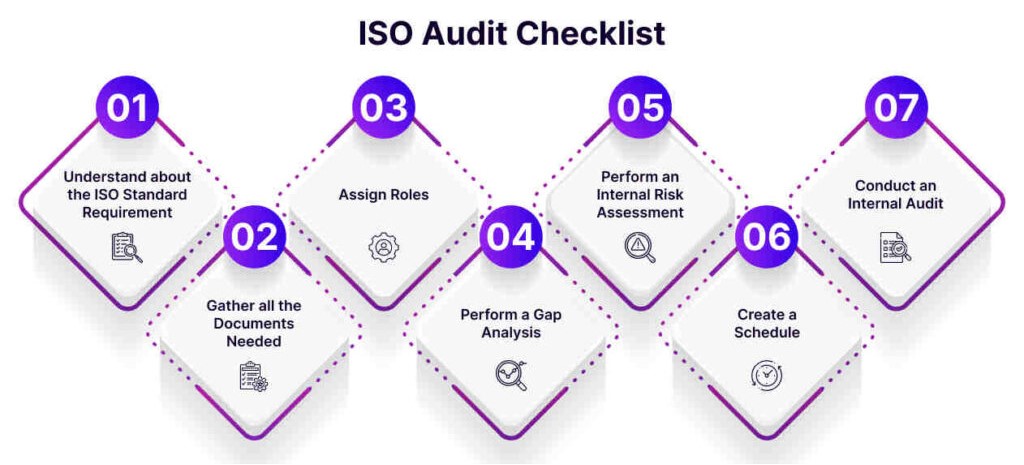
An ISO audit checklist is a support tool, not the audit itself. It helps organize criteria, evidence, process coverage, and sampling so the audit stays focused.
A useful checklist does three things well:
- links requirements to real processes
- prompts the auditor to look for evidence, not assumptions
- keeps coverage balanced across the audit scope
Bad checklists create box-ticking. Good checklists create clarity.
Which Documents Are Required for an ISO Audit?
There is no single universal document pack that fits every ISO audit. The exact document set depends on the management system, the audit type, and the scope.
That said, auditors commonly expect categories like these:
- scope statements
- policies
- procedures or process descriptions
- records and logs
- internal audit results
- management review outputs
- corrective-action records
- performance measures
- evidence of competence and training where relevant
For an ISO 9001 audit, that might lean toward quality objectives, customer-related records, and nonconformity handling. For ISO 14001, it may lean more toward environmental aspects, controls, and compliance obligations. For ISO/IEC 27001, risk treatment, controls, and evidence of security governance become much more central.
Common ISO Audit Findings and Red Flags
Audit findings are not always dramatic. Many come from weak evidence, inconsistent implementation, or poor follow-up.
|
Finding or red flag |
Example |
Why it matters |
|
Missing evidence |
Training is required, but no training record exists |
The auditor cannot verify competence |
|
Outdated documented information |
Staff use an old procedure version |
Document control may be ineffective |
|
Inconsistent implementation |
Procedure says one method, staff follow another |
The system may not reflect real operations |
|
Weak corrective action |
Issue closed without root-cause analysis |
The same problem may repeat |
|
Poor record control |
Forms are incomplete, unsigned, or missing dates |
Evidence may not be reliable |
|
Scope mismatch |
Certification scope does not match actual work or tender needs |
The certificate may not satisfy buyer requirements |
|
Repeated findings |
Same issue appears in multiple audits |
Root causes may not be properly addressed |
|
No management review evidence |
Leadership review is missing or too generic |
The system may lack top management control |
|
Internal audit weakness |
Internal audit was rushed or not completed |
The organization may not be ready for external review |
|
Unsupported claims |
Staff describe controls that records do not confirm |
Verbal explanation is not enough without evidence |
A finding is not the end of the process. What matters is whether the organization identifies the cause, corrects the issue, prevents recurrence, and keeps evidence that the action was effective.
Can an ISO Audit Be Remote?
Some ISO audit activities may be performed remotely, depending on the audit objective, certification body rules, risk level, site activities, technology access, and the need for physical observation.
Document review, interviews, screen-sharing, record sampling, and some management system checks can often be handled remotely. However, site-dependent processes may still require on-site review, especially where the auditor needs to observe operations, equipment, production, safety controls, storage conditions, food handling, environmental controls, or physical security.
A practical approach is to decide the audit method based on risk and evidence needs:
|
Audit method |
Best suited for |
Limitation |
|
Remote audit |
Document review, interviews, digital records, management review, some support processes |
May not fully verify site conditions or physical controls |
|
On-site audit |
Operations, production, construction sites, warehouses, laboratories, food areas, safety controls |
Requires travel, scheduling, and site access |
|
Hybrid audit |
Mix of document review, remote interviews, and site observation |
Needs clear planning so no critical evidence is missed |
Remote auditing should not be used just for convenience. The audit method should still allow the auditor to collect reliable evidence and reach a valid conclusion.
What Happens After an ISO Audit?
The audit does not end when the closing meeting ends. What happens next depends on the audit type and the findings.
Typical outputs include:
- observations
- minor nonconformities
- major nonconformities
- opportunities for improvement
- a recommendation for certification, continuation, or follow-up action
If nonconformities are raised, the organization usually needs to respond with corrective action. That means identifying the issue, finding the cause, fixing it, and providing evidence that the correction is real.
In a certification cycle, the post-audit path can also include:
- certification decision
- surveillance audits
- recertification audits
That is why a good audit culture does not treat findings as embarrassing. It treats them as inputs for system control and improvement.
What Is Included in an ISO Audit Report?
An ISO audit report records the audit scope, audit criteria, audit method, people or areas audited, evidence reviewed, findings, nonconformities, opportunities for improvement, and audit conclusions.
The report should make clear what was checked, what evidence supported the findings, and what action is required after the audit. For certification audits, the audit report also supports the certification body’s review and decision process.
A useful audit report should not only list problems. It should help the organization understand where the management system conforms, where evidence is weak, and what needs to be corrected before the next audit step.
Prepare for an ISO Audit With AGS
An ISO audit is not just a compliance event. It is one of the clearest ways to see whether your management system is real, effective, and trusted under review.
For organizations in the USA, Iraq, UAE and the wider Middle East, audit readiness can affect certification progress, tender confidence, supplier approval, client review, and long-term system credibility. The stronger your evidence trail is before the audit, the easier it becomes to show control during the audit.
AGS supports organizations with ISO audit readiness, documentation review, implementation gap checks, corrective-action review, and preparation for internal, supplier, or certification audit.
Prepare for Your ISO Audit With AGS