ISO Certification for Hospitals


    ISO Certification

    ISO 14001 CERTIFICATION
    ISO 18001 CERTIFICATION
    ISO 45001 CERTIFICATION
    ISO 27001 CERTIFICATION
    ISO 22000 CERTIFICATION
    ISO 50001 CERTIFICATION
    ISO 29001 CERTIFICATION
    ISO 18788 CERTIFICATION
    ISO 37001 CERTIFICATION
    ISO 22301 CERTIFICATION
    ISO 13485 CERTIFICATION
    ISO 10002 CERTIFICATION
    ISO 21500 CERTIFICATION
    ISO 17025 CERTIFICATION
    ISO 15189 CERTIFICATION

    Hospitals carry risk every day: patient care, clinical workflows, infection control, staff safety, medication processes, medical records, suppliers, waste handling, laboratories, complaints, and emergency response. ISO Certification for Hospitals gives healthcare organizations a structured way to control those risks through documented systems, independent audits, corrective actions, and continual improvement.

    AGS supports hospitals through a clear, scope-bound ISO certification pathway: standard selection, gap assessment, documentation readiness, certification audits, ISO training, surveillance planning, and certificate verification support where applicable.

    What Is ISO Certification for Hospitals?

    ISO Certification for Hospitals is a third-party assurance that a hospital’s management system meets the requirements of a relevant ISO standard within a defined certification scope. Common standards include ISO 9001, ISO 7101, ISO/IEC 27001, ISO 45001, ISO 14001:2026, ISO 13485, and ISO 15189, depending on the hospital’s services, departments, risks, and tender requirements.

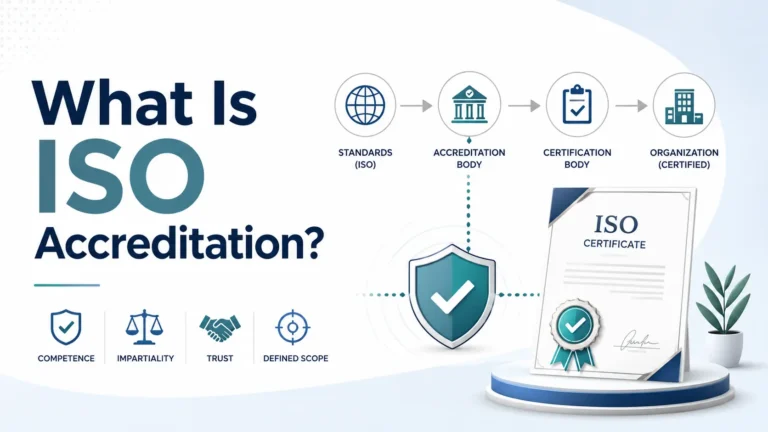
    A hospital is not certified “by ISO.” ISO publishes standards, but ISO does not perform certification or issue ISO certificates. Certification is performed by external certification bodies that audit the organization against a specific ISO standard and a defined scope.

    Critical certificate warning: ISO does not certify hospitals or issue ISO certificates. A credible hospital ISO certificate must show the certified organization, standard, scope, certification body, accreditation details, where applicable, and validity status.

    Why Do Hospitals Need ISO Certification?

    Hospitals need ISO certification because healthcare quality depends on controlled systems, not isolated good intentions. A hospital may have skilled staff and still struggle with inconsistent documentation, unclear responsibilities, weak supplier controls, poor corrective-action tracking, or audit gaps between departments.

    WHO reports that around 1 in 10 patients is harmed in health care, more than 3 million deaths occur annually due to unsafe care, and more than 50% of harm is preventable. ISO certification does not guarantee patient safety, but ISO-based management systems can help hospitals structure responsibilities, process controls, documentation, monitoring, corrective actions, and continual improvement around healthcare risk.

    For hospitals, the value is practical:
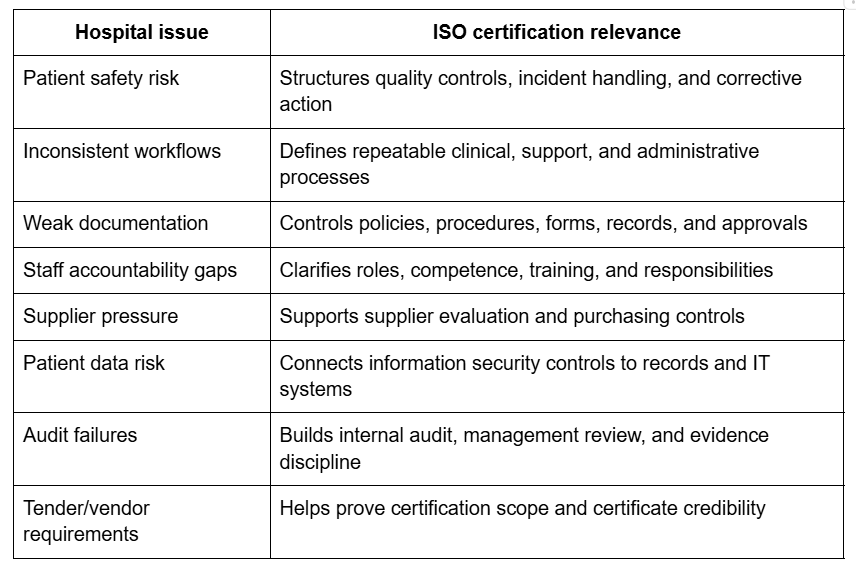
     

    The point is not to collect a certificate for decoration. The point is to build a hospital system that can stand up to internal review, external audit, patient-safety expectations, and stakeholder scrutiny.

    Doing the right thing, at the right time.

    300+

    Satisfied Clients

    10+

    Years of Experience

    1700+

    ISO certifications

    Which ISO Standards Are Relevant for Hospitals?

    Hospitals should choose ISO standards based on scope, risk, services, departments, and buyer requirements. Not every hospital needs every standard.
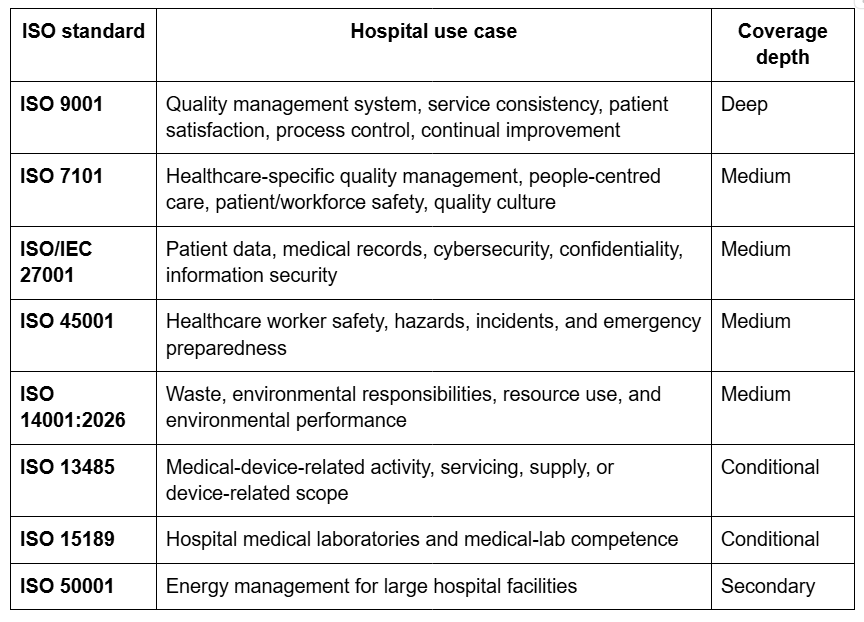
     

    ISO 14001:2026 is now the current ISO environmental management systems standard; ISO states that ISO 14001:2015 has been withdrawn and replaced by ISO 14001:2026. For hospitals, this matters where waste, resource use, environmental controls, and facility-level environmental responsibilities are in scope.


    Need help choosing the right standard? AGS can review your hospital scope and identify which ISO pathway fits your quality, safety, information security, environmental, laboratory, or tender requirements.
    How Does ISO 9001 Apply to Hospital Quality Management?

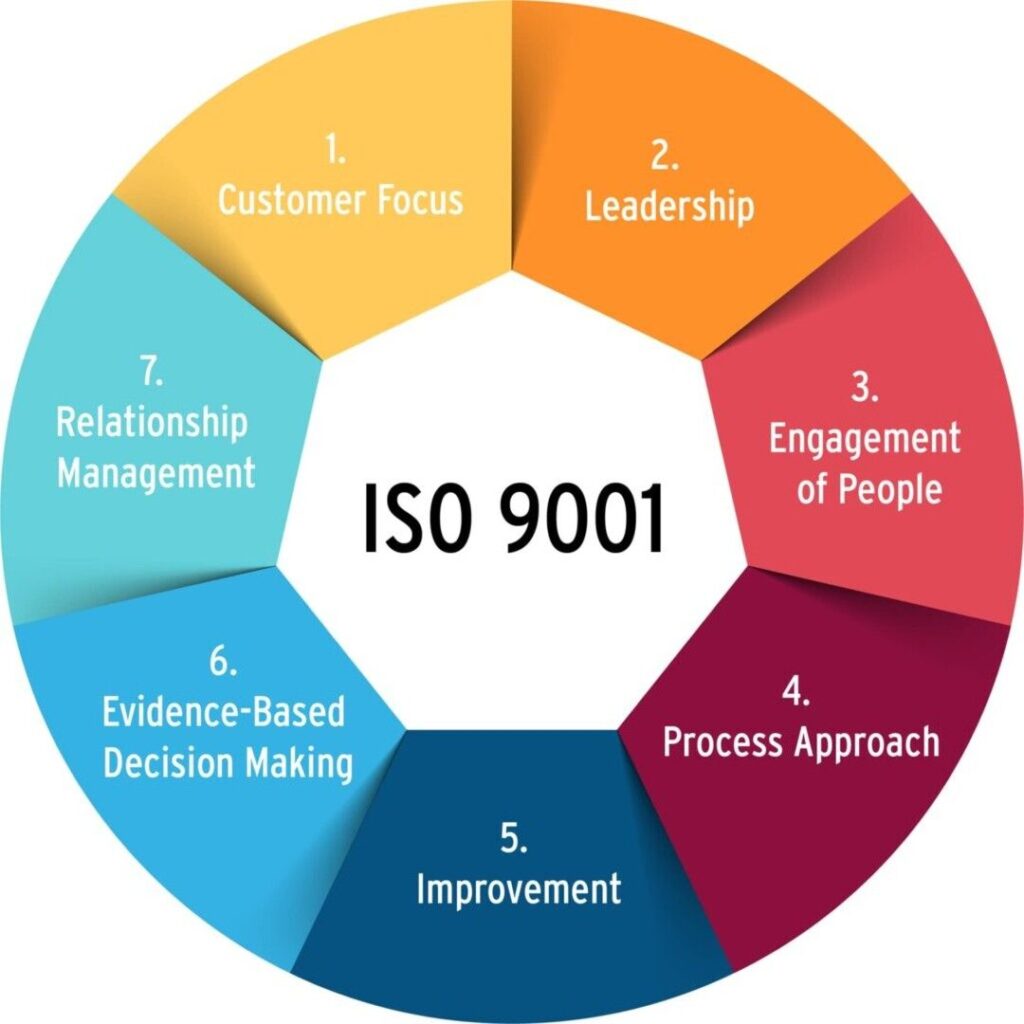
    ISO 9001 applies to hospitals by turning quality management into a controlled system of responsibilities, processes, records, internal audits, management reviews, corrective actions, and continual improvement. ISO 9001 remains the core quality-management standard for hospitals because it can apply across patient-facing, administrative, procurement, complaint-handling, and support workflows.


    For a hospital, ISO 9001 is not only about paperwork. It asks whether the hospital can define how work is done, prove that people follow the process, measure performance, respond to failures, and improve the system over time.
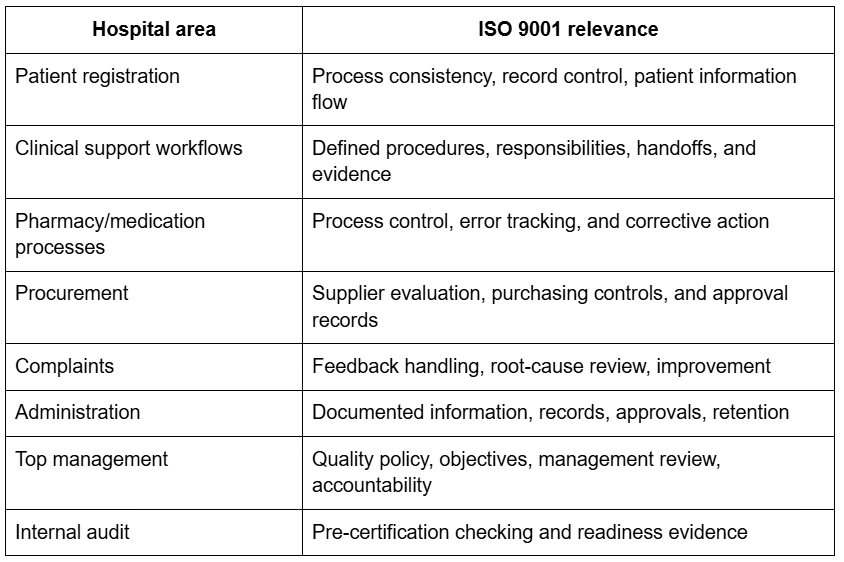


    ISO 9001 becomes stronger when it is built into real hospital operations. A procedure that nobody uses will not carry a hospital through a serious audit. AGS reviews the evidence trail: what the document says, what staff does, what records prove, and what leadership reviews.

    Where Does ISO 7101 Fit for Healthcare Quality Management?

    ISO 7101 adds a healthcare-specific quality-management layer for hospitals and healthcare organizations. ISO describes ISO 7101 as the first international consensus standard for healthcare quality management, with a systematic approach to sustainable, high-quality health systems.


    ISO 9001 remains the most widely used quality-management standard for hospitals. ISO 7101 adds a more healthcare-specific focus, including people-centred care, patient and workforce safety, service delivery, risk management, performance monitoring, and continual improvement.

    • ISO 9001: General hospital quality management, process control, documentation, customer/patient satisfaction, continual improvement
    • ISO 7101: Healthcare-specific quality management, patient-centred delivery, healthcare safety culture, clinical-service quality governance

    How Do ISO Standards Map to Hospital Departments?

    ISO certification becomes useful when it matches how the hospital actually works. A hospital quality system cannot sit only with the quality manager. It must connect clinical operations, records, HR, procurement, facilities, laboratories, IT, and leadership.
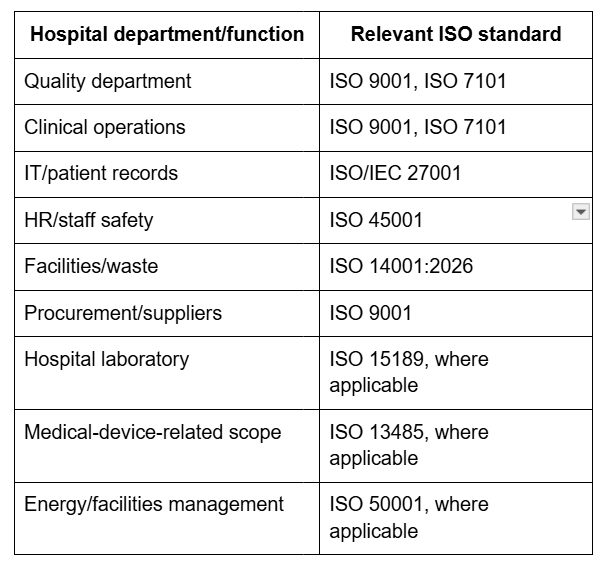
     

    This department mapping prevents a common mistake: choosing a standard because it sounds impressive, not because it fits the hospital’s actual risk and scope.

    What Are the Benefits of ISO Quality Management for Hospitals?

    The main benefit of ISO quality management for hospitals is stronger control over how care-supporting work is planned, documented, audited, corrected, and improved. It gives leadership and department heads a clearer way to manage quality instead of reacting only when problems appear.

    Hospital ISO certification can support:
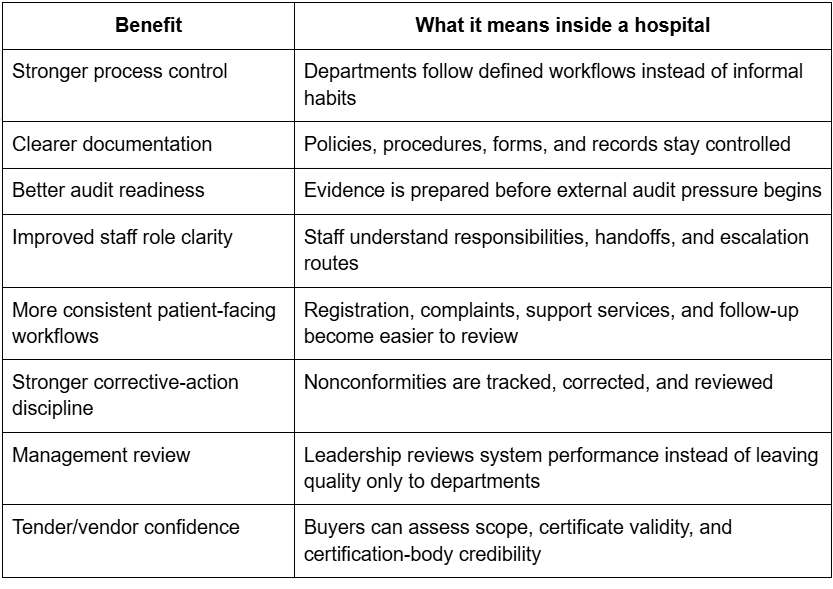


    ISO certification does not replace clinical judgment, medical regulation, hospital licensing, or hospital accreditation. It gives the hospital a management system structure that supports control, accountability, and improvement.


    What Are the ISO Requirements for Hospitals?

    ISO requirements for hospitals depend on the selected standard, but most management-system certifications require a defined scope, leadership commitment, risk-based planning, documented information, competence, operational control, internal audit, management review, and corrective action.
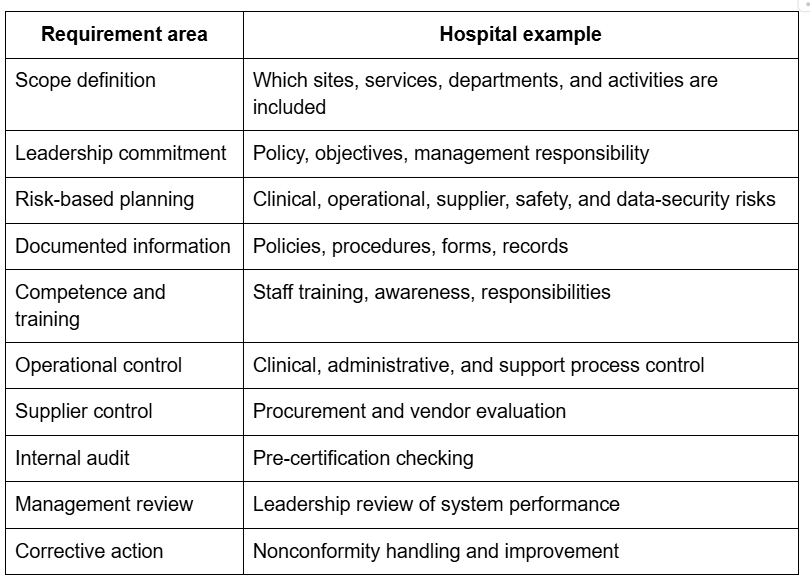
     

    Hospitals often fail readiness checks for simple reasons: unclear scope, uncontrolled forms, missing training records, weak internal-audit evidence, or corrective actions that were opened but never closed. AGS focuses on these issues before they become audit findings.


    How Do Hospitals Get ISO Certified?

    Hospitals get ISO certified by defining the certification scope, selecting the right ISO standard, closing readiness gaps, preparing documented evidence, completing internal review, undergoing external certification audit, and maintaining the certificate through surveillance and recertification.

    1. Hospital Scope Review

    Hospitals first define the certification scope by identifying which sites, departments, services, exclusions, and activities will be included. This step ensures the ISO system reflects real hospital operations and avoids gaps during audit.

    2. Standard Selection

    The hospital selects the most relevant ISO standard based on its needs, such as ISO 9001, ISO 7101, ISO/IEC 27001, ISO 45001, ISO 14001, or other applicable standards, depending on services and risk areas.

    3. Gap Analysis

    Current hospital practices are compared against ISO requirements to identify missing processes, weak controls, or documentation gaps that must be addressed before certification.

    4. Documentation and Process Alignment

    Hospitals prepare and align key documentation such as policies, SOPs, records, process maps, registers, and operational controls to ensure consistency with ISO requirements.

    5. Staff Training and Awareness

    Relevant staff, including process owners and department heads, are trained to understand their roles, responsibilities, and required ISO practices within daily hospital operations.

    6. Internal Audit

    An internal audit is conducted to evaluate readiness, check implementation, and identify nonconformities before the external certification audit takes place.

    7. Management Review

    Hospital leadership reviews system performance, risks, audit results, and improvement actions to confirm the management system is effective and aligned with objectives.

    8. Stage 1 Audit

    The certification body reviews documentation, scope, and readiness level to confirm the hospital is prepared for the full implementation audit.

    9. Stage 2 Audit

    The certification body evaluates actual implementation, processes, and objective evidence to verify compliance with the selected ISO standard.

    10. Corrective Actions

    Any nonconformities identified during the audit are addressed through corrective actions, including root cause analysis and evidence-based closure.

    11. Certification Decision

    After reviewing audit results and corrective actions, the certification body makes the final decision on issuing the ISO certificate.

    12. Surveillance and Recertification

    Ongoing surveillance audits and periodic recertification ensure the hospital continues to comply with ISO requirements over time.


    Industries Sector

    Oil & Gas
    Construction & Infrastructure
    Manufacturing & Industrial Production
    Food, Agriculture & Processing
    Security & Private Protection Services
    Government & Public Sector
    IT & Digital Services
    Healthcare & Medical Services
    Laboratories & Testing Facilities
    Logistics & Transportation
    Energy & Utilities
    Banking, Financial Services & Insurance
    Educational institutions
    Healthcare Organizations

    Trainings

     
    Quality
     
    Environment
     
    Health & Safety
     
    Food Safety
     
    Business Continuity

    Blogs & News

    ISO Certification

    What Is ISO Accreditation?

    What Is ISO Accreditation? ISO accreditation is formal recognition that a conformity assessment body is…
    READ MORE →
    ISO audit meaning for management system evaluation

    What Is an ISO Audit? Scope, Evidence & Findings

    What Is an ISO Audit? Types, Stages, and How to Prepare An ISO audit is…
    READ MORE →
    ISO 9001 quality management system explained

    What Is ISO 9001? QMS Requirements & Certification

    What Is ISO 9001? A Beginner’s Guide for Businesses Most businesses don’t struggle with quality…
    READ MORE →
    ISO certification

    How Many Types of ISO Certification Are There?

    How Many Types of ISO Certification Are There? ISO certification applies to 4 categories of…
    READ MORE →
    ISO certification benefits for business systems and performance

    What Is ISO Certification? Definition, Process, and How to Verify It

    What Is ISO Certification? ISO certification is an independent third-party confirmation that a product, process,…
    READ MORE →
    Basra Municipality Requirements for ISO Certification

    Government Procurement & Tender Requirements in Basra

    Government Procurement & Tender Requirements in Basra ISO Certification, Compliance Expectations & Practical Guidance Government…
    READ MORE →
    Basra Municipality Requirements for ISO Certification

    Basra Municipality Requirements for ISO Certification: What Businesses Must Comply With

    Basra Municipality Requirements for ISO Certification: What Businesses Must Comply With Basra Municipality does not…
    READ MORE →
    ISO for Food Businesses in Basra

    ISO for Food Businesses in Basra

    ISO for Food Businesses in Basra: A Complete Guide to Food Safety, Compliance & ISO…
    READ MORE →
    ISO for Manufacturing in Basra

    ISO for Manufacturing in Basra

    ISO for Manufacturing in Basra: How International Standards Strengthen Industrial Performance? Basra’s manufacturing sector is…
    READ MORE →

    What Documents Should a Hospital Prepare Before ISO Certification?

    A hospital should prepare documents that prove the management system is defined, implemented, monitored, reviewed, and improved. The required documents depend on the selected ISO standard and hospital scope, but the following evidence is commonly reviewed during readiness work.
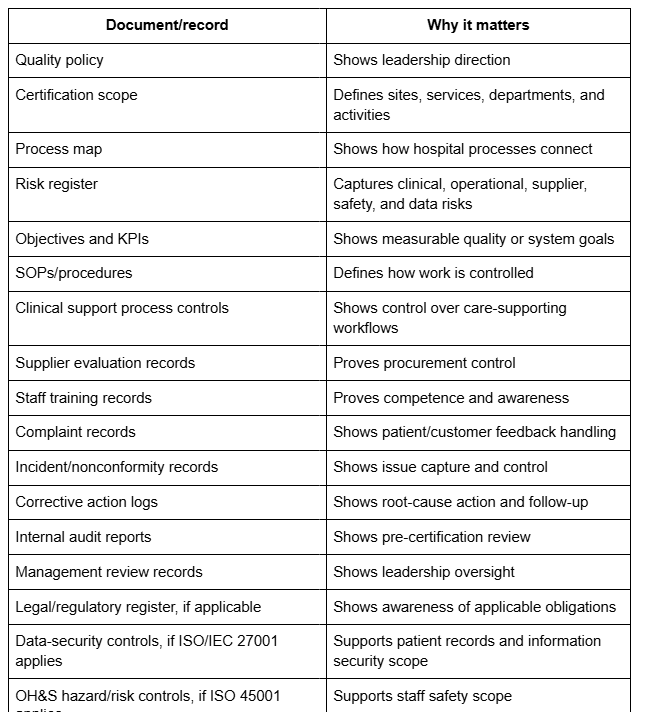


    Documentation should not be built as a separate “ISO folder” that nobody uses. It should reflect how the hospital works, who owns each process, what evidence is kept, and how the hospital responds when something fails.


    What Challenges Do Hospitals Face During ISO Certification?

    Hospitals usually face ISO certification challenges when the quality system looks organized on paper but breaks down across departments. The audit tests evidence, not intention.

    Department Silos

    Hospitals often operate in separate units like clinical care, pharmacy, laboratory, and administration, which can lead to disconnected processes. ISO certification requires cross-functional coordination, so responsibilities, handoffs, and communication between departments are clearly defined and consistently followed.

    Poor Documentation Control

    Many hospitals struggle with scattered or inconsistent documentation. ISO systems require structured document control, including approvals, version tracking, and controlled access so that only current procedures and records are used during operations and audits.

    Staff Resistance

    Staff may see ISO processes as an extra workload if not properly introduced. Effective implementation requires practical training and awareness so employees understand how ISO supports their daily work rather than complicating it.

    Unclear Scope

    A poorly defined certification scope can create major audit issues. Hospitals must clearly define which sites, departments, and services are included so the ISO system matches actual operational boundaries and expectations.

    Weak Internal Audit

    Internal audits are often treated as a formality rather than a real check of system performance. A strong ISO system requires structured audit planning, proper evidence collection, documented findings, and corrective follow-up to ensure readiness for external audits.

    Open Corrective Actions

    Hospitals sometimes identify issues but fail to close them properly. ISO certification requires a controlled corrective action process where nonconformities are tracked, root causes are addressed, and closure is verified with evidence.

    Data/Security Gaps

    Patient records and hospital data systems can be vulnerable if not properly controlled. Where applicable, ISO/IEC 27001 helps map risks related to the confidentiality, integrity, and availability of information to strengthen overall data security.

    Lab/Device Confusion

    Hospitals with laboratories or medical-device-related activities often mix standards. A clear separation between ISO 15189 for medical laboratories and ISO 13485 for medical devices is necessary to avoid applying the wrong compliance framework.

    Cost/Timeline Uncertainty

    Hospitals often face uncertainty in planning ISO certification due to unclear scope or readiness level. A proper assessment based on the number of sites, audit duration, and existing documentation helps create a realistic cost and timeline structure.


    The earlier these gaps are identified, the less pressure the hospital faces during Stage 1 and Stage 2 audits.

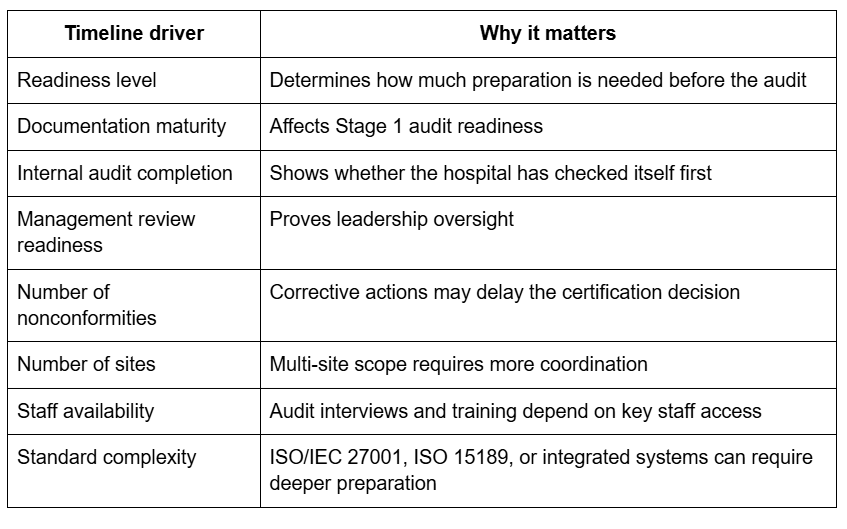
    How Long Does ISO Certification for Hospitals Take?

    A hospital’s ISO certification timeline depends on scope, readiness, documentation maturity, number of sites, staff availability, internal audit completion, management review readiness, and corrective actions required before the certification decision.

    A hospital with controlled documentation, trained process owners, completed internal audits, and closed corrective actions can move faster than a hospital starting from scattered documents and unclear responsibilities. The timeline also changes when multiple standards, multiple sites, laboratories, or information-security controls are included.


    How Is ISO Certification for Hospitals Maintained?

    Hospital ISO certification is maintained through surveillance audits, internal audits, management reviews, corrective-action tracking, scope control, and recertification under the certification body’s scheme rules.

    Certification is not a one-time event. Hospitals change: departments expand, staff rotate, systems move online, suppliers change, waste processes evolve, and new risks appear. The management system must keep up.

    Maintenance usually includes:

    • Surveillance audits: To confirm the system remains implemented after certification
    • Internal audit cycle: To find gaps before external review
    • Management review: to keep leadership involved in performance and risk
    • Corrective action tracking: To ensure nonconformities are closed with evidence
    • Training updates: To keep staff aware of responsibilities
    • Scope change review: To update certification when sites, departments, or services change
    • Standard transition planning: To keep systems aligned when ISO standards are revised

    Certificate validity depends on the certification body rules, accreditation pathway, and surveillance program. Hospitals should confirm validity and maintenance requirements directly with the certification body.

    How Can Hospitals Verify an ISO Certificate?

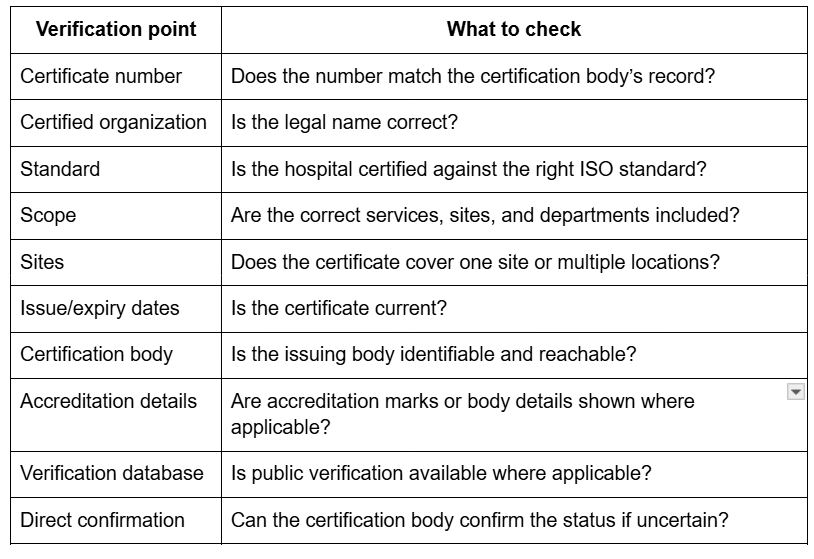
    Hospitals can verify an ISO certificate by checking the certificate number, organization name, standard, scope, sites, issue and expiry dates, certification body, accreditation mark/body where applicable, and public verification route where available.

    A certificate should not be judged only by its design. The real questions are: who issued it, what standard does it cover, what scope does it include, which sites are covered, and can the certificate status be checked?


    The accreditation ecosystem has also changed. As of January 1, 2026, IAF states that it is no longer operational and that its website is maintained for archival/reference purposes, with Global Accreditation Cooperation Incorporated replacing IAF and ILAC for current information.

    How Should Hospitals Choose an ISO Certification Body?

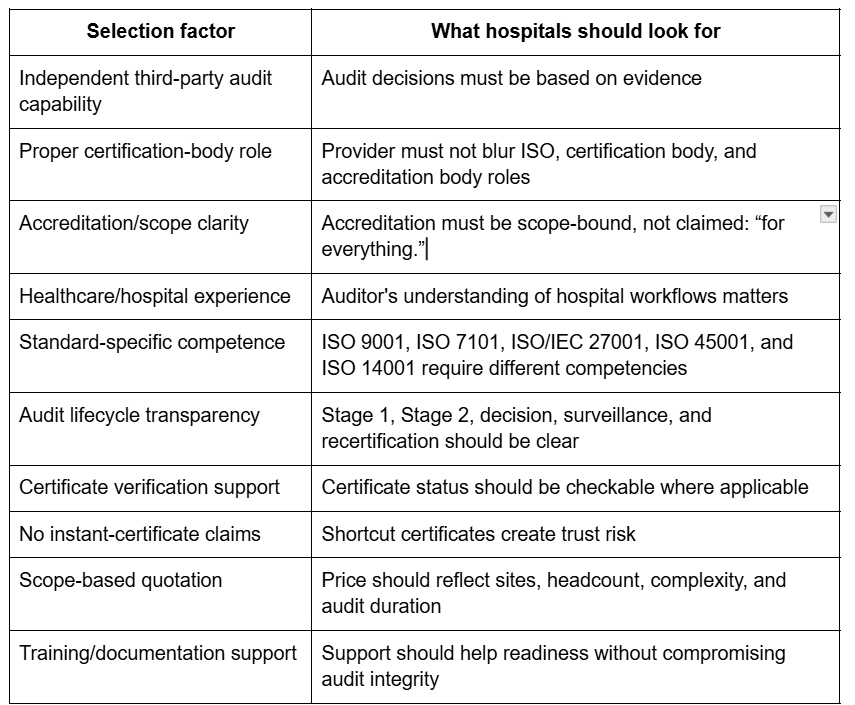
    Hospitals should choose an ISO certification body that can provide independent third-party audits, clear scope definition, standard-specific competence, transparent audit lifecycle, accreditation/scope clarity, surveillance planning, and certificate verification support where applicable.

    Avoid providers that promise instant certificates, guaranteed tender acceptance, or “ISO-approved” certification. ISO does not approve certification bodies for issuing certificates, and certification must be tied to a real audit process, a defined scope, and objective evidence.


    Why Choose AGS for Hospital ISO Certification?

    AGS supports hospital ISO certification through independent third-party audits, scope-bound certification pathways, gap assessments, readiness reviews, ISO training, documentation support, surveillance planning, and certificate verification support where applicable. 


    For hospitals, AGS focuses on the work that makes certification credible:
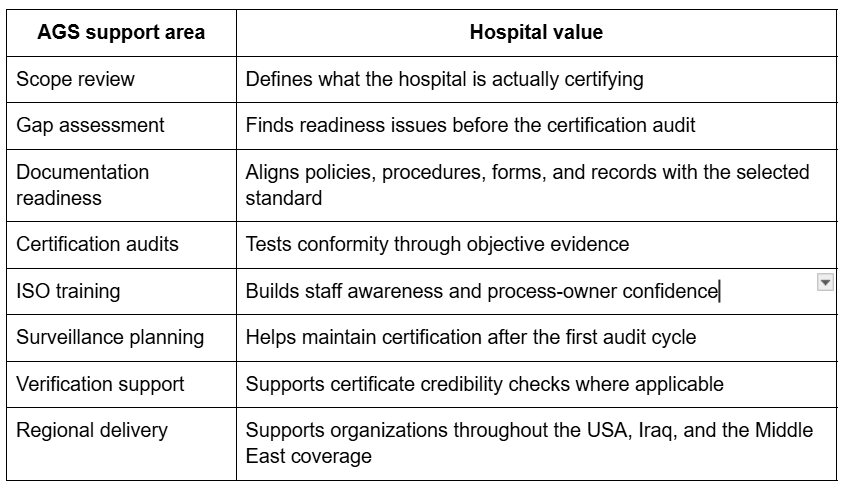
     

    AGS does not position ISO certification as a shortcut. We position it as a controlled audit pathway for hospitals that need credible, scope-bound assurance.


     

    Request Hospital ISO Certification Consultation

    If your hospital needs ISO certification for quality management, patient safety governance, data security, staff safety, environmental control, tender requirements, or audit readiness, AGS can help you identify the right standard, define scope, review gaps, prepare documentation, complete the audit process, and maintain certification through surveillance.

    We support hospitals with a practical, evidence-based certification route, not generic advice, not shortcut certificates, and not unclear claims.

    Request a scope-based ISO certification quote.

    Logo
    Logo
    Logo
    Logo
    Logo
    Logo
    Logo
    Logo
    Logo
    Logo
    Logo
    Logo
    Logo
    Logo

    FAQs About ISO Certification for Hospitals

    ISO certification for hospitals is a third-party certification of a hospital’s management system against a relevant ISO standard and defined scope. It may cover quality management, healthcare quality, information security, staff safety, environmental control, or other hospital-specific systems.

    Relevant ISO standards for hospitals include ISO 9001, ISO 7101, ISO/IEC 27001, ISO 45001, ISO 14001:2026, and conditional standards such as ISO 13485 and ISO 15189. The right standard depends on scope, services, departments, and certification goals.

    ISO 9001 may be enough for a hospital’s general quality-management goals, but it depends on the hospital’s risks, tender requirements, services, and operational scope. Hospitals with healthcare-specific quality goals may also consider ISO 7101.

    ISO 9001 is a general quality management system standard, while ISO 7101 is healthcare-specific. ISO 9001 supports broad process control and continual improvement; ISO 7101 focuses more directly on healthcare quality management and people-centred care.

    ISO 15189 relates to medical laboratories, while ISO 13485 relates to medical-device quality management systems. A hospital laboratory may consider ISO 15189, where laboratory competence is in scope. ISO 13485 is relevant where medical-device-related activity, servicing, supply, or device scope applies.

    ISO certification is not universally mandatory for all hospitals. Requirements depend on regulators, tenders, purchasers, contracts, internal governance, and the healthcare market where the hospital operates.

    Yes, small hospitals can get ISO certified if they define scope, implement required processes, maintain documentation, complete audits, and address nonconformities. Certification scope should match the hospital’s actual size, services, and operational reality.

    Hospital ISO certification time depends on readiness, documentation maturity, internal audit completion, corrective actions, number of sites, staff availability, and certification-body scheduling. A readiness review can give a clearer timeline.

    A hospital can verify an ISO certificate by checking the certificate number, organization name, standard, scope, sites, certification body, accreditation details where applicable, validity dates, and available verification database. If uncertain, contact the certification body directly.

    No, ISO certification does not automatically replace hospital accreditation, licensing, or regulatory approval. ISO certification and hospital accreditation are different systems unless a regulator, purchaser, or authority specifically links them.

    A hospital may complete some consultation, documentation, or training steps remotely, but credible certification requires a defined audit process. “Free ISO certification” or “instant ISO certificate” claims should be treated cautiously.

    Get ISO Certification for Hospitals Through AGS


      ISO Certification

      ISO 9001 CERTIFICATION
      ISO 14001 CERTIFICATION
      OHSAS 18001 CERTIFICATION
      ISO 45001 CERTIFICATION
      ISO 27001 CERTIFICATION
      ISO 22000 CERTIFICATION
      ISO 50001 CERTIFICATION
      ISO 29001 CERTIFICATION
      ISO 18788 CERTIFICATION
      ISO 37001 CERTIFICATION
      ISO 22301 CERTIFICATION
      ISO 13485 CERTIFICATION
      ISO 10002 CERTIFICATION
      ISO 21500 CERTIFICATION
      ISO 17025 CERTIFICATION
      ISO 15189 CERTIFICATION
       

      Industries Sector

      Oil & Gas
      Construction & Infrastructure
      Manufacturing & Industrial Production
      Food, Agriculture & Processing
      Security & Private Protection Services
      Government & Public Sector
      IT & Digital Services
      Healthcare & Medical Services
      Laboratories & Testing Facilities
      Logistics & Transportation
      Energy & Utilities
      Banking, Financial Services & Insurance
      Educational institutions
      Healthcare Organizations

      Trainings

      Quality
      Environment
      Health & Safety
      Food Safety
      Business Continuity
      Translate »