
What Is ISO 9001? A Beginner’s Guide for Businesses
Most businesses don’t struggle with quality because they lack effort; they struggle because quality is not systematized. ISO 9001 is the international standard that turns quality into a structured management system instead of an informal process.
ISO 9001 is the international standard for quality management system requirements. It tells an organization how to build, run, maintain, and improve a quality management system so it can deliver products or services consistently, meet customer and regulatory requirements, and keep improving over time. It is written for organizations, not for individual training seekers, and it applies across sectors and business sizes.
If you run a business and you keep hitting the same problems, inconsistent delivery, repeated complaints, unclear ownership, process drift, avoidable rework, ISO 9001 is often where the conversation starts. It gives structure to quality instead of leaving it to good intentions.
- Current status: ISO 9001:2015 remains current. ISO says the 2015 edition was last reviewed and confirmed in 2021, has one published amendment, and is expected to be replaced by a revised edition in September 2026.
What is ISO 9001?
ISO 9001 is the requirements standard for a quality management system. In plain English, it gives organizations a structured way to control processes, reduce inconsistency, meet customer needs, and improve performance based on evidence rather than guesswork.
The problem it solves is simple: too many businesses rely on informal habits instead of repeatable systems. ISO 9001 replaces that with a framework for defining responsibilities, controlling operations, monitoring results, and improving what is not working.
ISO 9000 sits next to it in the same family. ISO 9000 provides the fundamentals and vocabulary. ISO 9001 provides the requirements.
What is a quality management system (QMS)?
A quality management system is the way an organization manages its processes so quality is planned, controlled, measured, and improved. It is the operating framework behind how a business delivers consistent results instead of leaving quality to chance.
Under ISO 9001, the QMS is the system used to establish, implement, maintain, and continually improve those processes. That includes how the organization defines objectives, assigns responsibilities, controls operations, measures performance, and responds when something goes wrong.
Who is ISO 9001 for?
ISO 9001 is suitable for organizations of any size and applies across sectors. That includes manufacturers, service companies, healthcare providers, education organizations, public agencies, and non-profits. ISO is explicit that it is not limited to one industry or one business model.
That broad fit is one of the reasons the standard is so widely used. A small service firm can use it to bring control to delivery and complaints. A manufacturer can use it to reduce defects and tighten process discipline. A government agency can use it to improve consistency and accountability in service delivery.
Why is ISO 9001 important?
ISO 9001 matters because it turns quality from a vague goal into a managed system. It helps organizations improve consistency, strengthen customer satisfaction, meet applicable requirements, and create a rhythm of continual improvement instead of reacting to problems one by one. ISO also states that more than one million certificates have been issued in 189 countries, which is one reason the standard carries so much weight in contracts, supplier reviews, and cross-border business.
The practical value is usually easy to spot. When processes are clear, roles are owned, performance is measured, and problems are reviewed properly, businesses waste less time fixing avoidable mistakes. They also become easier to trust. Customers see more consistency. Teams see fewer fire drills. Leadership gets better visibility into what is actually working.
Take a simple example. A growing manufacturer keeps missing delivery dates and reworking customer orders because production planning, purchasing, and final checks are not aligned. ISO 9001 does not magically fix that overnight, but it forces the business to define processes, assign ownership, track outcomes, and improve the system based on evidence. That is where the gains usually come from.
When ISO 9001 matters most for a business
| Situation | Why ISO 9001 becomes relevant |
| Bidding on contracts | Many buyers and tenders want formal proof that quality is controlled |
| Customer requirement | Some customers expect certified suppliers or structured quality systems |
| Recurring inconsistency or defects | The standard helps bring process control and corrective action discipline |
| Regulated or quality-sensitive environment | Stronger documentation, accountability, and review processes matter more |
If your business keeps solving the same quality problem twice, ISO 9001 is usually worth a serious look. If you want a practical outside view before going deeper, AGS can help review your current setup and show where ISO 9001 would make a real difference.
What are the ISO 9001 requirements?
ISO 9001 specifies requirements for establishing, maintaining, and continually improving a quality management system. At a high level, the standard is organized around seven requirement areas: context of the organization, leadership, planning, support, operation, performance evaluation, and improvement.
That sounds formal, but the logic is straightforward. The organization needs to understand its environment, lead the system properly, plan what matters, provide the right support, control daily operations, evaluate how well the system works, and improve based on evidence. It is a management model, not just a documentation exercise.
What are the 7 quality management principles behind ISO 9001?
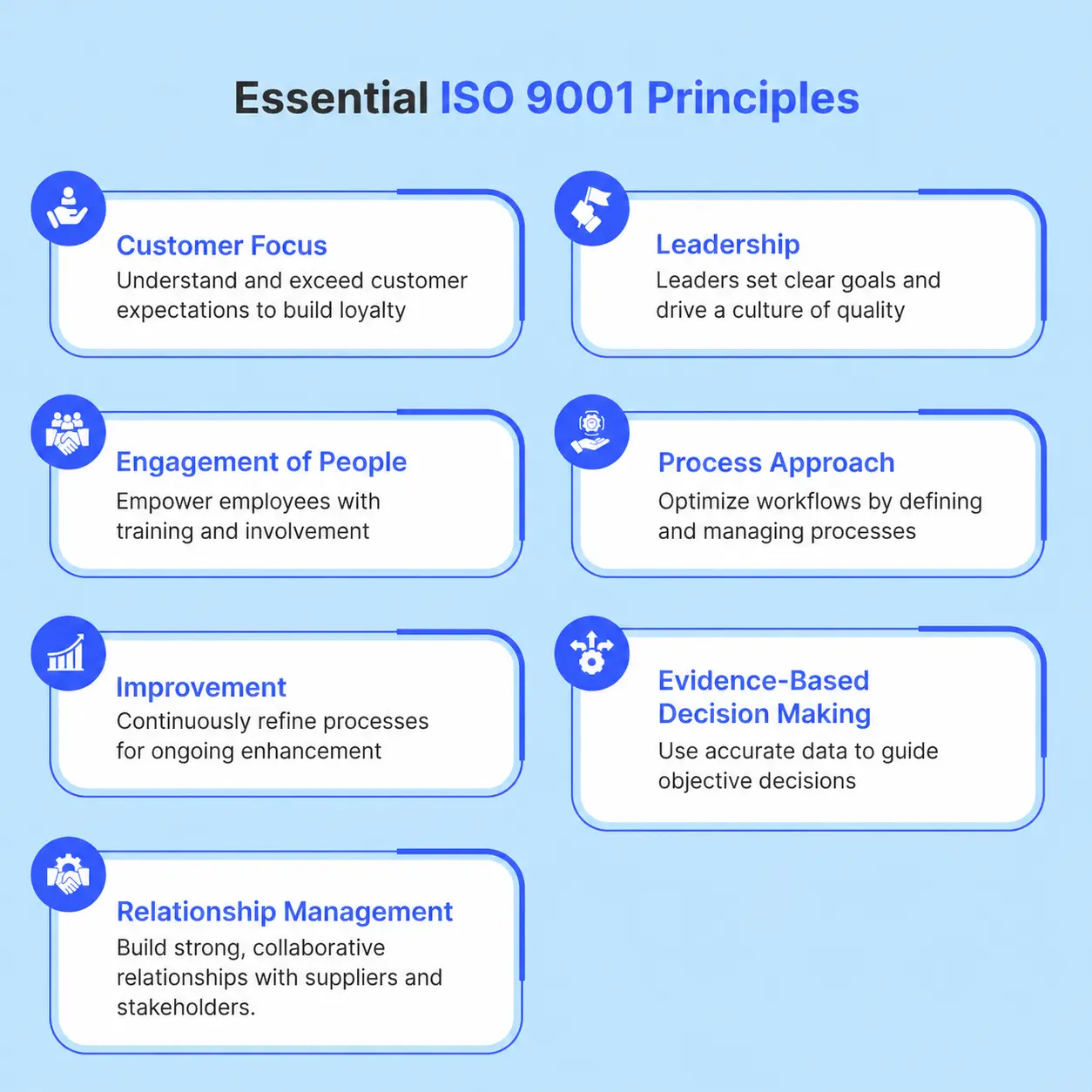
The ISO 9000 family is built on seven quality management principles. They are not a second requirements list. They are the thinking underneath the system. ISO identifies them as: customer focus, leadership, engagement of people, process approach, improvement, evidence-based decision making, and relationship management.
In practice, these principles explain why ISO 9001 works the way it does. Customer focus keeps the system tied to real expectations. The process approach keeps work connected instead of fragmented. Evidence-based decision-making stops quality from turning into opinion. Improvement keeps the system alive instead of freezing.
How does ISO 9001 work in practice?
Organizations use ISO 9001 to build a new QMS or improve an existing one. In practice, that means identifying the core processes that drive quality, understanding customer requirements, defining responsibilities, controlling variation, measuring performance, and improving based on results rather than assumptions.
A good ISO 9001 system does not sit beside the business. It becomes part of how the business runs. Sales, purchasing, operations, service delivery, complaints, training, review, and improvement all connect back to the same quality logic. That is why mature QMSs usually feel less like paperwork and more like an operating discipline.
Practical first steps with ISO 9001
- Map your key processes.
Get clear on how work actually flows across the business. - Assign ownership.
Every important process needs someone responsible for performance and control. - Define measures.
Choose the few indicators that show whether the process is working. - Document key controls.
Capture the information people actually need to perform consistently. - Review and improve.
Use complaints, audit findings, performance data, and internal review to make the system better.
Need a starting point that is more practical than theoretical? AGS can help you map the core processes, identify weak control points, and separate what really needs to be fixed from what is just noise.
What is ISO 9001 certification, and does your organization need it?
ISO 9001 is the standard. The Certification is the external confirmation that your organization conforms to it. Certification is voluntary. ISO says organizations can choose whether to go through certification or simply implement the standard internally. ISO also makes clear that ISO itself does not certify organizations. Independent certification bodies do.
So does your organization need certification? Sometimes yes, sometimes no. If you are trying to win contracts, satisfy supplier approval requirements, support international partnerships, or operate in a quality-sensitive market, certification often becomes strategically important. If your goal is internal improvement only, you may decide to implement ISO 9001 without pursuing third-party certification right away.
If ISO 9001 has been sitting on your to-do list for a while, the next step is not to memorize clauses. It is to decide whether the standard solves a real business problem for you now. If it does, AGS can help you turn that into a practical roadmap instead of another vague quality initiative.
FAQs
Can individuals be ISO 9001 certified?
No. Organizations can be certified to ISO 9001. Individuals cannot. What individuals can do is complete ISO 9001-related training, such as internal auditor or lead auditor courses. That is useful, but it is not the same thing as being certified to the standard.
Is there a sector-specific standard based on ISO 9001?
Yes. ISO lists several sector-adapted standards built on ISO 9001, including ISO 13485 for medical devices, ISO 18091 for local government, ISO 22163 for rail, ISO 29001 for petroleum and related products and services, and ISO/IEC/IEEE 90003 for software.
What documents are required for ISO 9001?
ISO 9001 does not reduce cleanly to a simplistic “six documents” answer. The better term is documented information. What matters is whether the organization has the documented controls and records needed to run the QMS effectively and prove it is working. That usually includes core process information, evidence of monitoring and review, corrective action records, and other system records that support conformity and improvement.
ISO 9001 vs ISO 14001 and ISO 13485
ISO 9001 focuses on quality management and customer satisfaction. ISO 14001 focuses on environmental management. ISO 13485 is the medical-device-specific quality management standard built on the quality management family. They are related, but they solve different business problems.
How much does ISO 9001 certification cost?
There is no honest one-price answer. Certification cost depends on organization size, number of sites, complexity, current system maturity, and the certification body you use. The smart move is to treat cost as a separate decision after you know your scope, your readiness, and whether certification is actually needed right now.