Candidates should prepare documents before the application stage, especially for CPSM and CPSD.
Useful documents may include:
- Current resume
- Job descriptions
- Employer letters
- Work experience details
- Dates of employment
- Supply management responsibilities
- Supplier diversity responsibilities, if applying for CPSD
- Education records
- Degree information, where applicable
- Exam records
- Name-matching details for testing
- Payment and application information
If your job title does not clearly show supply management, procurement, sourcing, supply chain, or supplier diversity responsibility, you may need stronger documentation explaining your actual job duties.
AGS can help you identify likely documentation gaps before the application stage.
ISM Certification Cost
ISM certification cost depends on the credential, membership status, exam count, application fees, study materials, and recertification needs.
Candidates should confirm current ISM pricing before purchasing exams, study products, membership, or application services.
Membership can affect the total cost, especially when a candidate needs multiple exams, learning systems, application support, or recertification.
AGS can help candidates compare the likely cost path before they commit to a route.
How Long Does ISM Certification Take?
The timeline depends on the credential, study pace, work schedule, exam availability, and how quickly application documents are ready.
The process may take longer if:
- The candidate needs to build experience
- Degree or employment documents are not ready
- Multiple exams are required
- Exam retakes are needed
- Application materials are incomplete
- The candidate chooses a slower study schedule
- Employer team training needs to be coordinated
A candidate with clear eligibility and a disciplined study plan may move faster than someone still confirming work history or choosing between credentials.
Recertification and Continuing Education
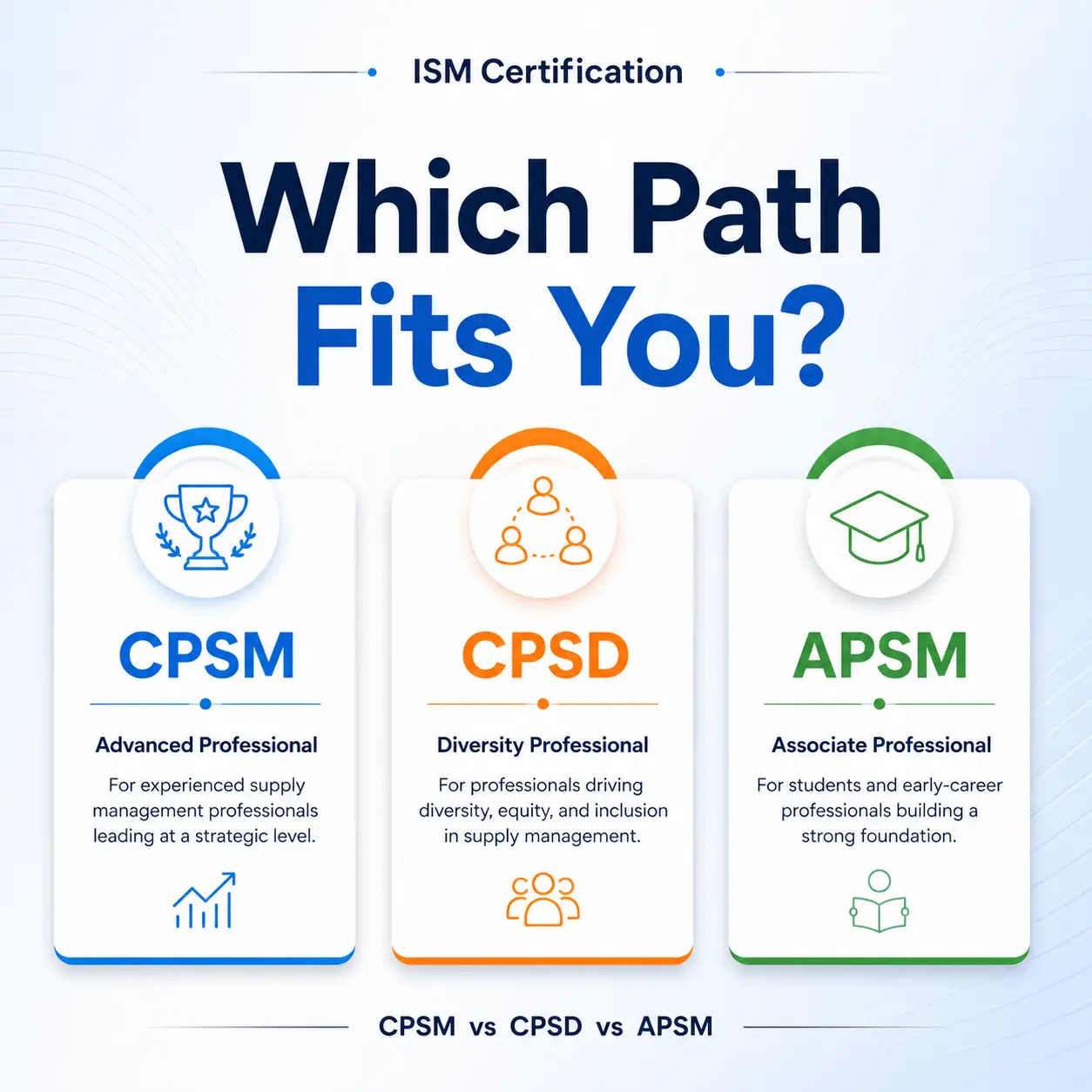
CPSM and CPSD are not one-time credentials.
They require recertification every three years. APSM works differently. It is valid for five years and does not recertify in the same way.
This matters when choosing a credential.
CPSM and CPSD can support long-term professional recognition, but they also require ongoing maintenance. APSM is simpler to maintain, but it is not the same long-term credential as CPSM or CPSD.
ISM Credential Verification
ISM provides a way to verify credential status.
Credential verification can help employers, recruiters, procurement departments, supplier qualification teams, and candidates confirm whether a claimed CPSM, CPSD, or APSM credential is active.
This can be useful when a credential is listed on:
- Resume
- LinkedIn profile
- Proposal
- Tender file
- Supplier qualification record
- Employer training record
- Internal promotion file
Before relying on any credential claim, check the issuing organization, credential name, holder name, status, and verification method.
ISM Certification Support for Employer Teams
Employers may need ISM certification planning for multiple staff members.
This is different from one person preparing for one exam. Employer-team planning may involve role mapping, eligibility review, training paths, exam readiness, documentation organization, and sequencing across departments.
AGS can help employer teams compare credential routes for:
- Procurement teams
- Supply management departments
- Sourcing teams
- Supplier diversity teams
- Supply chain staff
- Contract and vendor-management teams
- New procurement hires
- High-potential staff moving into leadership roles
For teams, the goal is not only passing exams. The goal is aligning the right people with the right credential path.
Organizations that need wider process, supplier-control, audit, or management-system support may also connect ISM credential planning with broader compliance and training needs.
What AGS Can and Cannot Help With
AGS provides support around ISM certification planning.
AGS can help with:
- Comparing CPSM, CPSD, and APSM route fit
- Pre-checking likely eligibility against published ISM criteria
- Reviewing career background and target role
- Explaining credential differences
- Planning exam sequence
- Organizing application documents
- Supporting study-path planning
- Advising employer teams on credential routes
- Helping candidates avoid the wrong exam or route
AGS cannot:
- Issue ISM credentials
- Approve ISM applications
- Guarantee exam results
- Change ISM eligibility rules
- Waive ISM exam or experience requirements
- Confirm final credential status on ISM’s behalf
Final credential decisions belong to ISM.
Get Started With ISM Certification Support
Not sure whether CPSM, CPSD, or APSM is the right route?
AGS can review your background, experience, education status, and target role before you choose an exam path.
Send us your details, and we’ll help you identify the most suitable ISM certification route, spot possible eligibility gaps, and avoid spending time or budget on the wrong credential.