UL Certification vs CE Marking: Key Differences and Which One You Need


    ISO Certification

    ISO 14001 CERTIFICATION
    ISO 18001 CERTIFICATION
    ISO 45001 CERTIFICATION
    ISO 27001 CERTIFICATION
    ISO 22000 CERTIFICATION
    ISO 50001 CERTIFICATION
    ISO 29001 CERTIFICATION
    ISO 18788 CERTIFICATION
    ISO 37001 CERTIFICATION
    ISO 22301 CERTIFICATION
    ISO 13485 CERTIFICATION
    ISO 10002 CERTIFICATION
    ISO 21500 CERTIFICATION
    ISO 17025 CERTIFICATION
    ISO 15189 CERTIFICATION

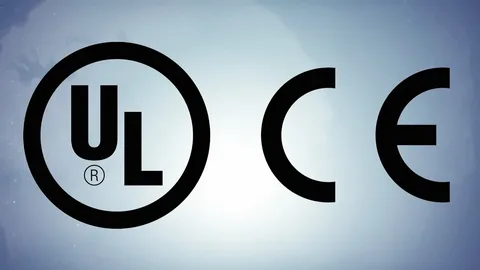
    UL certification mark and CE marking for product conformity

    Searchers often say UL vs CE certification. The technically correct comparison is UL certification vs CE marking. UL is a third-party certification and mark ecosystem. CE is a manufacturer-led conformity-marking system for products covered by EU rules. That distinction matters because the two frameworks serve different legal and market functions.

    If you are deciding what your product needs, the real question is not which one is better. The real question is where you want to sell, what product category you are in, and whether your product falls under EU CE rules, U.S. OSHA or code-driven requirements, or both.

    UL vs CE: What’s The Difference, And Which One Do You Need?

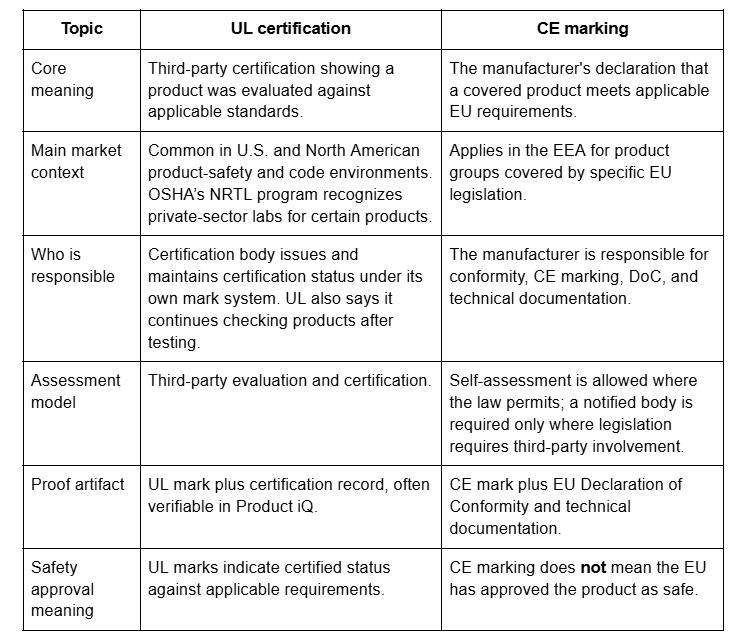
    UL certification is usually about third-party testing and certification to applicable standards. CE marking is the manufacturer’s declaration that a covered product complies with applicable EU requirements. UL says its product certifications show products have been tested to applicable standards. The EU says the manufacturer is responsible for CE marking and for ensuring the product meets applicable EU requirements.

    Key differences at a glance


    Does One Replace The Other?

    No. CE marking does not replace a UL mark, and a UL mark does not replace CE marking. UL’s own Code Authority FAQ says CE marking is not equivalent to a UL Listing Mark. OSHA says the CE mark is unrelated to U.S. product-safety requirements under its NRTL framework.

    A product can carry both marks, but they mean different things. A CE-marked product claims conformity with applicable EU law. A UL-marked product is showing certification under UL’s certification system to applicable standards. They are not interchangeable.

    When Do You Need UL, CE, Or Both?

    You need CE marking when your product falls under EU legislation that requires it, and you want to place that product on the EEA market. You need an OSHA-relevant NRTL mark, such as a UL mark, when your product is in a category that requires NRTL approval in a U.S. workplace or code-driven contexts. You need both when you want to sell the same covered product into both environments.

    A simple decision rule works:

    • Selling in the EEA with a covered product: start with CE marking.
    • Selling into U.S. contexts where OSHA or code acceptance matters: check whether your product category needs NRTL approval.
    • Selling in both markets: plan for both compliance paths from the start.

    What Is CE Marking, When Is It Required, And Who Is Responsible?

    CE marking is a legal conformity mark used in the EEA for products covered by specific EU legislation. By affixing it, the manufacturer declares that the product meets the applicable legal requirements and can be sold throughout the EEA. The EU also states that not all products need CE marking.

    The manufacturer is responsible. The EU says the manufacturer is responsible for ensuring the product meets applicable EU requirements and for affixing the CE marking. If you have a product made for you and sell it under your own name or brand, you are treated as the manufacturer for compliance purposes.

    When CE Marking Is Mandatory

    CE marking is mandatory only for product groups covered by specific EU rules. The EU says it is compulsory only for products covered by the relevant harmonized legislation and forbidden on products outside that scope.

    That is why the first CE question is always product-category scope, not geography alone. A product sold in Europe does not automatically need CE marking just because it is sold in Europe. It needs CE marking if its category is covered by EU rules that require it.

    Who Draws Up The Doc And Keeps The Technical Documentation?

    The manufacturer draws up and signs the EU Declaration of Conformity and must hold the technical documentation that supports it. The EU says there is no central EU body that gives permission or a certificate to use the CE mark. Instead, the manufacturer must identify the applicable rules, gather evidence, prepare technical documentation, and sign the DoC.

    The retention period is at least 10 years after the product is placed on the market. The EU says the DoC and supporting technical documentation must be kept up to date and retained for at least 10 years.

    When A Notified Body Is Involved

    A notified body is involved only when the applicable EU legislation requires third-party conformity assessment. The EU says that if the law allows self-assessment, the manufacturer can assess the product without a conformity-assessment body. If the law requires third-party testing, the manufacturer must involve a notified body.

    That is the point many sloppy pages miss. CE marking is not automatically a third-party certification. In many product categories, it is a manufacturer-led conformity route with documentation and legal responsibility sitting with the manufacturer.

    Common Ce Misconceptions

    CE marking is not an EU safety approval certificate. Access2Markets says the CE marking does not indicate that a product was approved as safe by the EU or another authority. The EU also warns about voluntary certificates that are not legally recognized for CE marking.

    CE marking has placement rules. The EU says the CE mark must be visible, legible, and indelible, and the minimum size is 5 mm unless product rules specify otherwise.

    What is UL Certification, and do you need it in the USA?

    UL certification is a third-party certification route in which products are evaluated against applicable standards and then authorized to bear UL certification marks. UL says its certifications demonstrate that products have been tested to applicable standards, and the UL Mark means a product has been certified to meet scientific safety, quality, or security standards.

    You do not ask whether UL is needed for the whole United States. You ask whether your product and use case fall into a context where an NRTL mark matters. OSHA’s NRTL program recognizes private-sector organizations to certify certain products, and OSHA publishes categories of products that require NRTL approval under its general industry standards.

    What UL Certification Demonstrates

    A UL mark shows certified status against applicable requirements and supports market acceptance in relevant North American contexts. UL says the mark indicates certification and that it continues checking products months and years after testing to make sure they still meet the requirements.

    That ongoing follow-up is one of the big practical differences from CE marking. UL’s model is a certification-mark ecosystem with continuing oversight. CE marking is a legal conformity-marking framework built on manufacturer responsibility and documentation, with notified-body involvement only when required.

    When OSHA And NRTL Requirements Matter

    OSHA’s NRTL requirements matter for certain products, not every product. OSHA says NRTLs certify certain products to ensure they meet the requirements of OSHA electrical standards, and it provides a list of product categories requiring approval.

    That means blanket claims like “UL is required in the USA” are wrong. The right rule is narrower: if your product is in a category covered by OSHA approval requirements or enters a code-driven, authority-having-jurisdiction, workplace, or channel environment that expects an NRTL mark, you need to address that requirement directly.

    Is CE Marking Accepted in the USA, And Does OSHA Recognize It?

    No, CE marking does not substitute for OSHA-relevant NRTL approval in the United States. OSHA’s FAQ says the CE mark is unrelated to U.S. product-safety requirements and that, where OSHA’s NRTL requirements apply, the product must bear the specific mark of an OSHA-recognized NRTL for that type of product.

    UL’s Code Authority FAQ says the same thing in a different way: CE marking is not equivalent to a UL Listing Mark, is usually a manufacturer self-declaration, may not include assessment to safety requirements, and does not make the product “Listed” under U.S. model codes.

    A product sold in the U.S. can still carry a CE mark if it is also sold into Europe. That does not turn the CE mark into U.S. approval. It just means the product is carrying separate compliance signals for separate markets.

    How To Verify A UL Claim In Product IQ

    Use UL Product iQ to verify whether a UL claim is real. UL says Product iQ is the database used to find UL Listed and UL Certified products, components, and materials.

    A clean verification flow looks like this:

    1. Get the product identity details, such as model number, file number, or product category details, from the product or seller.
    2. Search Product iQ by file number, model number, product type, or category control number.
    3. Match the record to the actual product and mark type rather than assuming any UL logo means the same thing. UL uses different mark types for finished products, components, and products evaluated for specific hazards or conditions.

    Doing the right thing, at the right time.

    300+

    Satisfied Clients

    10+

    Years of Experience

    1700+

    ISO certifications


    Industries Sector

    Oil & Gas
    Construction & Infrastructure
    Manufacturing & Industrial Production
    Food, Agriculture & Processing
    Security & Private Protection Services
    Government & Public Sector
    IT & Digital Services
    Healthcare & Medical Services
    Laboratories & Testing Facilities
    Logistics & Transportation
    Energy & Utilities
    Banking, Financial Services & Insurance
    Educational institutions
    Healthcare Organizations

    Trainings

    Quality
    Environment
    Health & Safety
    Food Safety
    Business Continuity

    Blogs & News

    ISO Certification

    ISO certification

    How Many Types of ISO Certification Are There?

    How Many Types of ISO Certification Are There? ISO certification applies to 4 categories of…
    READ MORE →
    ISO certification

    What Is ISO Certification? Definition, Process, and How to Verify It

    What Is ISO Certification? Definition, Process, and How to Verify It ISO certification is a…
    READ MORE →
    Basra Municipality Requirements for ISO Certification

    Government Procurement & Tender Requirements in Basra

    Government Procurement & Tender Requirements in Basra ISO Certification, Compliance Expectations & Practical Guidance Government…
    READ MORE →
    Basra Municipality Requirements for ISO Certification

    Basra Municipality Requirements for ISO Certification: What Businesses Must Comply With

    Basra Municipality Requirements for ISO Certification: What Businesses Must Comply With Basra Municipality does not…
    READ MORE →
    ISO for Food Businesses in Basra

    ISO for Food Businesses in Basra

    ISO for Food Businesses in Basra: A Complete Guide to Food Safety, Compliance & ISO…
    READ MORE →
    ISO for Manufacturing in Basra

    ISO for Manufacturing in Basra

    ISO for Manufacturing in Basra: How International Standards Strengthen Industrial Performance? Basra’s manufacturing sector is…
    READ MORE →
    ISO for Construction Companies in Basra

    ISO for Construction Companies in Basra

    ISO for Construction Companies in Basra: A Complete Guide for 2026 This is the practical…
    READ MORE →
    ISO for Security Companies in Basra

    ISO for Security Companies in Basra

    ISO for Security & PSC Companies in Basra (2026 Guide) This is the practical guide…
    READ MORE →
    ISO Certification for Oil & Gas Companies in Basra

    ISO Certification for Oil & Gas Companies in Basra

    ISO Certification for Oil & Gas Companies in Basra This is the practical guide for…
    READ MORE →
    Logo
    Logo
    Logo
    Logo
    Logo
    Logo
    Logo
    Logo
    Logo
    Logo
    Logo
    Logo
    Logo
    Logo

    UL Certification vs CE Marking FAQ

    UL Certified is a general term. UL Listed and UL Classified are more specific mark types. UL says “Certified” is a general term encompassing “Listed” and “Classified,” and it carries the same meaning as the traditional Listed or Classified marks in model codes. UL also says the Listed Mark appears on many finished products, the Classified Mark is used for products evaluated for a specific hazard or performance under specific conditions, and the Recognized Component Mark is used on components that are part of a larger product or system.

    Start Your UL Certification and CE Marking Certification Journey with AGS

    Translate »