Home » ISO 17025
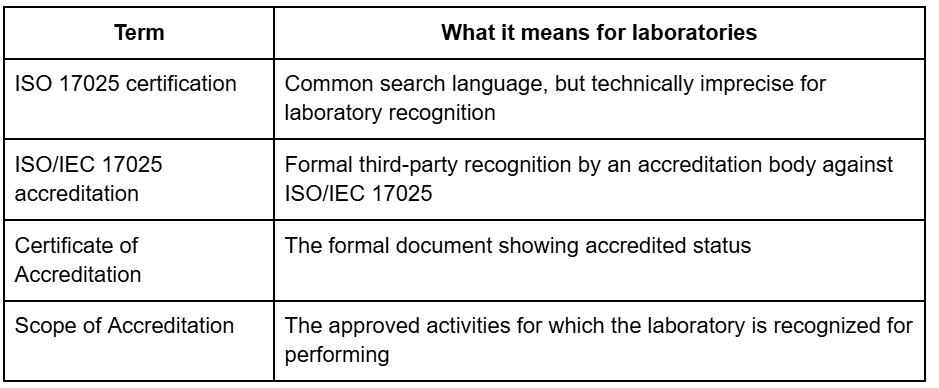
For laboratories, the search phrase “ISO 17025 certification” usually points to ISO/IEC 17025 accreditation. ISO/IEC 17025:2017 is the international standard used to assess laboratory competence, impartiality, and consistent operation, and accreditation bodies use it to recognize laboratories that can generate valid results.
If your laboratory needs stronger technical credibility, wider acceptance of results, or a clearer path through accreditation, this page is the starting point. It explains what ISO/IEC 17025 accreditation is, who it applies to, what the five requirement families cover, how the process works, and how support should map to the real accreditation journey.
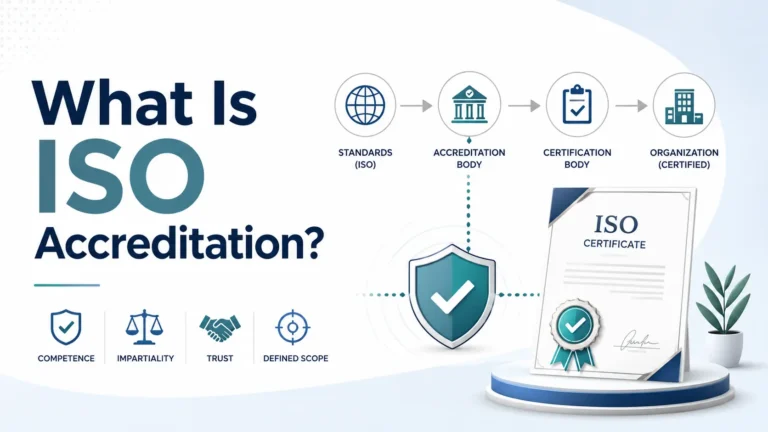
ISO/IEC 17025 accreditation is formal recognition that a laboratory meets ISO/IEC 17025 requirements for competence, impartiality, and consistent operation within a defined scope. ISO says the standard helps laboratories demonstrate competence and generate valid results. NIST explains that accreditation verifies a laboratory has an appropriate quality management system and can properly perform specific tests or calibrations according to its scope.
A laboratory’s accredited status is not just a logo or a certificate. It is tied to a Certificate of Accreditation and a Scope of Accreditation that defines the exact activities the laboratory is recognized to perform.
ISO 17025 Certification vs ISO/IEC 17025 Accreditation
For laboratories, accreditation is the correct term. NIST states that NVLAP accredits laboratories found competent to perform specific tests or calibrations and is not a certifier of products, data, or certification programs.
ISO/IEC 17025 applies to organizations performing laboratory activities, including testing, calibration, and related sampling. ISO says the standard is useful for any organization that performs testing, sampling, or calibration and wants reliable results. It is not limited to one sector or one lab size.
Testing laboratories, calibration laboratories, and organizations performing sampling that supports later testing or calibration are in scope. ISO’s standards text and supporting pages make that clear, and NATA states that ISO/IEC 17025 accreditation suits almost any organization performing testing, sampling, or calibration that wants independent assurance about the reliability of its outputs.
That includes labs in areas such as environmental testing, food analysis, dimensional measurement, electrical testing, forensic work, industrial calibration, university research, and in-house laboratory functions inside larger organizations. The point is not the sector first. The point is whether the organization performs laboratory activities that need technically reliable, independently recognized results.
ISO/IEC 17025 is not the right root standard for every conformity-assessment activity. ILAC’s scope map shows that medical testing laboratories are typically linked to ISO 15189, inspection bodies to ISO/IEC 17020, proficiency testing providers to ISO/IEC 17043, and reference material producers to ISO 17034. If your activity fits one of those categories better than testing, calibration, or related sampling, that standard may be the correct route instead.
Satisfied Clients
Years of Experience
ISO certifications
The five main ISO/IEC 17025 requirement families are general, structural, resource, process, and management system requirements. A2LA’s guidance and ANAB’s materials both use this framework to explain how the standard is organized.
General requirements cover impartiality and confidentiality. The lab has to protect the integrity of its work, control conflicts that could affect objectivity, and handle customer information appropriately. Those are not side issues. They are core credibility conditions.
Structural requirements define how the laboratory is organized and governed. The lab must have a clear legal and operational structure, defined responsibilities, and management authority that support competence and consistent operation.
Resource requirements cover the people, equipment, facilities, and support needed to produce valid results. Personnel competence, suitable equipment, environmental conditions, and traceability all sit here. NIST’s accreditation summary lists quality systems, personnel, accommodation and environment, methods, equipment, traceability, sampling, and reporting as core assessed areas.
Process requirements cover how the laboratory does the work. That includes method selection, validation or verification where needed, sampling, handling of items, technical records, measurement uncertainty where applicable, data control, quality assurance of results, and reporting.
Management system requirements cover how the laboratory controls and improves the system around the technical work. Internal audits, management review, document control, corrective action, risk-aware control, and continual improvement sit here. A2LA’s accreditation steps explicitly include internal audit and management review before application.
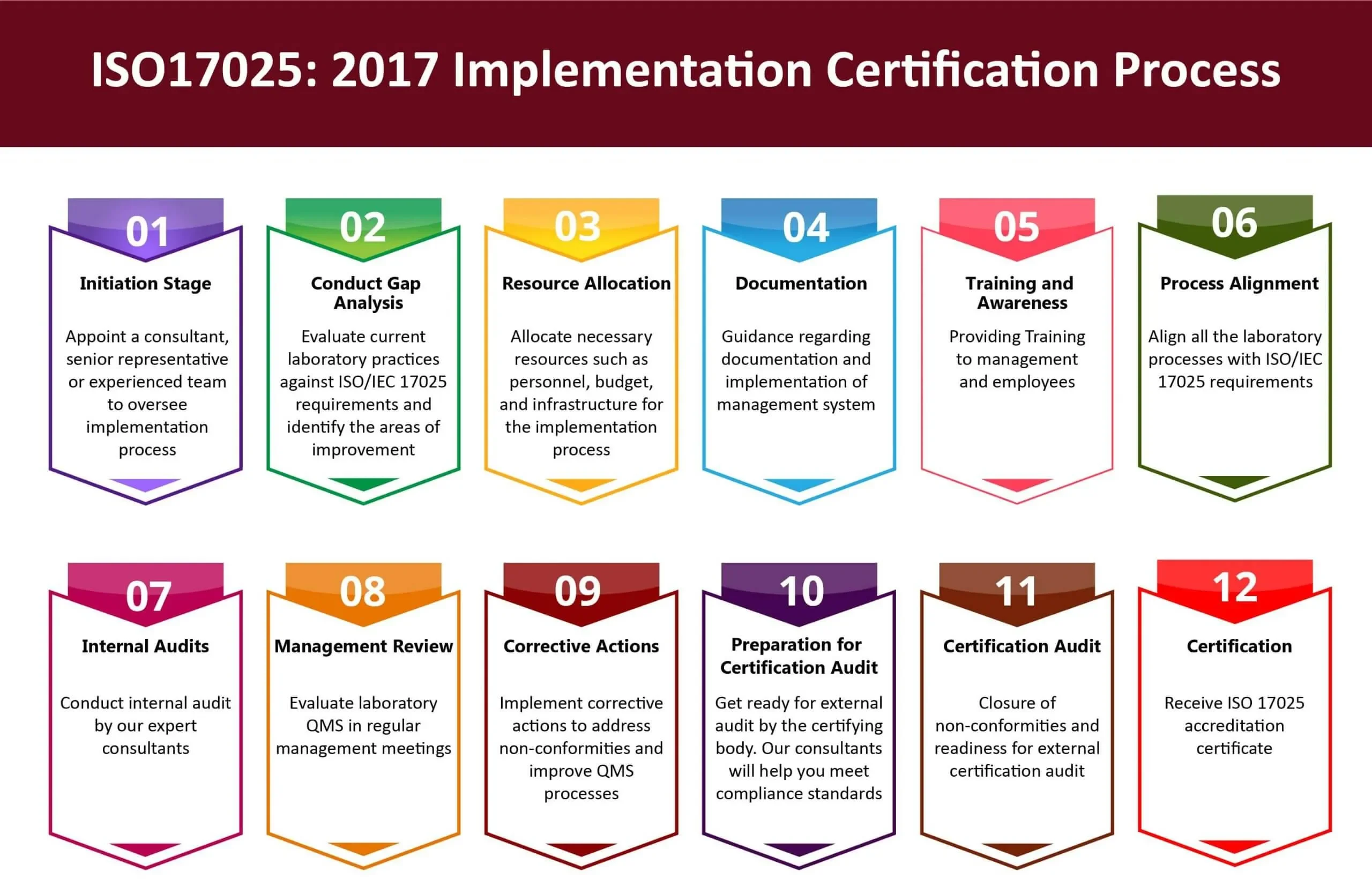
A laboratory gets accredited by defining its scope, preparing the system, submitting to an accreditation body, completing the assessment, closing nonconformities, and receiving an accreditation decision. That is the real sequence shown by accreditation bodies, not a vague “apply and get certified” promise.
The first practical step is choosing the accreditation body and defining the scope you want to be accredited. The scope matters because accreditation is granted for specific activities, not for every possible task the lab performs. ILAC’s signatory search helps laboratories and buyers identify recognized accreditation bodies in the relevant economy, and some signatories link directly to searchable directories.
The next step is building the documents and the working system together. A2LA’s preparation guidance starts with understanding the standard, determining training needs, documenting the system, implementing updated policies and procedures, and only then moving into internal checks and application.
Before formal assessment, the lab should test its own system. A2LA includes both internal audit and management review in its step-by-step preparation path because a laboratory that has not checked its own system is not really ready for external assessment.
The external assessment checks both the documented system and the lab’s technical competence in practice. ANAB’s published path includes documentation review, optional preliminary assessment, accreditation assessment, corrective action if needed, accreditation decision, and certificate issuance.
There is no single fixed global price for ISO/IEC 17025 accreditation. Cost depends on scope, number of methods, number of sites, lab complexity, readiness level, assessor time, and the accreditation body’s fee structure. ANAB begins its published process with Request a Quote, which tells you the right commercial logic immediately: pricing is scope-based, not universal.
There is no single universal timeline either. Timeline depends on how mature the system already is, how much documentation and technical evidence exists, how quickly internal audit and management review are completed, how large the scope is, and how many corrective actions come out of the assessment. The official sources support the sequence, but they do not publish one authoritative duration that honestly fits every laboratory.
The biggest benefits are confidence in valid results, wider recognition, stronger buyer trust, and less duplication. ISO states that the standard helps laboratories generate valid results and promotes confidence in their work. ISO and NATA also say it facilitates wider acceptance of results between countries and organizations.
Accreditation gives laboratories a stronger credibility position because competence is independently assessed. That matters to customers, regulators, procurement teams, and internal stakeholders who need proof that results are technically reliable, not just internally asserted.
Accreditation supports market access because recognized results travel better. ILAC says the ILAC MRA underpins confidence in the acceptance of testing and calibration results, and NATA says ISO/IEC 17025 promotes trade by reducing the need for additional testing between countries and organizations.
A recognized accreditation route can reduce repeat evaluation by customers and schemes. ISO says wider acceptance of results reduces the need for retesting, which saves time and resources. That is one reason labs pursue accreditation even when the initial project feels heavy.
We support readiness. We do not grant accreditation. The accreditation body evaluates the laboratory and issues the Certificate of Accreditation and Scope of Accreditation. Our role is to help your laboratory get ready for that process with fewer blind spots and clearer evidence.
We start by comparing your current laboratory system against the standard and your intended scope. That produces a practical roadmap instead of a generic compliance lecture. The aim is to show what is already working, what is missing, and what has to be fixed before the application.
We help structure the core documents and the working routines behind them. That includes procedures, records, responsibilities, review points, and competence-related preparation so the system works in practice and not only on paper.
We help laboratories organize the technical evidence that usually creates friction: methods, validation or verification logic, measurement traceability, equipment controls, technical records, and reporting consistency. That support stays tied to the lab’s real scope.
We help laboratories prepare for assessment, respond to findings, and strengthen ongoing control after accreditation. That includes internal audits, management review support, corrective-action structure, and preparation for surveillance or reassessment.
As an accredited body, we issue certificates for the most sought-after management system standards:


Not universally. Whether accreditation is required depends on the market, regulator, program, or customer using your results. NIST says NVLAP programs arise in response to legislative or administrative actions or to requests from government agencies or private-sector entities, and NATA says suppliers and regulators often will not accept results from laboratories that are not accredited.
Accreditation is maintained, not forgotten. UKAS states that laboratories undergo regular surveillance assessments and full reassessments to show they continue meeting the requirements. The exact cycle depends on the accreditation body and program, so there is no single universal validity rule you can apply to every lab in every economy.
Check the accreditation body’s directory and confirm the lab’s scope. ILAC’s signatory search helps users find recognized accreditation bodies and, where available, links to their online directories. For bodies such as ANAB, searchable directories are public. A valid check includes the lab name, active status, certificate details, and exact scope of accreditation.
If your laboratory needs a clearer path to ISO/IEC 17025 accreditation, start with scope and readiness. That is the part that saves time later.