Home » ISO 22000
ISO 22000 certification is third-party confirmation that an organization’s food safety management system conforms to ISO 22000:2018. It is used to show that the business has a structured system for identifying food safety hazards, controlling them consistently, and maintaining safe food processes across its defined scope. ISO 22000:2018 remains current after review in 2023, and it now includes Amendment 1:2024 on climate action changes.
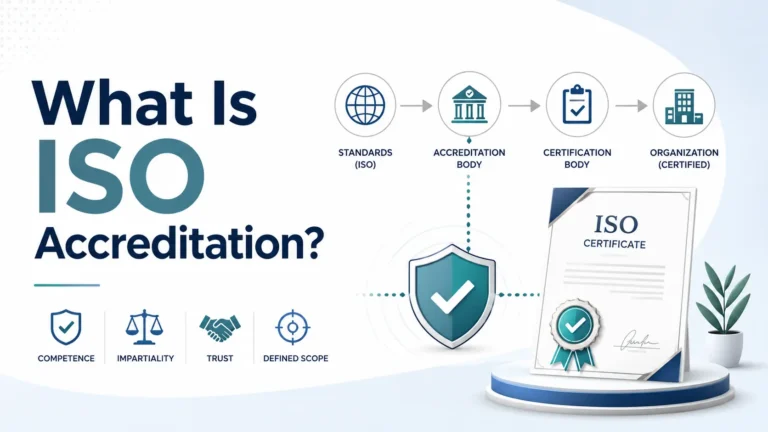
The certification applies to the organization’s FSMS, not to a single product and not to an individual employee. ISO writes the standard, but ISO does not certify organizations. Certification is performed by an independent certification body.
AGS Iraq supports food businesses in achieving ISO 22000 certification by providing end-to-end guidance, including FSMS development, HACCP implementation, PRP setup, and audit preparation. Our focus is on helping organizations build a compliant and well-structured food safety management system that meets international certification requirements. We work with clients to identify gaps early, strengthen documentation, and prepare effectively for third-party certification audits.
ISO 22000 is the standard. ISO 22000 certification is a third-party confirmation that the organization’s FSMS meets that standard. The certifiable object is the management system used to control food safety hazards through planning, monitoring, communication, validation, verification, and continual improvement. It is a management system certification, not a blanket product certification.
ISO says the standard can be used by any organization in the food chain, regardless of size or position. That includes primary production, food manufacturing, packaging, storage, transport, equipment, distribution, food service, feed production, and other organizations that directly or indirectly affect food safety.
That breadth is what makes ISO 22000 commercially useful. It gives food-chain organizations one certifiable framework for managing hazards and showing outside parties that food safety is being controlled through a real system, not informal habits. It can also sit alongside other management system standards, such as ISO 9001, because ISO 22000 follows the same high-level structure used across modern ISO management system standards.
Businesses pursue ISO 22000 certification because it gives them a stronger, more auditable way to control food safety hazards and prove that control to customers, buyers, and supply-chain partners. ISO says certification is often used when organizations need independent confirmation that their FSMS meets the requirements of the standard.
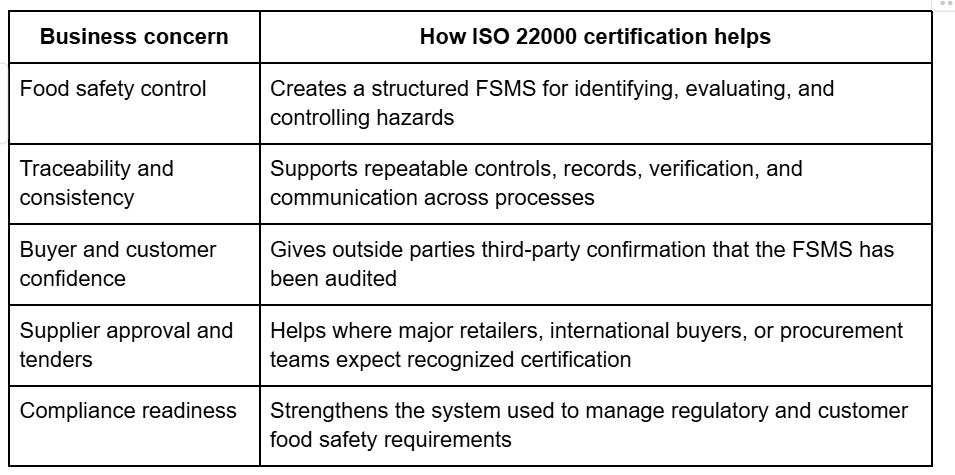
The point is not the image. The point is control. When a food business is being assessed by a retailer, manufacturer, distributor, buyer, or tender authority, a credible FSMS certificate can reduce doubt and shorten the trust-building process. ISO’s explainer explicitly links certification demand to supplier approval processes, major buyers, and procurement environments.
Satisfied Clients
Years of Experience
ISO certifications
Before certification, your business needs a working FSMS, not just a food safety manual. At a high level, the organization needs a defined scope, food safety policy and objectives, hazard analysis and control logic, HACCP-aligned controls, prerequisite programmes, records and evidence, internal review, and people with clear food safety responsibilities. ISO 22000 is a management system standard, so the audit looks at how the system works in practice, not just whether documents exist.
Most organizations need these readiness components in place:
There is no fixed old-style list of “mandatory six procedures” here. The real question is whether the organization has the controls, records, and system discipline needed to operate safely and demonstrate conformity during an audit.
ISO 22000 is not the same as standalone HACCP. HACCP is the hazard analysis and control methodology. ISO 22000 takes that hazard-control logic and places it inside a full management system with leadership, planning, communication, verification, internal audit, review, and improvement requirements. ISO is explicit that ISO 22000 integrates the HACCP principles and application steps developed by the Codex Alimentarius Commission.
PRPs are the operational foundation. They establish the hygiene and operational conditions needed to prevent contamination and support safe food production. ISO’s current explainer says ISO 22002 provides these PRP requirements, including sector-specific parts such as ISO/TS 22002-1 for food manufacturing and ISO 22002-100:2025 as a unified PRP approach across sectors.
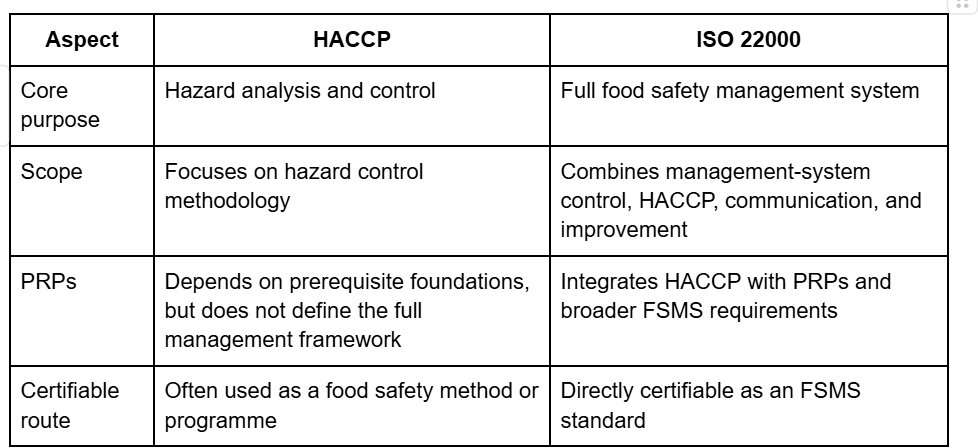
That is why businesses often ask about both. HACCP remains essential, but ISO 22000 goes further by turning food safety control into a managed, auditable system.
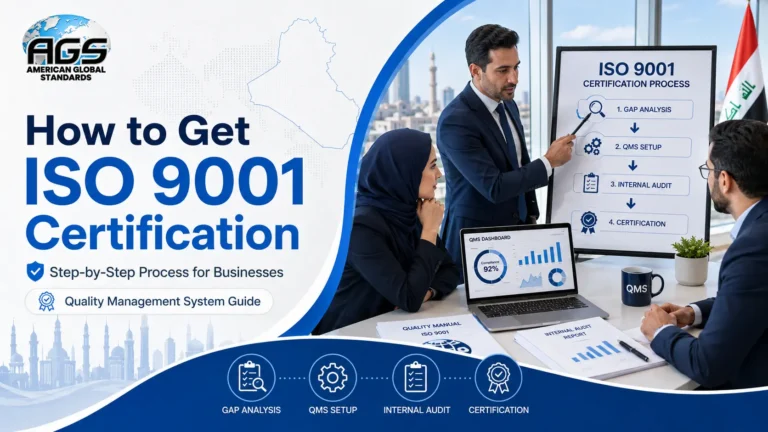
Certification follows implementation and an independent audit of the food safety management system. The route is staged, and it is designed to test whether the FSMS has been built, implemented, and maintained well enough to support certification. ISO 22003-1:2022 exists specifically to set requirements for bodies that audit and certify FSMS.
This is where support services matter. Most delays come from unclear scope, weak PRPs, incomplete HACCP studies, poor evidence, or audit-stage surprises. A good readiness review usually saves more time than a rushed audit booking. That is an inference from the way ISO 22003-1 and FSSC structure implementation, audit, and maintenance stages.
Most delays and audit failures happen due to missing PRPs, incomplete HACCP documentation, or unclear FSMS scope, not the certification process itself.
A structured readiness assessment helps you identify gaps early, reduce audit risks, and avoid unnecessary rework before Stage 1 and Stage 2 audits.
Get a quick ISO 22000 readiness review with AGS for your organization and understand exactly where you stand before starting certification.
Independent certification matters because the value of the certificate depends on trust outside your business. ISO says organizations should evaluate certification bodies and check accreditation, and it points users to IAF CertSearch to verify accredited certification status.
A simple way to reduce risk is to separate four things clearly:
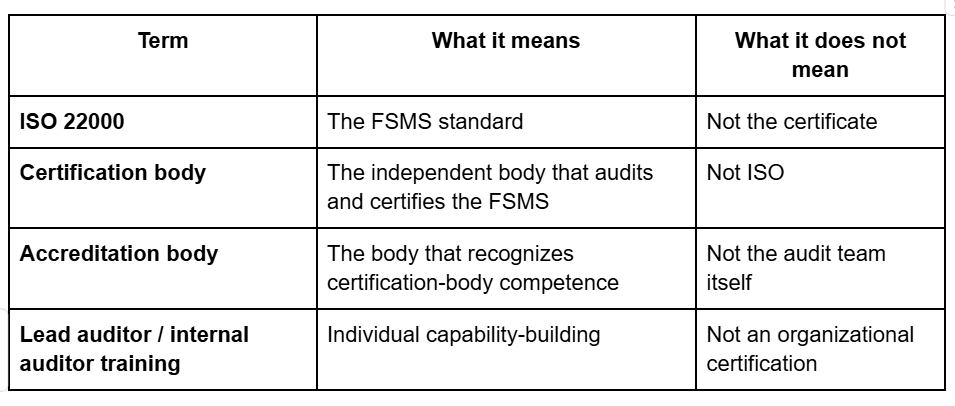
ISO 22003-1:2022 is the relevant standard for bodies providing audit and certification of FSMS, and accreditation bodies such as ANAB accredit certification bodies for ISO 22000 against that framework. ANAB’s own ISO 22000 accreditation material makes that link explicit.
Before you shortlist a provider, ask:
ISO 22000 and FSSC 22000 are related, but they are not the same thing. ISO 22000 is the certifiable FSMS standard. FSSC 22000 is a certification scheme built on ISO 22000, sector-specific PRPs, and additional FSSC requirements. FSSC states this directly and also notes that the scheme is recognized by GFSI.
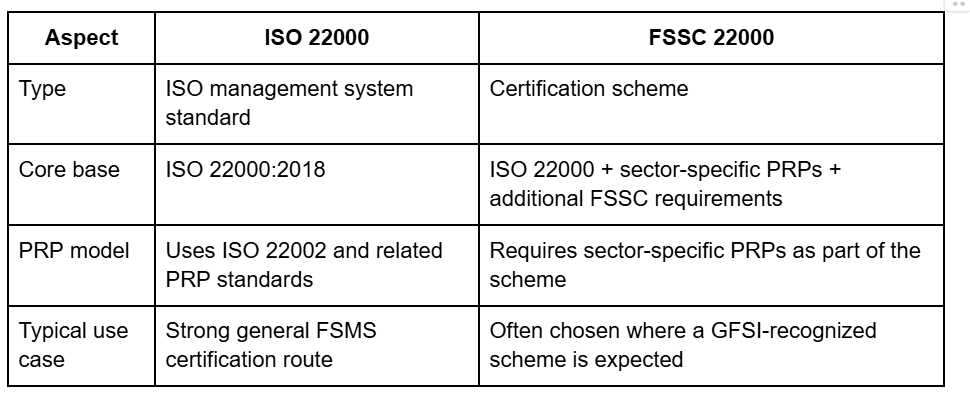
That distinction matters in buyer-facing markets. Some organizations only need a credible ISO 22000 certificate. Others are working with retailers or supply chains that specifically expect FSSC 22000 or another GFSI-recognized route.

If your business is evaluating ISO 22000 certification now, the right next step is a readiness review, not a blind quote request. You need to confirm scope, food-chain activities, PRP requirements, HACCP complexity, current FSMS maturity, and whether you need support before the external audit.
At AGS, we help food-chain organizations move through that decision properly: define scope, assess gaps, prioritize documentation and control points, prepare for audit, and build a cleaner certification route. AGS publicly presents ISO 22000 certification support on its site and positions itself as an independent third-party certification body with accredited certification services.
Get support planning your ISO 22000 certification journey.


It applies to organizations across the food chain, including primary production, manufacturing, distribution, food service, packaging, equipment, and feed production. ISO states that it can be used by any organization regardless of size or position in the food chain.
No. ISO 22000 integrates HACCP principles into a broader food safety management system. HACCP is part of the control logic, but ISO 22000 adds management-system requirements, communication, verification, review, and continual improvement.
FSSC 22000 is a certification scheme based on ISO 22000, sector-specific PRPs, and additional FSSC requirements. It is commonly chosen where GFSI-recognized schemes are expected.
Usually no. Certification is voluntary, but retailer, buyer, exporter, or procurement requirements can make it commercially necessary in practice.
Use IAF CertSearch where the certificate is listed, or verify through the issuing certification body and the relevant accreditation body. ISO’s certification guidance points users directly to IAF CertSearch for this purpose.