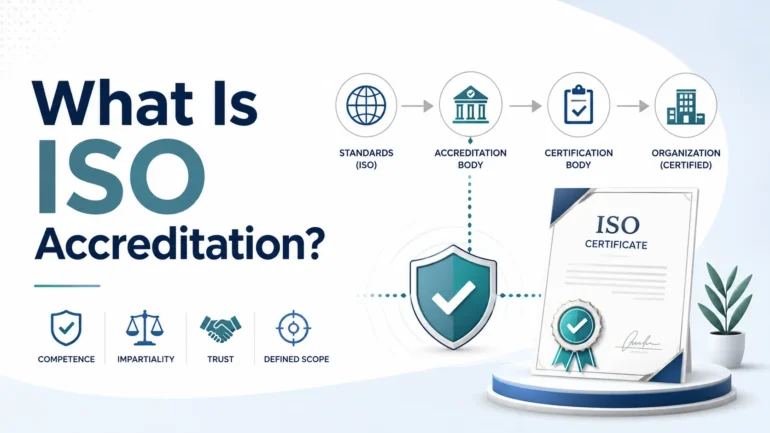
What Is ISO Accreditation? ISO accreditation is formal recognition that a conformity assessment body is competent, impartial, and able to carry out specific assessment work. That body may be a certification body, testing laboratory, calibration laboratory, inspection body, or medical laboratory. Most businesses are not trying to become “ISO accredited.” They are usually trying to become ISO certified. The certification body may be accredited, while the business receives certification to a specific ISO standard. That difference is small in wording but important in practice. It affects how certificates are issued, how buyers review them, and how organizations avoid misleading ISO claims. What ISO Accreditation Means in Practice ISO accreditation means an accreditation body has recognized that a conformity assessment body is competent for defined assessment activities. In simple words, accreditation checks whether the organization doing the assessment is qualified to do that work. A certification body may be accredited to audit and certify management systems. A testing laboratory may be accredited to perform certain tests. A medical laboratory may be accredited to show quality and competence in medical testing. The keyword is scope. Accreditation is not a general approval for every activity. It applies to specific standards, technical areas, sectors, or assessment services. ISO/IEC 17011 is the main standard for accreditation bodies. It specifies requirements for the competence, consistent operation, and impartiality of accreditation bodies that assess and accredit conformity assessment bodies. ISO Accreditation vs ISO Certification ISO accreditation evaluates the body doing the assessment. ISO certification evaluates the organization, system, product, service, process, or person being assessed. Attribute ISO Accreditation ISO Certification Who receives it? Certification bodies, laboratories, inspection bodies, and other conformity assessment bodies Companies, management systems, products, services, processes, or persons Who grants or issues it? Accreditation body Certification body What does it show? The assessment body is competent and impartial for a defined scope The certified subject meets specific requirements Simple example A certification body is accredited to certify ISO 9001 systems A company is certified to ISO 9001 Common wording issue “Our company is ISO accredited.” Usually should be “Our company is ISO certified.” ISO defines certification as written assurance by an independent body that a product, process, service, or system meets specific requirements. ISO also states that it does not provide certification or conformity assessment itself; certification is performed by external certification bodies. How the ISO Accreditation System Works The ISO accreditation system works through separate roles: ISO publishes standards, accreditation bodies assess conformity assessment bodies, and certification bodies issue certificates. This separation is what gives the system credibility. The same organization should not write the standard, accredit itself, audit the company, and approve the result without independent checks. ISO publishes the standards ISO develops and publishes international standards. ISO does not issue ISO certificates and does not certify companies directly. Accreditation bodies recognize assessment bodies. Accreditation bodies assess organizations such as certification bodies, laboratories, and inspection bodies. Their job is to confirm competence, impartiality, and consistent operation for a defined scope. Certification bodies issue ISO certificates Certification bodies audit organizations against specific standards and issue certificates when requirements are met. For management system certification, ISO/IEC 17021-1 sets requirements for bodies that audit and certify management systems. A simple example makes this clearer: a company may be certified to ISO 9001, while the certification body that audited the company may be accredited for ISO 9001 certification. Who Actually Needs ISO Accreditation? Conformity assessment bodies need accreditation when they want formal recognition of their competence. Most ordinary businesses need ISO certification instead. A business seeking ISO 9001, ISO 14001, ISO 45001, or ISO/IEC 27001 is usually looking for certification. The business wants an independent certification body to confirm that its management system meets the chosen ISO standard. Accreditation is different. It is usually relevant to organizations that assess others, such as: certification bodies, testing laboratories, calibration laboratories, inspection bodies, product certification bodies, validation and verification bodies, medical laboratories. A construction company may become ISO 9001 certified. The certification body that audits the construction company may be accredited. The construction company receives certification; the certification body holds accreditation for that certification activity. What Makes a Certification Body Accredited? An accredited certification body has been assessed by an accreditation body and recognized as competent for a defined certification scope. The word “defined” matters. A certification body may be accredited for one standard but not another. It may be accredited for ISO 9001 certification but not ISO/IEC 27001 certification. It may also have limits by sector, technical area, or certification scheme. For management system certification bodies, ISO/IEC 17021-1 contains requirements for competence, consistency, and impartiality. ISO also notes that certification bodies operating to ISO/IEC 17021-1 do not have to offer every type of management system certification. So an accreditation claim should always be checked against the actual standard and scope. The name of the certification body alone is not enough. Why ISO Accreditation Matters for Certificate Credibility ISO accreditation matters because it adds trust to the organization performing the assessment. Most buyers cannot personally evaluate whether a certification body or laboratory is technically competent. Accreditation gives them another layer of confidence because the assessor has been reviewed by an accreditation body. Accreditation can support: confidence in competence, confidence in impartiality, more consistent assessment, stronger procurement review, better certificate credibility, lower risk of weak or misleading certificate claims. Still, accreditation does not guarantee acceptance everywhere. A buyer, regulator, or tender authority may still review the certificate scope, accreditation route, certification body, dates, and specific contract requirements. Accredited vs Non-Accredited ISO Certification Accredited ISO certification is issued by a certification body accredited for the relevant certification activity and scope. Non-accredited certification is not backed by that accreditation route. Non-accredited certification may exist. In some cases, it may be enough for internal use or a low-risk buyer requirement. In other cases, it may not satisfy a tender, regulator, procurement team, or customer. The problem usually appears later. A company may receive a certificate and then discover that the buyer wanted