Home » ISO 50001
ISO 50001 Certification UAE helps organizations control energy use, reduce operating costs, and demonstrate regulatory and sustainability discipline across Dubai, Abu Dhabi, Sharjah, JAFZA, Dubai Industrial City, and other UAE business zones. AGS provides accredited third-party ISO 50001 audits for organizations that need an Energy Management System assessed by an independent certification body, not a consultant-only provider.
For UAE businesses, ISO 50001 certification supports three commercial realities. ISO 50001 certification reduces energy waste. ISO 50001 certification strengthens reporting discipline. ISO 50001 certification supports market credibility with regulators, investors, and major buyers. In energy-intensive sectors, that credibility matters on the ground, whether the organization operates from a factory in Dubai, a logistics site in Jebel Ali, or a hotel portfolio in Abu Dhabi.
ISO 50001 certification also fits the current UAE policy direction. UAE organizations face growing pressure to improve energy performance, document emissions data, and support national sustainability goals. An accredited ISO 50001 certificate gives that effort an auditable structure.
ISO 50001:2018 is the international standard for Energy Management Systems. ISO 50001:2018 specifies requirements for organizations to establish, implement, maintain, and improve energy management practices that enhance energy efficiency, reduce costs, and lower environmental impact.
Published by the International Organization for Standardization, ISO 50001:2018 provides a systematic framework for organizations to improve energy performance, including energy efficiency, energy use, and energy consumption. ISO 50001:2018 turns energy management from an ad hoc activity into a governed business system. ISO 50001 certification requires an organization to:
ISO 50001 certification does not mean ISO issues certificates. ISO develops the standard. Accredited certification bodies audit organizations against the standard. That distinction matters in the UAE because regulators, tender authorities, investor groups, and enterprise procurement teams often look for a certificate issued through an accredited third-party route.
For organizations operating in the UAE, ISO 50001 certification provides the framework to reduce energy costs, comply with federal regulations, and contribute to national sustainability goals. ISO 50001 certification converts energy performance into a documented management discipline instead of a general operational ambition.
UAE Federal Decree-Law No. 11 of 2024 requires large emitters to monitor and report greenhouse gas emissions. The brief positions the threshold at large emitters (500,000+ tons CO₂ equivalent) annually. ISO 50001 provides the management framework to establish energy baselines, track energy performance, and document the data needed to support structured emissions monitoring and reporting.
For UAE organizations, that link matters. Energy data and emissions data sit close together in operational practice. An Energy Management System creates documented controls around energy review, monitoring, measurement, objectives, action plans, and management review. That structure supports a cleaner reporting trail when the organization needs to show how energy use is measured and managed.
UAE Net Zero 2050 sets the national direction for long-term decarbonization and energy transition. ISO 50001 helps organizations align internal energy management with wider policy goals under UAE Vision 2021/2050, the Dubai Clean Energy Strategy, and the Abu Dhabi Energy Strategy.
For a UAE business, that alignment is not only reputational. That alignment supports ESG positioning, investor conversations, bid qualification, and stakeholder confidence. When an organization says energy performance improves year over year, ISO 50001 gives the organization the governance structure to prove that claim.
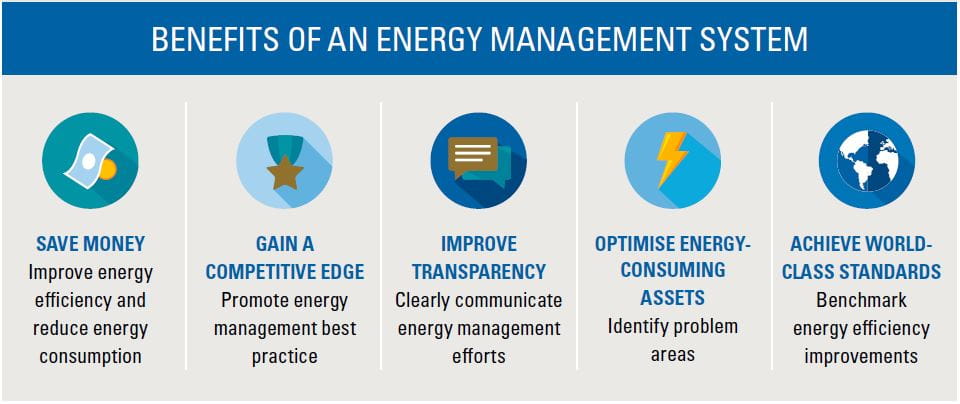
Energy-intensive operations carry real cost exposure. Manufacturing plants, logistics hubs, hospitality assets, utilities, and oil and gas operators all feel that pressure in utility bills, fuel use, process loads, chilled water demand, and HVAC consumption. ISO 50001 drives systematic identification of energy-saving opportunities and typically supports 10-20% energy cost reduction within the first few years of disciplined implementation, according to the content brief. ISO 50001 certification supports 6 main business outcomes in the UAE:
For UAE operators, that business case is straightforward. Lower consumption improves margins. Better reporting improves defensibility. Accredited certification improves trust.
Satisfied Clients
Years of Experience
ISO certifications
ISO 50001 certification delivers significant value across multiple sectors of the UAE economy, particularly for energy-intensive industries.
Each of those sectors has different energy signatures. Manufacturing focuses on process loads. Logistics focuses on fleet and warehouse energy. Hospitality focuses on comfort-driven loads such as cooling, hot water, and public-area lighting. ISO 50001 provides one framework that adapts to those different operational realities.
ISO 50001 is built on the Plan-Do-Check-Act framework, with specific emphasis on Energy Baselines, EnB, and Energy Performance Indicators, or EnPI, to measure and track energy performance. Those elements make ISO 50001 more than an energy policy document. Those elements make ISO 50001 a measurable management system.
The PDCA cycle provides the method for systematic energy management.
That cycle matters because energy performance does not improve through policy language alone. Energy performance improves when the organization reviews data, defines priorities, applies controls, checks results, and corrects gaps.
Energy Baselines or EnB are quantitative reference points against which energy performance is compared. An organization establishes EnB using historical energy data and adjusts that baseline for relevant variables such as production volume, weather, occupancy, or operational hours.
An EnB answers a core business question. An EnB shows where the organization starts. Without an EnB, a business cannot show credible improvement. For UAE factories, an EnB may reflect energy per unit of production. For UAE hotels, an EnB may reflect energy per occupied room or per square meter. For logistics facilities, an EnB may reflect warehouse electricity or fleet fuel use.
Energy Performance Indicators or EnPI are metrics that quantify energy performance. An EnPI translates raw consumption into a performance indicator that management can track. Common EnPI examples include:
An EnPI matters because utility spend alone does not explain performance. Energy spend changes with tariffs. Energy performance changes with how efficiently the operation runs.
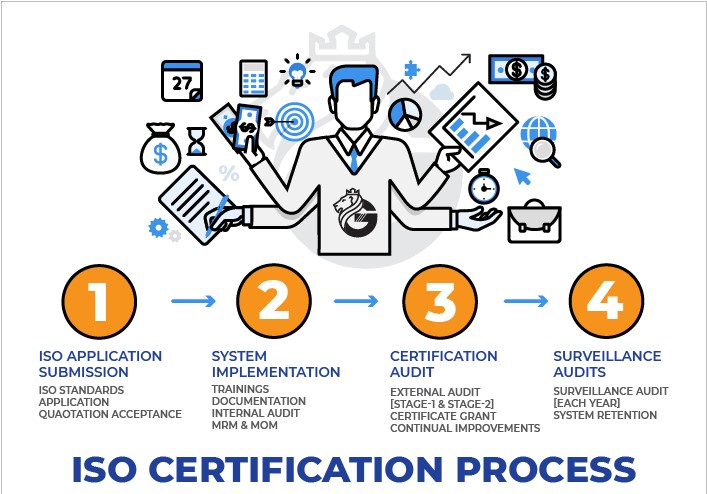
Achieving ISO 50001 certification in the UAE follows a structured process that typically takes 4-8 months from initiation to certificate issuance, depending on organization size and EnMS maturity. ISO 50001 certification follows an audit pathway, not a shortcut exercise.
For UAE businesses, the biggest delays usually appear in three areas. Weak baseline data causes delays. Incomplete EnPI logic causes delays. Poor documentation discipline causes delays. When those three areas are clean, the audit route usually moves in a more predictable way.
ISO 50001 certification typically takes 4 to 8 months from the start of implementation to certificate issuance for most UAE organizations. Timeline depends on four main factors:
The certification cycle then continues with annual surveillance audits and recertification every 3 years. For UAE organizations, timing also depends on operational complexity. A single commercial building with stable utility data usually moves faster than a multi-site industrial group across Dubai, Abu Dhabi, and JAFZA. A mature operation with existing ISO 9001 or ISO 14001 controls also tends to move faster because document control, internal audit, and management review structures already exist.
ISO 50001 certification is valid for three years, subject to passing annual surveillance audits in years 1 and 2. To maintain certification:
That lifecycle keeps the EnMS active. That lifecycle keeps energy performance review active. That lifecycle also helps the organization adapt when operations, tariffs, equipment, occupancy, or production volumes change.
As an accredited body, we issue certificates for the most sought-after management system standards:
As organizations research ISO 50001 certification in the UAE, organizations encounter two distinct provider categories: energy management consultants and accredited certification bodies. Understanding that distinction is critical, especially when certification must stand up to regulatory scrutiny under UAE Federal Decree-Law No. 11 of 2024.
Energy management consultants help an organization develop, document, and implement the EnMS. A consultant may establish energy baselines, define EnPI, support documentation, and prepare the organization for audit. A consultant does not issue the certificate. Accredited certification bodies perform the independent third-party audit and issue the certificate when audit evidence supports conformity. AGS maintains structural separation and impartiality safeguards. AGS does not consult for companies that AGS audits for certification.
That distinction matters in the UAE market because buyers, regulators, and investor-side reviewers do not treat implementation support and independent certification as the same thing. A consultant prepares the system. A certification body validates the system. The sections below explain how ISO 50001 maps to UAE compliance, why accreditation matters, how certificate verification works, and how AGS operates as an independent, USA-headquartered certification partner with local presence in Dubai and Abu Dhabi.
UAE Federal Decree-Law No. 11 of 2024 mandates that large emitters monitor and report greenhouse gas emissions. The brief positions the threshold at large emitters generating 500,000+ tons CO₂ equivalent annually. ISO 50001 provides the management framework to operationalize those legal requirements into systematic energy and emissions management.
For organizations subject to Decree-Law No. 11, independent certification to ISO 50001 provides regulators and counterparties with stronger confidence that monitoring and measurement systems are structured, documented, and reviewed. AGS audits verify that the EnMS includes appropriate records, controls, objectives, performance tracking, and management review logic.
Non-compliance exposure brings legal risk, commercial risk, and reputational risk. ISO 50001 certification with an accredited body such as AGS acts as a compliance shield in governance terms because ISO 50001 certification demonstrates that the organization has implemented systematic energy management and documented monitoring aligned with international best practice. For UAE businesses, that matters when the organization needs to show more than intent. The organization needs evidence. ISO 50001 creates that evidence trail.
Accreditation matters because accreditation confirms that a certification body is competent, impartial, and authorized to certify within a defined scope. Without accreditation, a certificate may exist as a document, but a document alone does not carry the same trust in tendering, investor review, supply-chain qualification, or regulator-facing scrutiny.
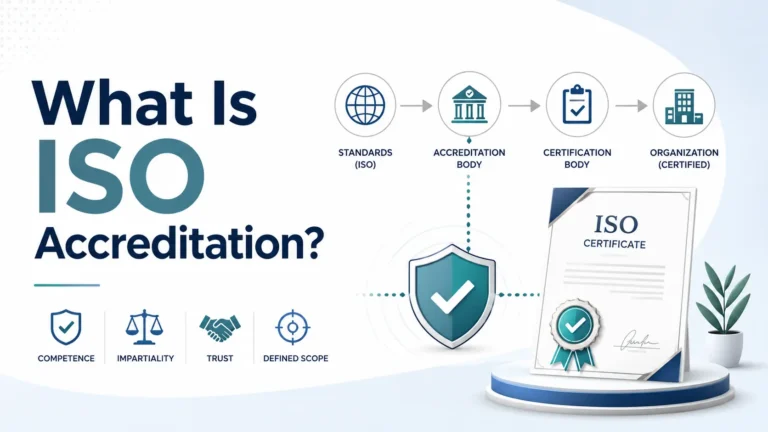
Accreditation is the formal recognition by an authoritative body that a certification body such as AGS is competent, impartial, and capable of certifying organizations to specific ISO standards. In the certification hierarchy:
Key accreditation entities include:
All accredited ISO 50001 certificates issued by AGS are registered in IAF CertSearch, the global verification platform referenced in the brief. To verify a certificate:
That verification capability protects organizations from greenwashing concerns and weak credentials. That verification capability also helps regulators, investors, and international partners independently confirm authenticity. AGS also maintains a certificate verification tool for quick access.
ISO 50001 certification with AGS is a 3-year partnership, not a one-time transaction. The lifecycle includes initial certification and ongoing maintenance.
That lifecycle maintains the organization’s license to operate from an energy management perspective. Energy performance improvement does not hold value unless the system continues to operate, adapt, and produce evidence.
For manufacturing facilities in Dubai, ISO 50001 certification provides a structured framework to optimize energy-intensive processes, reduce per-unit production costs, and support sustainability expectations in Dubai Industrial City and Dubai South. Manufacturing facilities often focus on:
ISO 50001 helps a manufacturing site establish EnB and EnPI against production activity. A site can then measure whether energy performance per unit actually improves. For Dubai manufacturers, that matters because utility performance, process efficiency, and sustainability expectations often sit in the same conversation.
JAFZA logistics companies and fleet operators use ISO 50001 to optimize fuel consumption, reduce carbon emissions, and demonstrate energy discipline to global clients and supply-chain partners. Logistics operations often focus on:
A JAFZA operator often deals with customer audits, shipping pressure, temperature-sensitive goods, and multinational partner expectations. ISO 50001 gives those operations a measurable framework rather than a loose efficiency program.
Abu Dhabi hotels and hospitality establishments use ISO 50001 to manage energy-intensive HVAC, lighting, hot water, laundry, kitchen equipment, and public-area systems while reducing operating costs and strengthening green credentials. Hospitality operations often focus on:
For hospitality portfolios, energy performance often sits right next to guest comfort. ISO 50001 helps balance both. A hotel group can benchmark performance, review energy intensity, and support sustainability positioning under local expectations such as DCT and Estidama-related market awareness.
Organizations with multiple facilities across the UAE can achieve multi-site ISO 50001 certification under a single coordinated EnMS. A business may run a manufacturing plant in Dubai, a warehouse in JAFZA, and a head office in Abu Dhabi. A coordinated certification route makes that structure manageable. Multi-site certification provides four practical advantages:
For UAE groups, multi-site certification reduces administrative duplication while keeping audit rigor in place. AGS auditors work with the organization to define scope boundaries, site relationships, central functions, and site-specific evidence expectations.
Complex groups often need that coordination because mainland and free zone sites do not always operate with the same risk profile, energy use, or reporting structure. A coordinated EnMS creates consistency without forcing every site into the exact same operating model.


ISO 50001 provides the systematic framework for GHG emissions monitoring by establishing energy baselines, Energy Performance Indicators, documented controls, and management review. The compliance mapping section above shows how ISO 50001 clauses support the reporting discipline expected under UAE Federal Decree-Law No. 11 of 2024 for large emitters.
Accredited ISO 50001 certification is issued by a certification body evaluated by a recognized accreditation body such as IAS or EIAC, while non-accredited certification carries no equivalent independent confirmation of certifier competence. Non-accredited certificates often face acceptance issues in government tenders, utility-linked qualification processes, and multinational supply chains.
IAF CertSearch verifies an ISO 50001 certificate’s authenticity by certificate number or organization name. AGS also provides a certificate verification tool for quick status checks. A valid accredited certificate shows current status, scope, and accreditation information.
Most organizations use a consultant for EnMS preparation and an accredited certification body for the final audit. A consultant supports baselines, EnPI, and documentation. A certification body provides the independent audit and accredited certificate. AGS maintains strict separation to preserve impartiality.
ISO 50001 certification is not legally mandatory for most UAE businesses, but ISO 50001 certification is increasingly relevant in government tenders, DEWA-linked qualification contexts, and large corporate supply chains. For large emitters under UAE Federal Decree-Law No. 11 of 2024, ISO 50001 certification demonstrates compliance capability and due diligence.
ISO 50001 certification is valid for three years, subject to passing surveillance audits in years 1 and 2. A recertification audit renews the next cycle before expiry.
ISO 50001 certification is a strategic framework that reduces costs, supports UAE compliance, and demonstrates sustainability commitment. Contact our UAE team today: