ISO Standards Covered for Audit Readiness
Audit support should match the required ISO standard. A generic ISO checklist will not properly prepare an organization for a standard-specific audit.
Standard | Audit focus | Common evidence reviewed |
ISO 9001 | Quality management | Process controls, customer requirements, quality objectives, supplier controls, nonconformity handling, internal audits, management review |
ISO 14001 | Environmental management | Environmental aspects, compliance obligations, objectives, operational controls, emergency planning, monitoring records, corrective actions |
ISO 45001 | Occupational health and safety management | Hazard identification, risk controls, worker consultation, incident records, emergency preparedness, training records, OH&S objectives |
ISO/IEC 27001 | Information security management | Information risk assessment, risk treatment, asset inventory, access controls, incident response, Statement of Applicability, security objectives |
ISO 22000 | Food safety management | Hazard analysis, prerequisite programmes, supplier controls, traceability, monitoring records, corrective actions, food safety team evidence |
ISO 29001 | Petroleum, petrochemical, and natural gas sector quality management | Product or service conformity, supply-chain controls, risk controls, process quality, failure analysis, corrective action |
ISO 37001 | Anti-bribery management | Anti-bribery controls, risk assessment, due diligence, reporting channels, training, monitoring records |
ISO 22301 | Business continuity management | Business impact analysis, continuity plans, exercises, recovery procedures, incident response records |
ISO 13485 | Medical device quality management | Regulatory controls, design/process records, supplier controls, risk management, traceability, corrective actions |
ISO/IEC 17025 | Laboratory accreditation readiness support | Testing/calibration competence, traceability, method validation, quality control, proficiency testing, impartiality records |
Important note: ISO/IEC 17025 is generally used for laboratory accreditation, not ordinary management-system certification. If your organization needs laboratory recognition, the audit path should be scoped separately.
ISO Audit Process in Iraq
A useful ISO audit process should show what will be reviewed, what evidence is needed, and what happens after findings are issued.
1. Confirm the Audit Objective
The first step is to confirm why the audit is needed.
The reason may be:
- Certification preparation.
- Tender readiness.
- Surveillance audit preparation.
- Recertification preparation.
- Supplier approval.
- Customer audit response.
- Internal review.
- Corrective-action closure.
- Multi-site consistency review.
The audit objective affects the depth of review, evidence required, audit team needed, timeline, and final deliverables.
2. Define the Audit Scope and Criteria
The audit scope explains what sites, services, departments, processes, and activities will be reviewed.
The audit criteria explain what requirements the system will be checked against. These may include ISO standard clauses, internal procedures, client requirements, legal or contractual obligations, and certification-body expectations.
A weak scope can create problems later. An audit report or certificate that does not match the real business activity may fail a client, buyer, tender, or certification review.
3. Review Documents and Records
The auditor or audit support team reviews documents, procedures, records, registers, training evidence, internal audit reports, management review minutes, risk records, incident records, corrective actions, and other evidence.
This stage identifies weak or missing evidence before the organization faces a formal audit.
4. Conduct Interviews and Process Checks
Audits do not rely only on documents. Staff may be asked how they perform work, report issues, control records, manage risks, follow procedures, respond to incidents, or handle customer requirements.
The goal is to check whether the management system is used in practice.
5. Report Findings
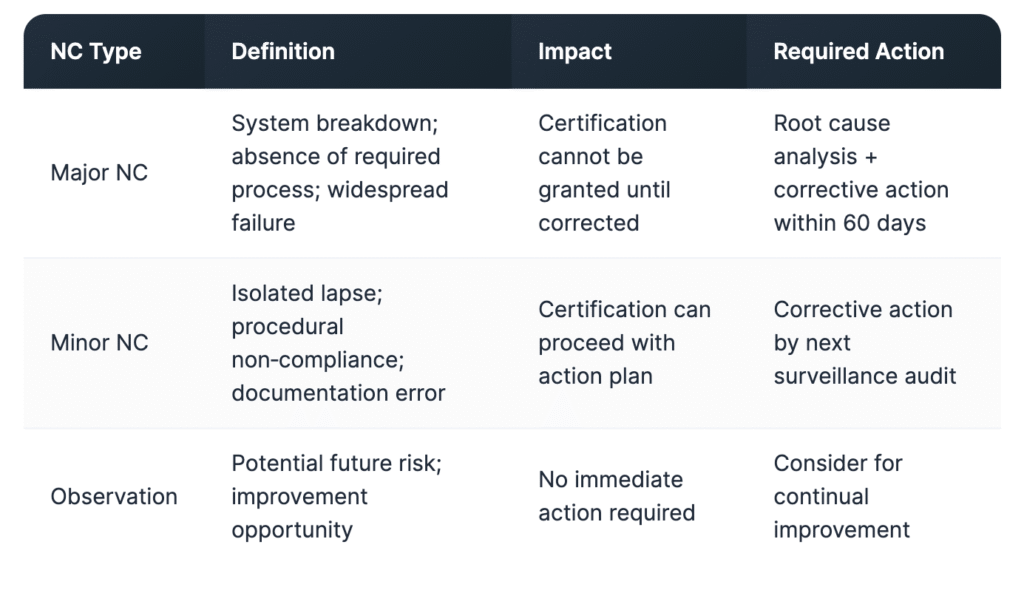
The audit report should identify conformities, nonconformities, observations, evidence gaps, and areas needing correction.
Strong reports connect each finding to:
- The requirement.
- The process reviewed.
- The evidence checked.
- The risk created.
- The correction needed.
- The responsible person or team.
6. Close Corrective Actions
Corrective action should address the cause of the problem, not only the visible mistake. A missing record may point to poor responsibility assignment, weak training, unclear document control, or lack of management review.
AGS can support corrective-action tracking so the organization understands what needs to change before the next audit.
What You Receive From an ISO Audit Readiness Review
The deliverable depends on the audit type, standard, organization size, site scope, and audit objective.
Audit need | Review activity | Expected deliverable |
Certification audit preparation | Review scope, documents, implementation evidence, internal audit, and management review | Readiness summary and priority action list |
Internal audit support | Review system against selected ISO standard and internal procedures | Internal audit plan, findings, and corrective-action tracker |
Gap assessment | Identify missing documents, weak records, and implementation gaps | Gap register with priority levels |
Surveillance preparation | Review current evidence since the previous audit | Surveillance readiness checklist |
Recertification preparation | Review system performance, changes, and previous audit history | Recertification readiness summary |
Supplier audit support | Review supplier controls or supplier readiness against buyer requirements | Supplier audit checklist or findings report |
Nonconformity closure | Review root cause, correction, corrective action, and closure evidence | Corrective-action follow-up record |
Documents Required for an ISO Audit
The required documents depend on the standard, scope, company activity, sites, and audit type. Most ISO audits review a core evidence set first.
Evidence area | Examples auditors may review |
Scope and policy | Management system scope, policy, responsibilities, interested parties |
Objectives | Quality, safety, environmental, food safety, information security, energy, or business continuity objectives |
Procedures | Process controls, document control, operational controls, incident handling, supplier controls |
Risk records | Business risks, safety hazards, environmental aspects, food safety hazards, information security risks |
Training evidence | Training plans, attendance records, competence records, awareness records |
Internal audit | Audit programme, audit plan, audit report, findings, corrective actions |
Management review | Meeting records, decisions, performance review, resource decisions |
Corrective actions | Nonconformity records, root-cause review, actions taken, closure evidence |
Operational records | Inspection records, monitoring logs, supplier checks, service delivery records |
Compliance evidence | Legal, regulatory, contract, client, or tender-related records where applicable |
Common ISO Audit Findings

Many audit problems come from weak evidence rather than total absence of a system. The organization may have documents, but the records do not prove that the system works.
Common findings include:
- Outdated procedures.
- Missing training records.
- Unclear process ownership.
- Weak internal audit records.
- Incomplete management review.
- Unresolved corrective actions.
- Poor document control.
- Missing risk assessments.
- Incomplete supplier records.
- Records that do not match actual work.
- Staff who are unaware of their responsibilities.
- Objectives that are not measured.
- Scope that does not match real operations.
For certification audit preparation, the most serious risk is discovering these issues after the certification body has already started the formal audit. A readiness review helps identify these problems earlier.
ISO Audit Support for Key Iraqi Sectors
AGS provides ISO audit readiness support for different Iraqi sectors. The audit scope should always match the real activity, site, risk level, and required standard.
Sector | Common audit concerns | Relevant standards may include |
Oil and gas services | Supplier qualification, process quality, safety controls, environmental records, contractor management | ISO 9001, ISO 14001, ISO 45001, ISO 29001 |
Construction and infrastructure | Site quality, subcontractor control, inspection records, safety risks, environmental controls | ISO 9001, ISO 14001, ISO 45001 |
Manufacturing | Process control, product conformity, calibration, supplier controls, corrective actions | ISO 9001, ISO 14001, ISO 45001 |
Food and catering | Food safety hazards, traceability, supplier controls, monitoring records, corrective actions | ISO 22000, HACCP-related systems |
IT and digital services | Information risk, access control, incident response, asset management, security objectives | ISO/IEC 27001 |
Healthcare and clinics | Administrative quality, patient-related process control, safety records, supplier controls | ISO 9001, ISO 45001, other applicable healthcare standards |
Laboratories | Testing competence, calibration traceability, method control, impartiality, quality control | ISO/IEC 17025 readiness support |
Security operations | Operational planning, training, risk controls, incident response, operational-control records | ISO 18788, PSC.1 where specifically required |
Do not assume that one standard solves every requirement. A tender, client, buyer, or certification body may require a specific scope, standard, accreditation route, or supporting evidence.