Home » ISO 27001
ISO 27001 Certification UAE helps organizations protect sensitive data, demonstrate information security governance, and meet buyer, regulator, and tender expectations across Dubai, Abu Dhabi, DIFC, ADGM, DMCC, JAFZA, and other UAE business hubs. AGS provides accredited third-party ISO 27001 audits for organizations that need an Information Security Management System assessed by an independent certification body, not a consultant-only provider. For UAE businesses, that distinction matters in the real world when enterprise clients, free zone authorities, procurement teams, and compliance functions ask for a certificate that carries proper weight.
ISO 27001 certification supports a practical commercial need. ISO 27001 certification protects data, supports regulatory alignment, and strengthens trust with clients, investors, and partners. In the UAE market, ISO 27001 certification also functions as a licence to operate for SaaS companies, FinTech firms, healthcare operators, government contractors, and other organizations that handle sensitive information at scale.
ISO/IEC 27001:2022 is the international standard for Information Security Management Systems. ISO/IEC 27001:2022 specifies requirements for establishing, implementing, maintaining, and continually improving an Information Security Management System to protect sensitive information. Published by ISO, ISO/IEC 27001:2022 is the most widely recognized framework for information security management. ISO/IEC 27001:2022 helps organizations manage risks, demonstrate compliance, and build stakeholder trust. ISO 27001 certification requires an organization to:
ISO 27001 certification does not mean ISO issues certificates. ISO publishes standards. Accredited certification bodies audit organizations against ISO/IEC 27001:2022. That distinction matters across the UAE because procurement teams, regulators, and enterprise clients often ask for accredited third-party certification, not internal declarations or consultant-issued paperwork.
For organizations operating in the UAE, ISO 27001 certification provides the framework to protect sensitive data, comply with national regulations, and demonstrate information security excellence to clients and partners. UAE organizations use ISO 27001 certification to show that information security controls are documented, risk-based, monitored, and independently audited. In local commercial terms, ISO 27001 certification helps UAE businesses show that data governance is in place before vendor onboarding, due diligence review, or tender evaluation starts.
The UAE PDPL or Personal Data Protection Law imposes legal requirements for handling personal data. ISO 27001 certification provides a systematic management framework that turns those legal requirements into practical controls, governance routines, and audit evidence. The brief also positions ISO 27001 certification as supporting alignment with NESA and SIA requirements in relevant contexts. For UAE organizations, that means ISO 27001 certification supports legal defensibility, internal accountability, and external trust.
Cyber risk is not theoretical for UAE businesses. Cyber risk affects cloud platforms, payment systems, healthcare records, vendor portals, employee devices, and cross-border data flows. ISO 27001 certification helps organizations identify vulnerabilities, assess risk, apply treatment plans, and monitor control effectiveness. That approach reduces the risk of data breaches, service disruption, compliance failures, and loss of client trust. For organizations in Dubai or Abu Dhabi, that framework often becomes the difference between a deal moving ahead and a deal stalling at security review. ISO 27001 certification delivers 6 main business benefits in the UAE:
Satisfied Clients
Years of Experience
ISO certifications
ISO 27001 certification delivers critical value across multiple sectors of the UAE economy, especially in industries where sensitive data, regulated operations, and buyer due diligence shape commercial outcomes. The strongest demand usually comes from sectors where enterprise customers, regulators, and investors expect formal information security governance.
ISO/IEC 27001:2022 represents a major update to the information security standard. Published in October 2022, ISO/IEC 27001:2022 responds to modern cyber threats, cloud-heavy architectures, supply-chain dependencies, and the growing importance of privacy-linked controls. For UAE organizations, the 2022 version matters because it aligns better with current business models, especially in cloud services, FinTech, SaaS, and outsourced operations.
The 2022 version introduces 11 new controls and restructures Annex A into 93 controls across 4 themes. The new control set responds to current operating realities rather than legacy-only security issues. Key additions include:
Those controls matter in the UAE market because organizations now operate across hybrid infrastructure, outsourced environments, regulated cloud platforms, and cross-border service chains. For Dubai-based SaaS providers, Abu Dhabi healthcare operators, and DIFC FinTech firms, those additions are not side notes. Those additions touch live business risk.
Modern cyber threats include ransomware, supply-chain compromise, privilege abuse, cloud misconfiguration, credential theft, and weak third-party control environments. ISO/IEC 27001:2022 addresses those threats by strengthening how organizations identify risk, assign ownership, document applicability, and evaluate control effectiveness. That change is especially relevant for UAE businesses operating in free zones, regional headquarters, and technology-heavy environments where business continuity and data protection sit under constant client scrutiny.
Organizations certified to ISO 27001:2013 had to transition to the 2022 version by October 2025. That date matters because outdated certificates lose relevance once the transition window closes. Organizations that still carry legacy documentation logic often need a transition audit and a structured review of Annex A changes, Statement of Applicability updates, and control applicability. AGS positions transition support as part of the certification pathway.
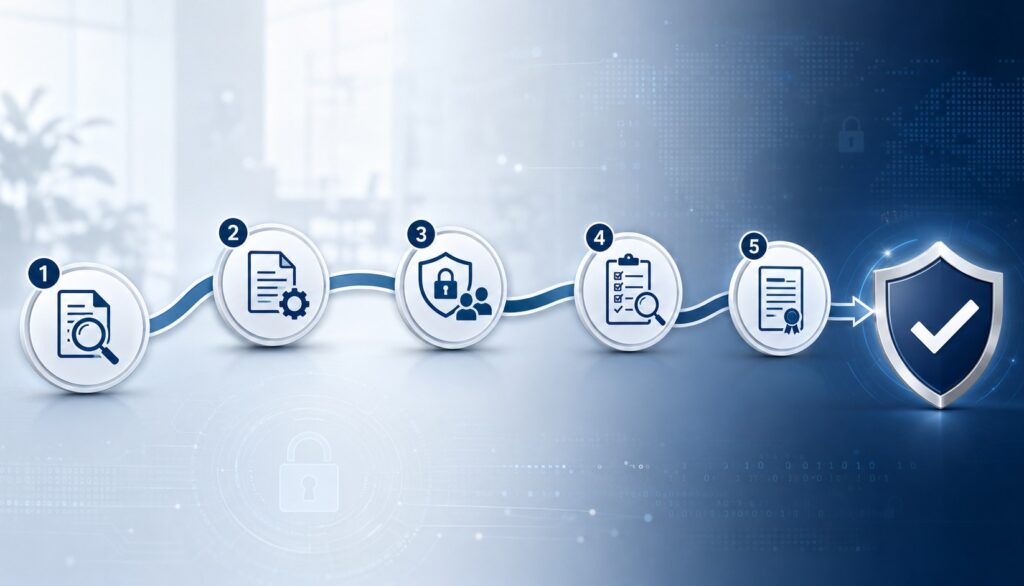
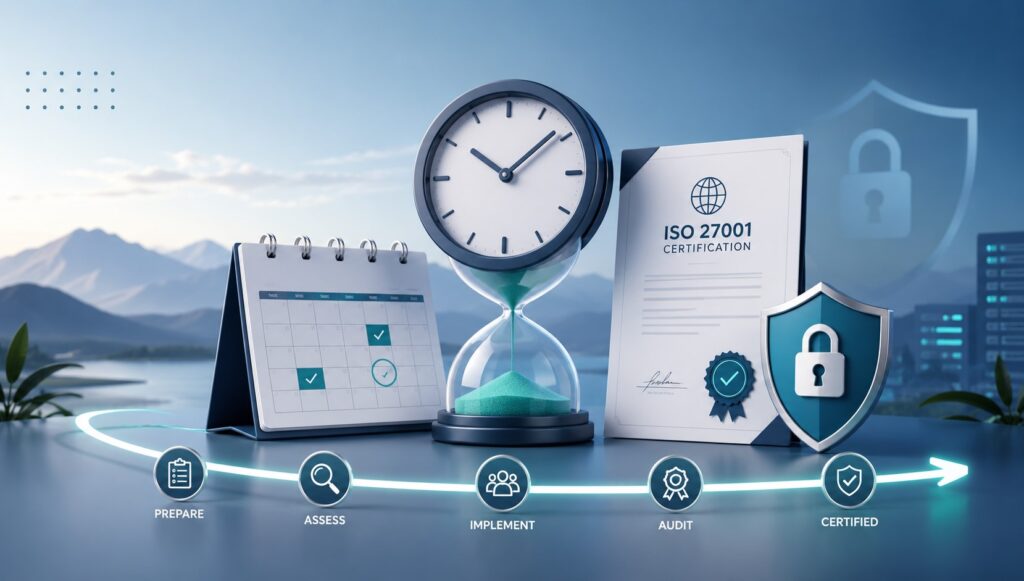
Achieving ISO 27001 certification in the UAE follows a structured audit process that usually takes 4 to 8 months from initiation to certificate issuance, depending on organization size, ISMS maturity, site count, and technical complexity. For UAE businesses, a proper certification route involves preparation, internal review, Stage 1 audit, Stage 2 audit, certification decision, and ongoing maintenance. A proper route does not mean unrealistic 2-week shortcuts.
For UAE organizations, the most common drag points appear in three areas: weak asset inventories, incomplete risk treatment logic, and underdeveloped Statements of Applicability. When those elements are in shape, the audit path usually moves more smoothly.
ISO 27001 certification typically takes 4 to 8 months from the start of implementation to certificate issuance for most UAE organizations. The timeline depends on organization size, ISMS maturity, scope complexity, and internal resource commitment. Small to medium organizations often complete certification in 4 to 6 months. Multi-site or technically complex environments often move closer to 6 to 8 months. Four timeline factors usually drive the schedule:
The certification cycle then continues with annual surveillance audits and recertification every 3 years. For UAE businesses, the fastest route usually comes from getting the scope, risk assessment, SoA, and evidence structure sorted early rather than trying to rush the final audit window.
As an accredited body, we issue certificates for the most sought-after management system standards:
ISO 27001 certification is valid for three years, subject to passing annual surveillance audits in years 1 and 2. That structure means certification is not a one-off exercise. Certification remains current only when the Information Security Management System continues to operate, adapt, and improve. To maintain certification:
That lifecycle matters because cyber threats, outsourced services, system architecture, and regulatory expectations change fast. A current ISMS needs a live review cycle, not shelf documentation.
As organizations research ISO 27001 certification in the UAE, organizations usually encounter two provider types: information security consultants and accredited certification bodies. Understanding that distinction is critical because the implementation role and the certification role are not the same. A consultant helps build or improve the Information Security Management System. A certification body performs the independent third-party audit and issues the certificate after conformity is confirmed.
Information security consultants help organizations design, document, and implement the Information Security Management System. Accredited certification bodies conduct the audit and issue the certificate when the audit evidence supports certification. AGS maintains structural separation and impartiality safeguards. AGS does not consult for organizations that AGS audits. That distinction is not academic. That distinction protects certificate credibility in front of clients, regulators, tender authorities, and investor due diligence teams.
For UAE buyers, the difference is simple. The consultant gets the system ready. The certification body signs off only after independent assessment. That separation gives the certificate proper authority in mainland and free-zone markets alike.
The UAE PDPL or Personal Data Protection Law establishes requirements for collecting, processing, and storing personal data. ISO 27001 provides the management framework that turns those legal requirements into practical controls, governance processes, and audit evidence. This compliance mapping is the strongest differentiator in the brief because competitors largely miss the bridge between formal PDPL obligations and ISO 27001 control structure.
Achieving ISO 27001 certification with an accredited body such as AGS provides regulators and counterparties with documented evidence that technical and organizational measures are in place. That evidence matters for organizations operating in DIFC, ADGM, and wider UAE markets where data governance scrutiny is no longer a nice-to-have. It is board-level and contract-level.
Accreditation matters because accreditation confirms that a certification body is competent, impartial, and authorized to certify within a defined scope. A certificate without proper accreditation may still exist as a document, but a certificate without proper accreditation does not carry the same trust signal in tenders, supplier qualification, or regulator-facing scrutiny. That gap matters a lot in the UAE, especially in government, finance, healthcare, and multinational supply chains.
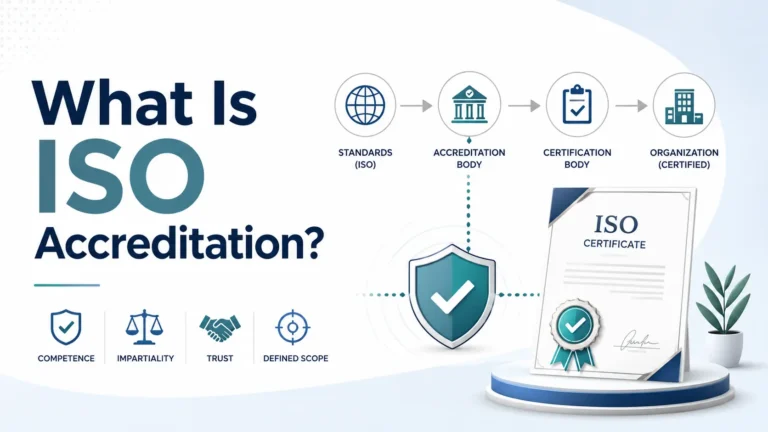
Accreditation is the formal recognition by an authoritative body that a certification body is competent, impartial, and capable of certifying organizations to specific ISO standards. In the certification hierarchy, ISO develops standards, accreditation bodies evaluate certification bodies, and certification bodies audit organizations.
All accredited ISO 27001 certificates issued by AGS are positioned in the brief as registered in IAF CertSearch, the official global verification platform maintained by the International Accreditation Forum. That verification capability matters because verification protects buyers, regulators, and counterparties from “certificate mills” and weak credential claims.
To verify an ISO 27001 certificate:
AGS also positions a dedicated certificate verification tool as a quick-access option. For UAE businesses, that means security review teams can check certificate status without back-and-forth delays.
ISO 27001 certification is often a non-negotiable requirement for enterprise contracts, platform partnerships, and investor due diligence.
FinTech firms in DIFC face stronger expectations around payment data security, transaction integrity, records protection, and regulator-facing governance.
Organizations must protect patient data in line with Department of Health or DoH expectations and wider health data requirements.
Companies operating in UAE free zones can achieve ISO 27001 certification with AGS while aligning the Information Security Management System to zone-specific business expectations and data protection environments. For UAE businesses, free-zone operations still face tough client due diligence, investor review, cross-border data scrutiny, and enterprise procurement checks. Free-zone status does not remove the need for credible information security governance.
AGS auditors are positioned in the brief as familiar with the business context and compliance pressures of those free zones. For local buyers, that matters because free-zone operations do not all face the same data, regulator, and customer mix.


Accredited ISO 27001 certification is issued by a certification body formally evaluated by a recognized accreditation body such as IAS or EIAC, while non-accredited certification carries no independent verification of the certifier’s competence. Non-accredited certificates often face acceptance problems in UAE government tenders, DIFC-linked reviews, and multinational supply chains. Non-accredited certificates also do not carry the same verification value through IAF CertSearch.
ISO 27001 provides the management framework and technical controls to operationalize UAE PDPL requirements, including data security, breach notification, governance, and accountability. The PDPL mapping section above shows how ISO 27001 clauses and Annex A controls translate legal obligations into auditable security practices. Accredited certification then provides external evidence that those practices are in place.
IAF CertSearch verifies an ISO 27001 certificate’s authenticity by certificate number or organization name. AGS also positions a certificate verification tool for quick status checks. Certificates issued under accredited routes such as IAS or EIAC can be checked for current status, scope, and accreditation details, which helps clients and regulators confirm authenticity independently.
Most organizations use a consultant for ISMS preparation and an accredited certification body for the final audit. Consultants support risk assessment, documentation, and control implementation. Certification bodies provide the independent audit and the accredited certificate. AGS maintains strict separation and does not consult for organizations that AGS audits, which protects impartiality.
ISO 27001 certification is not legally mandatory for most UAE businesses, but ISO 27001 certification is increasingly required for government tenders, DIFC and ADGM expectations, and major-corporate supply chains. In fintech, healthcare, SaaS, and technology, ISO 27001 certification often shifts from optional to commercially expected. That is the market reality.
ISO 27001 certification is valid for three years, subject to passing surveillance audits in years 1 and 2. A recertification audit is then required before expiry to renew the next cycle. That structure keeps the Information Security Management System active and current.
Organizations certified to ISO 27001:2013 had to transition to the 2022 version by October 2025. The transition required review of new control requirements, Annex A alignment, and updated applicability logic. AGS positions transition audits as part of the certification support pathway.
ISO 27001 certification is a strategic asset that protects data, supports UAE compliance, and qualifies your organization for new opportunities. Contact our UAE team today: