

















Home » Karbala
ISO certification in Karbala helps local companies prepare audited management systems for quality, safety, food safety, environmental, or information security requirements. We support standard selection, ISO documentation, audit readiness, certification-body coordination, and certificate verification guidance for companies that need stronger tender eligibility, supplier approval, and client trust.
Common certification routes include ISO 9001, ISO 45001, ISO 22000, ISO/IEC 27001, and ISO 14001 environmental management. The right route depends on your business activity, certification scope, current documents, site count, and buyer requirements.
ISO certification support gives your company a clear route from “we need a certificate” to “we are ready for audit.” The work starts with scope, not paperwork. A certificate only has value when the standard, site, business activity, certification body, and verification route are clear.
We help companies in Karbala prepare the system behind the certificate. That includes documentation, records, process controls, internal audit readiness, management review preparation, corrective-action planning, and certification audit coordination.
Companies usually seek ISO certification when a buyer, tender, supplier portal, project owner, or client asks for proof of a controlled management system.
Common triggers include:
A contractor may need ISO 9001 and ISO 45001 for project quality and worker safety. A hotel or catering company may need ISO 22000 for food safety. A service provider handling client data may need ISO/IEC 27001 for information security.
We help your team prepare the practical parts of the ISO certification route.
Our support can include:
The goal is not to create paper for the sake of paper. The goal is to build an audit-ready management system that matches your real work.
ISO preparation can use a hybrid delivery model when the project allows it. Document review, gap discussions, training coordination, and corrective-action tracking can often be handled remotely. Site visits are used when the scope, audit activity, or operational risk requires direct review.
For site-based companies, such as contractors, manufacturers, food operators, and healthcare facilities, the audit route may require stronger on-site evidence. For office-based service companies, much of the readiness work may be managed through structured remote review and scheduled meetings.
The delivery model is set after the standard, scope, site count, and audit requirements are understood.
The right ISO standard depends on what your company does and what the buyer needs to verify. A contractor, restaurant, clinic, manufacturer, and IT service provider do not need the same certification path.
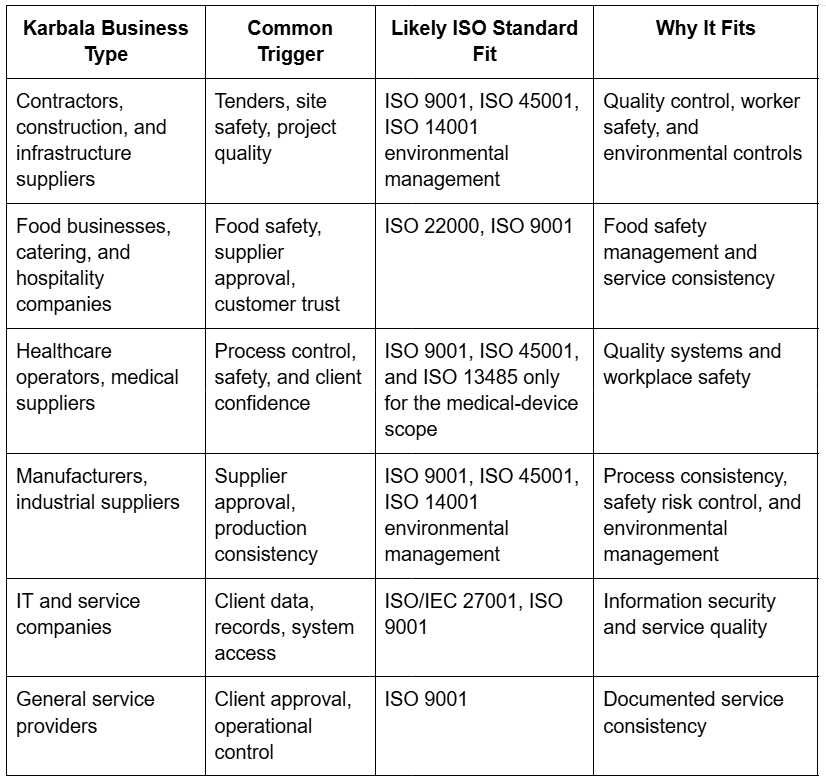
ISO 9001 certification in Karbala fits companies that need a quality management system. It supports consistent service delivery, documented processes, customer requirements, and improvement controls.
ISO 45001 certification in Karbala helps companies with workplace safety risks. It is common for contractors, industrial suppliers, site-based service providers, and operations to have worker safety responsibilities.
ISO 22000 certification in Karbala fits food businesses, catering companies, hotels, restaurants, and food suppliers that need a food safety management system.
ISO/IEC 27001 certification in Iraq fits companies that manage client information, digital records, system access, contracts, or sensitive business data.
ISO 14001 environmental management fits companies that need a structured environmental management system for waste, emissions, resource use, environmental risks, and operational controls.
Standard selection should follow the business trigger.
A tender asking for quality control usually points toward ISO 9001. A project with worker safety requirements may point toward ISO 45001. A food supply or hospitality requirement may point toward ISO 22000. A data-handling contract may point toward ISO/IEC 27001.
Karbala has documented activity across health, industry, tourism, education, services, infrastructure, and commercial development. That local mix matters because each sector creates a different certification need.
ISO 14001 environmental management should be handled with transition-aware wording because ISO has published ISO 14001:2026 as the current environmental management systems standard.
For Karbala companies, the key point is simple: environmental certification planning should confirm the applicable version, certification-body requirement, transition position, and buyer expectation before the audit route is finalized.
Satisfied Clients
Years of Experience
ISO certifications
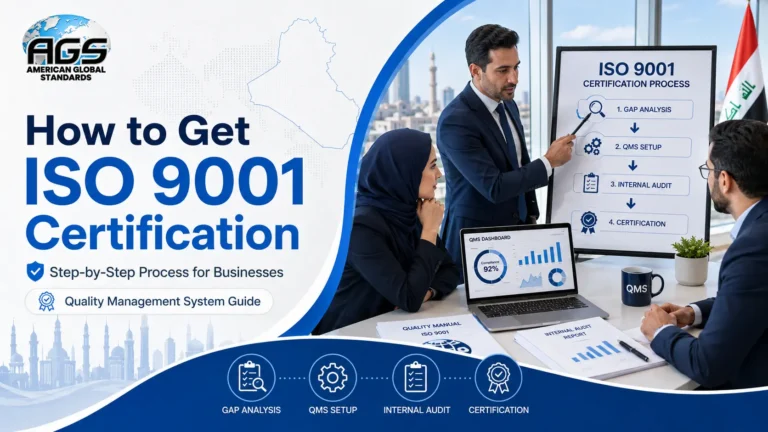
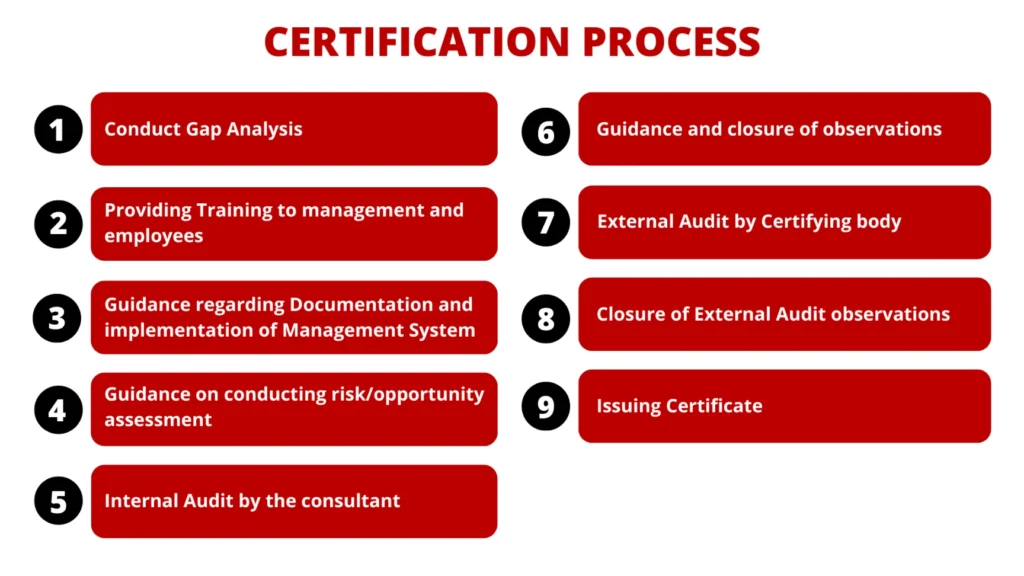
The ISO certification process moves from standard selection to certification decision through documented, auditable steps. Each step creates evidence for the next stage.
If the company has multiple sites, the certification scope and audit planning may change. If the company has weak documentation, more preparation is needed before the external audit.
ISO certification documents show how your company controls work, manages risk, trains people, checks performance, and corrects problems.
Most companies need a practical set of documents and records. The exact list changes by standard, scope, activity, and certification-body requirement.
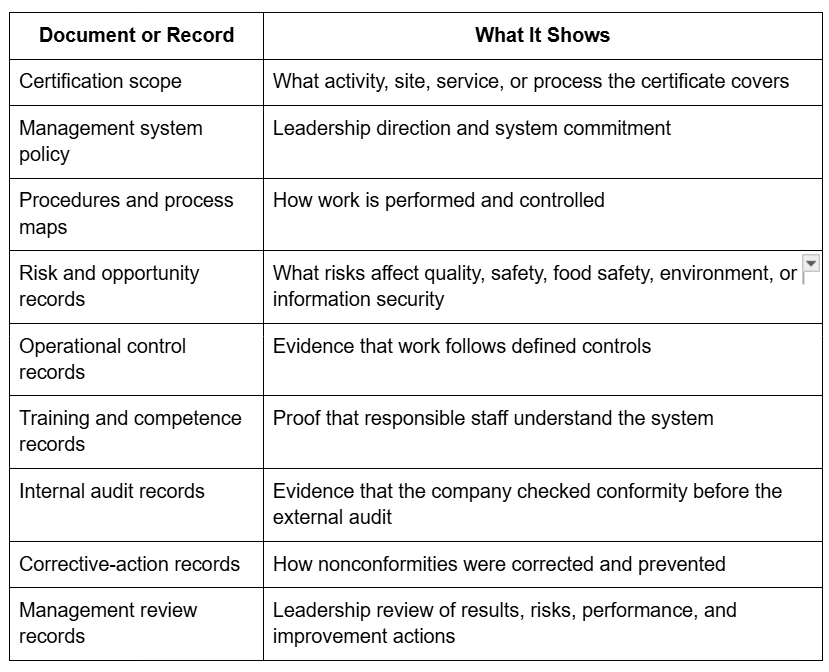
Documents should match the company’s actual operation. A copied manual with no working records creates audit risk.
ISO 9001 evidence focuses on quality management, customer requirements, process control, supplier control, and improvement.
ISO 45001 evidence focuses on hazards, OH&S risks, worker participation, legal requirements, incident controls, emergency planning, and safety performance.
ISO 22000 evidence focuses on food safety hazards, control measures, traceability, hygiene, monitoring, and food safety communication.
ISO/IEC 27001 evidence focuses on information risks, controls, access management, asset handling, security responsibilities, and continual improvement.
ISO 14001 evidence focuses on environmental aspects, compliance obligations, operational controls, environmental objectives, and performance review.
A company usually cannot rely on a certificate request alone. ISO certification depends on implemented processes, records, internal audit evidence, management review, and conformity with the selected standard.
Procedures do not always need to be long. Procedures need to be clear, controlled, used, and supported by records.
As an accredited body, we issue certificates for the most sought-after management system standards:
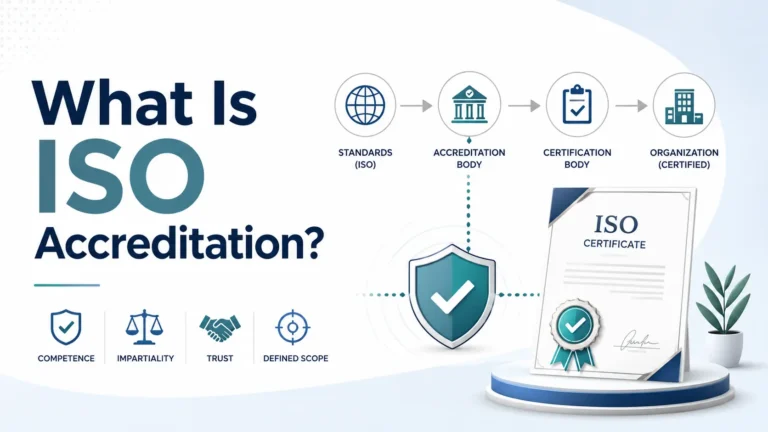
ISO certification involves separate roles. Understanding those roles protects your company from weak claims, invalid wording, and certificate routes that do not match buyer expectations.
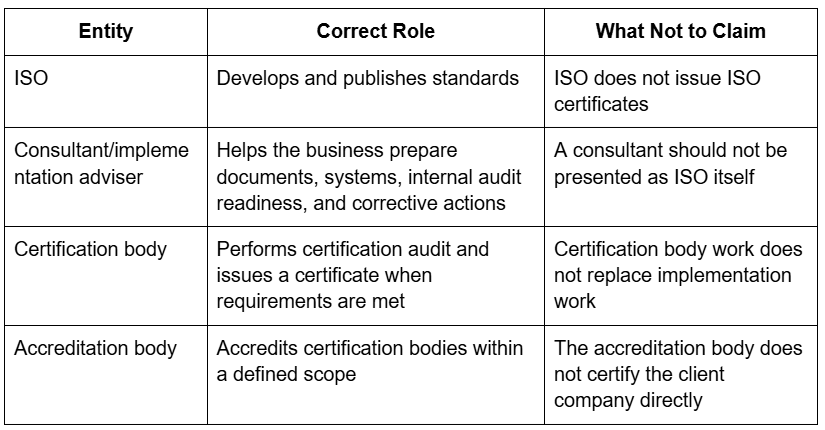
ISO develops and publishes international standards. ISO does not certify companies and does not issue ISO certificates.
A company should not say “certified by ISO.” The correct wording is that the company is certified to a specific ISO standard by a certification body, within a defined scope.
A consultant or implementation adviser helps the company prepare the system before the certification audit.
That support can include gap assessment, documentation, training, internal audit readiness, corrective-action support, and management review preparation. The consultant does not replace the certification body’s independent audit decision.
A certification body performs the certification audit and makes the certification decision.
The certification body checks whether the company’s management system conforms to the selected ISO standard and the defined certification scope. When requirements are met, the certification body issues the certificate.
An accreditation body assesses certification bodies within defined accreditation scopes.
Accreditation is important because it provides independent confirmation that the certification body operates under recognized conformity-assessment requirements. Certificate acceptance can depend on the accreditation route, buyer requirements, certification scope, and verification status.
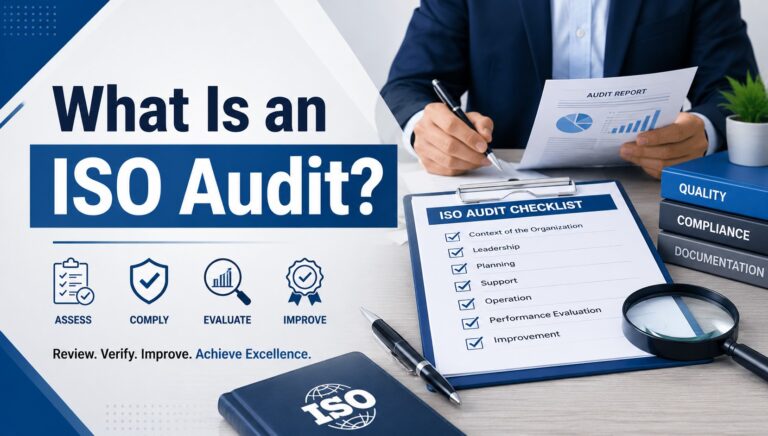
ISO certificate verification confirms whether the certificate is real, current, scope-aligned, and issued through the right route.
A certificate should be checked before being used for tenders, supplier approval, client onboarding, or compliance evidence.
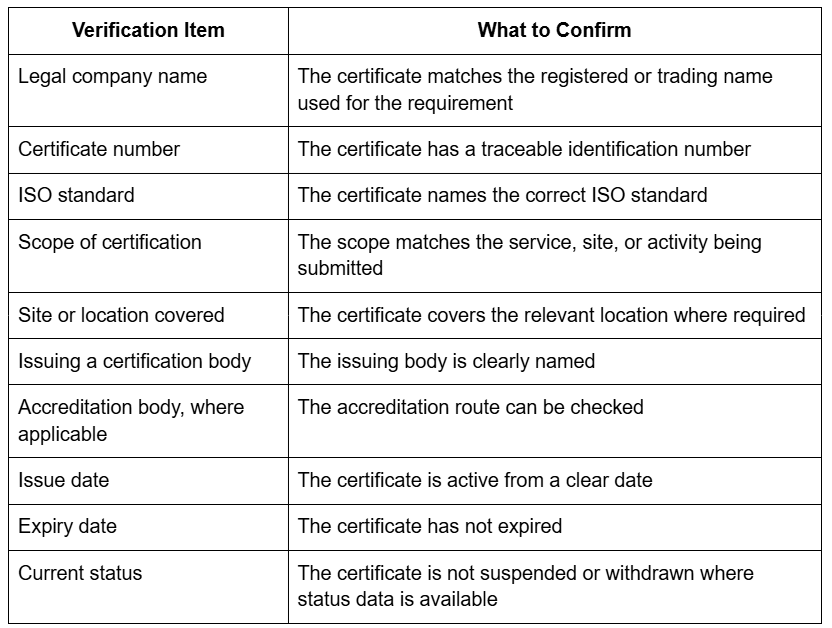
A valid certificate can still fail a buyer’s requirement when the scope is wrong.
A certificate for one service does not automatically cover every service. A certificate for one site does not automatically cover every branch. A certificate for ISO 9001 does not prove ISO 45001, ISO 22000, ISO/IEC 27001, or ISO 14001 conformity.
The scope must match the contract, tender, supplier portal, or client requirement.
IAF CertSearch can be used where applicable for accredited management-system certificate validation.
Direct confirmation with the certification body may also be needed when the certificate is not found, the scope is unclear, the buyer has a specific verification rule, or the accreditation route needs confirmation.
A verifiable ISO certificate should not leave the buyer guessing.

ISO certification is not one-time paperwork. The company must maintain the management system after approval.
Surveillance audits check whether the system remains active after certification.
The company should continue:
A certificate becomes weaker when records stop after the first audit.
Renewal planning should start before certificate expiry.
The company should review scope changes, new sites, new services, new risks, audit findings, and buyer requirements before recertification. If operations change, the certification scope may need to change as well.
AGS Iraq supports ISO certification in Karbala with a scope-based, audit-ready approach. We focus on what the buyer needs to prove: the right standard, the right scope, the right documents, the right audit route, and the right verification steps.
We audit. We support certification. We verify. We keep the process clear. We separate training, documentation support, audit activity, and certificate verification so the buyer understands what happens at each stage.
AGS helps companies prepare for ISO requirements connected to tenders, supplier approval, client audits, regulatory expectations, and international contracts.
The work starts with the requirement. We check what the tender or buyer asks for, which standard is named, which scope is needed, and what evidence must be ready before the external audit.
We support Karbala through Iraq-based service coverage, remote coordination, and scheduled site involvement where the scope requires it.
Hybrid support helps keep the process practical. Documents can be reviewed remotely. Meetings can be scheduled around the responsible team. Site-based checks can be planned when operational evidence needs direct review.
To begin the gap review, send:
From there, we can confirm the likely standard, scope, preparation work, audit-readiness gaps, and next step.
Ask AGS Iraq About Standard Selection and Audit Readiness


Karbala businesses apply for ISO certification by selecting the correct ISO standard, defining the scope, completing a gap review, preparing documents, implementing controls, and coordinating the certification audit with a certification body. The process should begin with the buyer's requirement or internal business need.
Legitimate ISO certification usually involves paid assessment and audit work when an external certification body performs the certification audit. Free certificate claims should be checked carefully because certificate value depends on the scope, issuing body, accreditation route, where applicable, and verification status.
Any organization with a defined scope and an implemented management system can pursue ISO certification in Karbala. Eligible organizations can include contractors, suppliers, food businesses, hotels, healthcare operators, manufacturers, service companies, education providers, and IT-related firms.
A company usually needs to implement procedures, records, internal audit evidence, management review, and corrective-action controls before ISO certification. The procedures can be simple, but the company must show that the management system is active and auditable.
Small businesses should check the provider’s role, scope clarity, documentation support, audit-readiness process, certification-body coordination, accreditation route, where applicable, and certificate verification method. The provider should explain who prepares the system, who audits it, and how the certificate can be checked.
ISO certification may support client trust, tender eligibility, and supplier approval when the standard, scope, issuing body, and certificate validity match the buyer's requirements. ISO certification does not guarantee contracts because buyer decisions depend on the full tender or procurement criteria.
After ISO certification is approved, the company must maintain records, complete surveillance audits, manage corrective actions, run internal audits, hold management reviews, and plan renewal. The management system should stay active after the certificate is issued.