ISO 29001 Certification - Quality Management for Oil & Gas Industry

ISO 29001 Certification helps product and service supply organizations prove that the quality management system meets the sector‑specific requirements of the petroleum, petrochemical, and natural gas industries. For US organizations, ISO 29001 strengthens quality controls for high‑hazard operations and credibility with oil majors, EPC contractors, and procurement teams.

What is ISO 29001:2020 Certification?

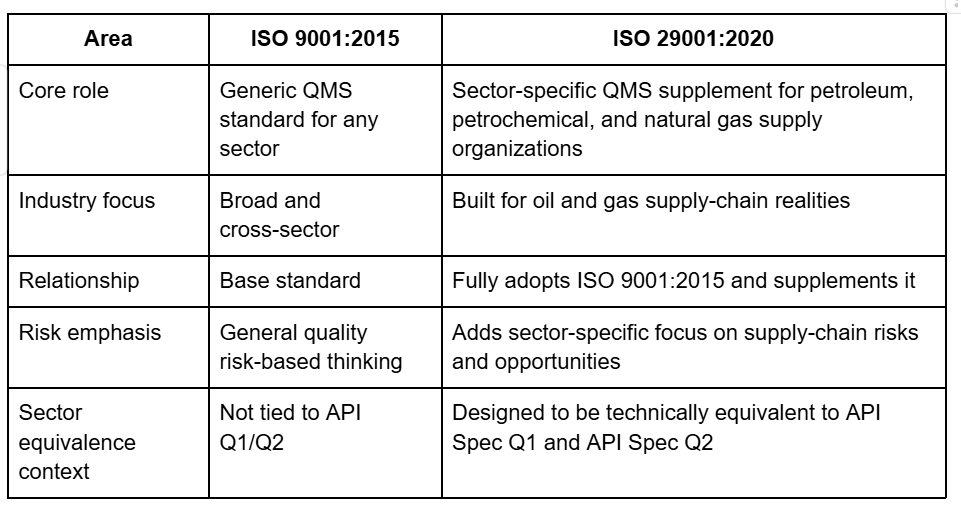
ISO 29001:2020 is a sector‑specific quality management system standard developed for the petroleum, petrochemical, and natural gas industries, defining requirements for product and service supply organizations. It supplements ISO 9001:2015 with additional requirements focused on risk reduction, defect prevention, and safety in high‑hazard environments. ISO 29001 Certification requires an organization to:
 

  • Define quality management system requirements for oil and gas supply chains
  • Supplement ISO 9001 with sector‑specific additions
  • Focus on risk reduction, defect prevention, and safety in high‑hazard environments
  • Apply to equipment manufacturers, service providers, and suppliers to the energy industry
  • Build on ISO 9001:2015 with additional requirements for design, production, and service
  • Support contract qualification and Approved Vendor List review in oil and gas procurement

Apply For The Certification Today

Why ISO 29001 Matters for Oil & Gas Organizations?

Meeting Supply Chain Requirements for Oil Majors

Major international and national oil companies (Saudi Aramco, ExxonMobil, Shell, BP, Chevron, TotalEnergies, ADNOC, Basra Oil Company) require suppliers to demonstrate robust quality management. ISO 29001 is a common qualification signal.

Securing a Place on Approved Vendor Lists (AVL)

ISO 29001 Certification is a frequent prerequisite for AVL inclusion, signalling that the supplier has implemented sector‑specific controls for design, production, and service.

Managing Risk in High‑Hazard Environments

ISO 29001 adds explicit emphasis on risk management and defect prevention across the product and service lifecycle – strengthening control around critical equipment, special processes, supplier quality, and service execution.

Six key outcomes for oil and gas suppliers:

  • Demonstrates capability against oil major procurement requirements
  • Supports review for Approved Vendor Lists
  • Reduces repeated client audits and qualification friction
  • Enhances credibility with operators, regulators, and partners
  • Improves tender competitiveness in high‑risk sectors
  • Strengthens supply‑chain integrity and safety performance

ISO 29001 vs ISO 9001: Key Differences

AspectISO 9001:2015ISO 29001:2020
ScopeGeneral quality management for any industrySector‑specific for petroleum, petrochemical, and natural gas industries
Risk FocusGeneral business risksSpecific focus on product and service risks in high‑hazard environments
Design RequirementsBasic design and development controlsEnhanced design controls for critical equipment and components
Production ControlsStandard production requirementsAdditional controls for special processes (welding, heat treating, NDT, coating)
Service RequirementsGeneral service provisionsSpecific requirements for field services, maintenance, and after‑sales support
Supply ChainGeneral supplier controlsEnhanced supply‑chain management for critical materials and components
Defect PreventionImplied through quality objectivesExplicit focus on defect prevention and reduction of variation and waste
DocumentationGeneral documentation requirementsMore rigorous traceability and record‑keeping for critical items

Start Your ISO 29001 Certification Today

300+

Satisfied Clients

10+

Years of Experience

1700+

ISO certifications

Who Needs ISO 29001 Certification?

Equipment Manufacturers

Pressure vessels, valves, pumps, compressors, drilling equipment, wellhead components, safety systems – where design controls and traceability are critical.

Service Providers

Drilling, well services, inspection, testing, maintenance, repair, logistics – field execution quality matters as much as documentation.

Upstream, Midstream, Downstream Suppliers

Exploration, production, pipeline, storage, refining, petrochemical – across the full value chain.

The ISO 29001 Certification Process

  1. Gap Analysis: Assess current QMS against ISO 29001 requirements.
  2. QMS Implementation: Update design procedures, special process controls, traceability records, supplier quality processes, competence records.
  3. Internal Audit: Verify conformity and effectiveness.
  4. Management Review: Leadership oversight of quality objectives, audit results, risks, improvement actions.
  5. Stage 1 Audit: Readiness review: documentation, design controls, scope.
  6. Stage 2 Audit: Full assessment: site activity, interviews, production controls, service evidence.
  7. Certification Decision: Independent technical review, certificate issuance.
  8. Surveillance Audits: Annually in years 1 and 2.
  9. Recertification: Every 3 years, full reassessment.


Typically takes 4‑8 months from initiation to certification, depending on size and complexity.

ISO 29001 Requirements

  1. Design Controls: Enhanced design validation, verification, qualification testing for critical equipment.
  2. Production Controls: Additional controls for special processes (welding, heat treating, NDT, coating).
  3. Service Requirements: Controls for field services, maintenance, after‑sales support.
  4. Supply Chain Management: Enhanced supplier evaluation, source inspection, material traceability.
  5. Risk Management: Systematic identification and mitigation of product/service risks across lifecycle.
  6. Documentation and Traceability: Rigorous record‑keeping for critical items (material certifications, test reports, as‑built docs).
  7. Competence Management: Qualification requirements for personnel involved in design, production, service of critical equipment.
  8. Corrective Action: Structured root‑cause discipline with explicit emphasis on defect prevention.

ISO 29001 Certification Validity and Maintenance

Valid for three years, subject to passing annual surveillance audits (years 1 and 2). Recertification audit at year 3 renews the cycle.


  • Year 1: surveillance audit, ongoing implementation and improvement
  • Year 2: surveillance audit, continued conformity
  • Year 3: recertification audit, renew certification

Other ISO Certifications We Provide in Iraq

As an accredited body, we issue certificates for the most sought-after management system standards:

Consultants vs. Accredited Certification Bodies for ISO 29001

Quality management consultants help develop, document, and implement the QMS. Accredited certification bodies perform the independent third‑party audit and issue the certificate. AGS maintains structural separation and impartiality safeguards – we do not audit organizations we have consulted for.

Why Accreditation Matters for Oil & Gas Supply Chains?

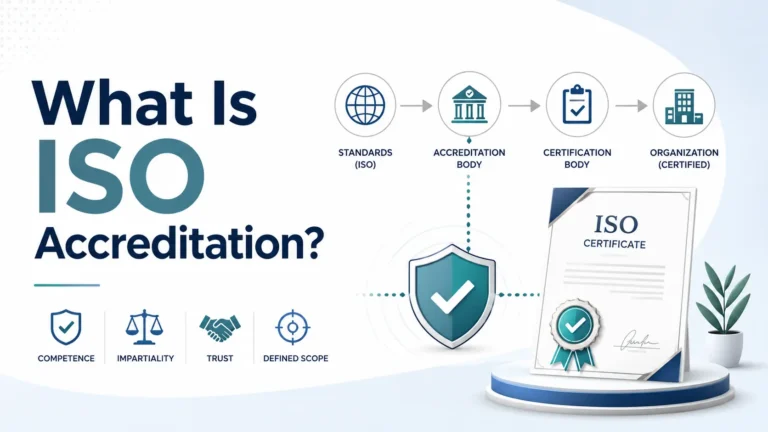
Accreditation confirms that a certification body is competent, impartial, and authorized to certify within a defined scope.

IAS, ANAB, and UKAS accreditation explained

  • IAS: International Accreditation Service, nonprofit, IAF MLA signatory, provides global recognition.
  • ANAB: ANSI National Accreditation Board, IAF/ILAC signatory, widely recognized in the US.
  • UKAS: United Kingdom Accreditation Service, IAF MLA signatory, strong international recognition.
  • IAF: International Accreditation Forum, manages international recognition framework and IAF CertSearch.

AGS holds IAS accreditation, a trusted name in global supply chains.

How to verify an ISO 29001 certificate with IAF CertSearch?

  1. Visit IAF CertSearch
  2. Enter the certificate number or organization name
  3. Review certificate status, scope, and accreditation details
  4. Confirm the certificate is current and linked to valid accreditation


AGS also provides a dedicated certificate verification tool for quick status checks.

AGS: Your USA‑Headquartered Certification Partner for Oil & Gas

USA Headquarters + Middle East Expertise

International audit discipline combined with regional knowledge of Iraq and GCC energy sectors. Bilingual auditors (English/Arabic).

Impartiality (ISO/IEC 17021‑1)

Structural separation, impartiality safeguards, conflict‑of‑interest controls – protecting certificate credibility.

The AGS Audit Lifecycle

A 3‑year partnership: initial certification, annual surveillance audits, recertification, keeping your QMS aligned with changing customer requirements and operational realities.

Industry‑Specific ISO 29001 Certification

  • Oil & Gas Equipment Manufacturers: Pressure vessels, valves, drilling equipment, pumps, compressors, safety systems – design validation, special processes, traceability.
  • Drilling Contractors & Well Service Providers: Field‑service procedures, equipment maintenance, personnel competence, job‑site quality controls.
  • Pipeline Operators & Refineries: High‑pressure, high‑temperature environments – supplier quality is part of operational integrity.

ISO 29001 and API Q1: Complementary Quality Frameworks

AspectISO 29001:2020API Q1
ScopeInternational standard for petroleum, petrochemical, and natural gas industriesAPI specification for organizations providing products for the petroleum and natural gas industry
RelationshipSupplements ISO 9001 with sector‑specific requirementsSupplements ISO 9001 with API‑specific requirements
RecognitionGlobal recognition through accredited certification and IAF‑linked acceptanceStrong recognition in the US market and increasing international visibility
IntegrationIntegrates well with ISO 9001, 14001, 45001Often used alongside ISO 9001 or in parallel quality programs

Many US organizations pursue both ISO 29001 and API Q1 to satisfy different customer expectations.

Our Happy Client's

ISO 29001 Frequently Asked Questions

What is the difference between ISO 9001 and ISO 29001?

ISO 29001 supplements ISO 9001 with additional requirements specific to the petroleum, petrochemical, and natural gas industries – stronger design controls, special‑process controls, traceability, and explicit focus on risk reduction and defect prevention.

Is ISO 29001 required for oil & gas tenders?

Yes, ISO 29001 Certification is frequently a mandatory requirement or major evaluation factor in oil and gas tenders for equipment and service suppliers, closely tied to Approved Vendor Lists.

How do I verify an ISO 29001 certificate?

Use IAF CertSearch (enter certificate number or organization name) to verify status, scope, and accreditation details. AGS also provides a dedicated verification tool.

Which accreditation bodies are recognized for ISO 29001?

IAS, ANAB, and UKAS are among the best‑known accreditation names in global oil and gas supply‑chain review. AGS holds IAS accreditation.

How long does ISO 29001 certification last?

Three years, subject to passing surveillance audits in years 1 and 2, followed by recertification.

Is ISO 29001 certifiable?

Yes, ISO 29001 is a certifiable standard. Certification should be issued by a certification body accredited by an internationally recognized accreditation body.

What is the scope of ISO 29001?

ISO 29001 applies to product and service supply organizations serving the petroleum, petrochemical, and natural gas industries – across upstream, midstream, and downstream operations.

Start Your ISO 29001 Certification Journey with AGS

ISO 29001 Certification is your passport to the global oil and gas supply chain. Contact our team today:

Translate »